

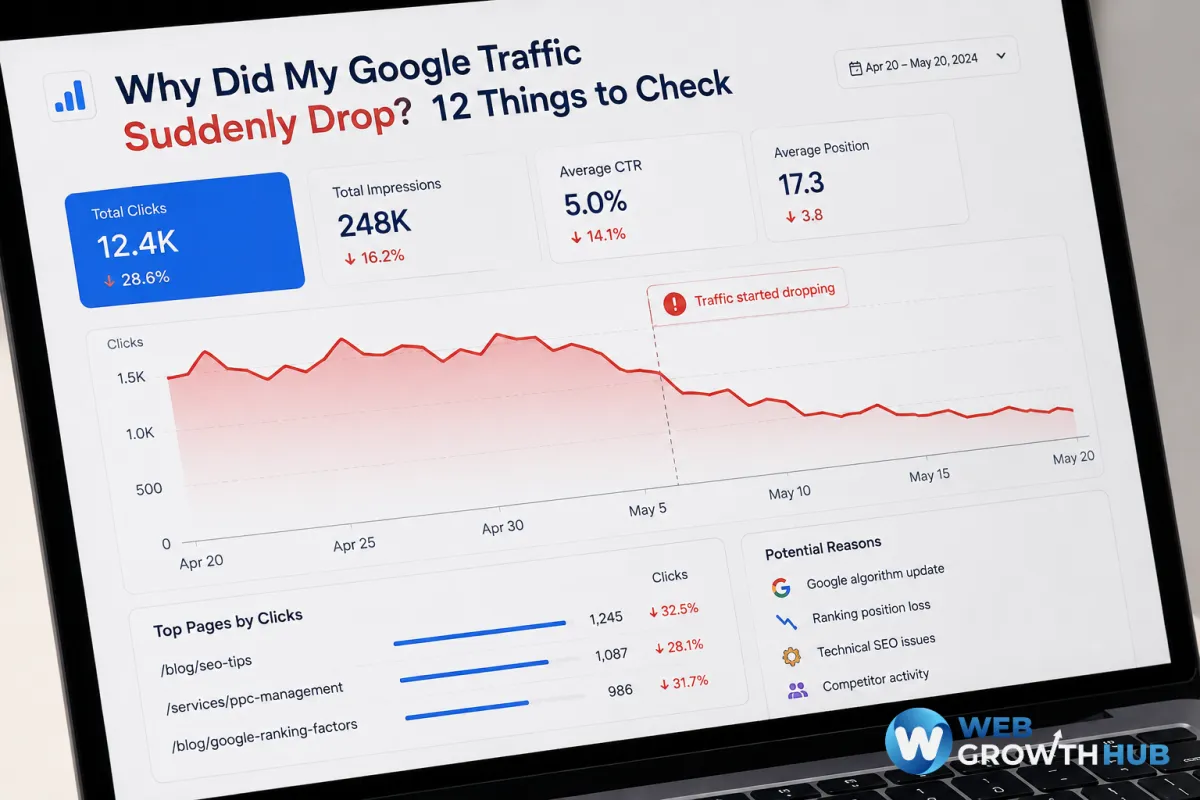
Why Did My Google Traffic Suddenly Drop? 12 Things to Check
A sudden drop in Google traffic can be alarming.
One day, your website is bringing in a steady stream of visitors from Google. Then, seemingly overnight, traffic falls. You check your analytics again. The numbers are still down.
Naturally, the first thought is:
“Did Google penalize my website?”
Not necessarily.
A drop in organic traffic can happen for many different reasons. Your rankings may have changed, search demand may have shifted, your website may have experienced a technical problem, Google may have changed how it displays results, or your traffic may have been coming from searches that are no longer generating the same volume.
The important thing is not to panic and start changing everything at once.
Instead, you need to figure out what changed, when it changed, and which pages or search queries were affected.
Here are 12 things to check when your Google traffic suddenly drops.
First, Confirm That Your Google Traffic Actually Dropped
Before trying to fix anything, make sure the decline is real.
Analytics platforms can show fluctuations for many reasons, including tracking problems, reporting changes, or normal variations in traffic.
Start by comparing your current organic traffic with a previous period.
For example, compare:
Last 7 days vs. previous 7 days
or:
Last 28 days vs. previous 28 days
You can also compare the same period from the previous year if your business experiences seasonal changes.
Then check Google Search Console.
Look at:
Clicks
Impressions
Average position
Search queries
Pages
This helps you determine whether the decline is actually coming from Google Search or whether something else is affecting your website analytics.
1. Your Rankings May Have Dropped
One of the most obvious reasons for lower Google traffic is a decline in rankings.
Even a relatively small ranking change can affect traffic.
For example, moving from position 3 to position 8 can significantly change how many people see and click your result.
Look at the pages that previously generated the most organic traffic.
Then compare their current rankings with their previous performance.
If several important pages have dropped at the same time, you have a stronger indication that your rankings may be responsible for the traffic decline.
This is also why it is important to look beyond your overall website traffic.
You need to identify which pages lost visibility.
If your pages are still appearing in Google but have slipped to page 2, learn why your website may be ranking on page 2 instead of page 1.
2. Your Google Impressions May Have Dropped

Traffic can fall because your website is appearing in fewer searches.
If impressions decline along with clicks, investigate what happened to your search visibility.
For example:
Previous period: 100,000 impressions
Current period: 65,000 impressions
If your impressions dropped significantly, improving your click-through rate alone probably won't solve the problem.
You need to understand why Google is showing your pages less often.
Look at your top queries and pages in Google Search Console and determine where the visibility loss occurred.
3. Your Click-Through Rate May Have Declined
Sometimes your website continues to receive impressions but gets fewer clicks.
This is a different problem.
Your page may still be appearing in Google, but fewer people are choosing your result.
This can happen because of changes to:
Search intent
Search-result layouts
Competing titles
Search features
Your rankings
Your page title
Your meta description
For example, if impressions remain relatively stable but clicks decline significantly, investigate your CTR before assuming your entire SEO strategy has failed.
You can also review our guide on why Google impressions can increase without generating more clicks to better understand this situation.
4. Google May Have Changed the Search Results
Google constantly changes how search results are presented.
Depending on the query, users may encounter different search features, including local results, videos, images, featured snippets, shopping results, and AI-powered search experiences.
These changes can affect how much attention traditional organic listings receive.
A page can therefore maintain visibility while receiving fewer clicks.
Search your important keywords and look at what the results actually look like today.
Compare them with what you remember seeing previously.
The search results themselves can provide important clues.
5. A Google Algorithm Update May Have Affected Your Website

Google regularly makes changes to its search systems.
Sometimes these changes can affect how websites perform in organic search.
If your traffic dropped sharply around the same time as a major Google update, investigate whether there is a potential connection.
However, don't automatically assume:
Traffic dropped = algorithm penalty.
Your website may simply have been affected by changes in how Google evaluates or ranks pages.
The best response is usually to analyze the pages and queries that changed rather than making random adjustments based on speculation.
If your traffic decline appears to be connected to falling rankings, take a closer look at these 10 reasons your Google rankings may have suddenly dropped.
6. Your Website May Have Technical SEO Problems
Technical problems can sometimes prevent Google from properly crawling, understanding, or serving your pages.
Check for issues such as:
Pages accidentally marked as noindex
Incorrect canonical tags
Broken internal links
Robots.txt changes
Redirect problems
Server errors
Broken pages
Incorrect URL changes
Crawl issues
This is especially important if your traffic dropped immediately after a website update, migration, redesign, or technical change.
A small technical mistake can sometimes affect important pages without being obvious to someone browsing the website normally.
If your pages are indexed but still aren't appearing prominently in search, here's why your website may not be ranking even though it's indexed.
7. Your Website Redesign or Migration May Have Caused the Drop

Website redesigns can create SEO problems even when the new website looks better.
If your traffic dropped after a redesign, investigate:
Did the URLs change?
Were redirects implemented correctly?
Did important pages disappear?
Did page titles and content change?
Were internal links preserved?
Are important pages still indexable?
Did the website structure change?
This is why SEO should be considered before launching a redesign, not only after traffic disappears.
If you've recently redesigned your website, your traffic decline may have a technical explanation.
8. Your Competitors May Have Improved
SEO is competitive.
Your website doesn't exist in isolation.
Even if you haven't changed anything, your competitors may have.
They may have:
Published better content
Improved their websites
Built stronger authority
Earned relevant links
Improved their local presence
Updated outdated pages
Created better user experiences
If your rankings declined while competitors moved upward, compare the pages.
Ask:
What are they doing better now?
This can reveal opportunities that aren't obvious when you only analyze your own website.
If your website has lost rankings and the decline has continued, learn how to recover lost Google rankings and rebuild your search visibility.
9. Search Demand May Have Changed
Not every traffic decline is caused by SEO problems.
Sometimes fewer people are simply searching for the topic.
This can happen because of:
Seasonality
Changing consumer behavior
Industry trends
Temporary events
Changes in demand
Shifts in terminology
For example, a business might receive significantly more searches during certain months and naturally see lower traffic during others.
Before assuming your rankings are broken, check whether overall search demand has changed.
A traffic decline caused by lower search demand requires a different response than a ranking decline.
10. Your Content May Have Become Outdated

Search results change.
Information that was useful two years ago may no longer provide the best answer today.
If competitors have published newer and more useful information, your page may gradually become less competitive.
Look at your most important pages and ask:
Is this information still accurate?
Does it answer the current version of the searcher's question?
Are there important topics competitors cover that we don't?
Could the page be more useful?
Updating content should not mean changing words simply for the sake of freshness.
The goal is to make the page genuinely more accurate, complete, and useful.
11. Your Website May Have Lost Important Backlinks
Links from relevant and reputable websites can contribute to your site's authority.
If important backlinks disappear, your website's overall authority signals may change.
This is particularly worth investigating if your rankings declined without an obvious content or technical problem.
Look at your backlink profile and identify:
Lost links
Broken links
Important referring domains
Changes to high-value backlinks
Don't respond by trying to acquire hundreds of random links.
Focus on building a strong website and earning relevant, trustworthy mentions.
12. Your Tracking or Analytics May Be Broken
This is one of the easiest things to overlook.
Sometimes your traffic didn't actually disappear.
Your tracking did.
If Google Analytics or another analytics system suddenly stops recording sessions correctly, your reports can make it look like organic traffic has collapsed.
Check:
Tracking code
Analytics configuration
Consent settings
Tag manager
Conversion tracking
Recent website changes
Data collection issues
Compare your analytics data with Google Search Console.
If Search Console shows that clicks are relatively stable while your analytics platform suddenly reports a huge traffic decline, investigate your tracking before changing your SEO strategy.
How to Find the Real Cause of a Google Traffic Drop
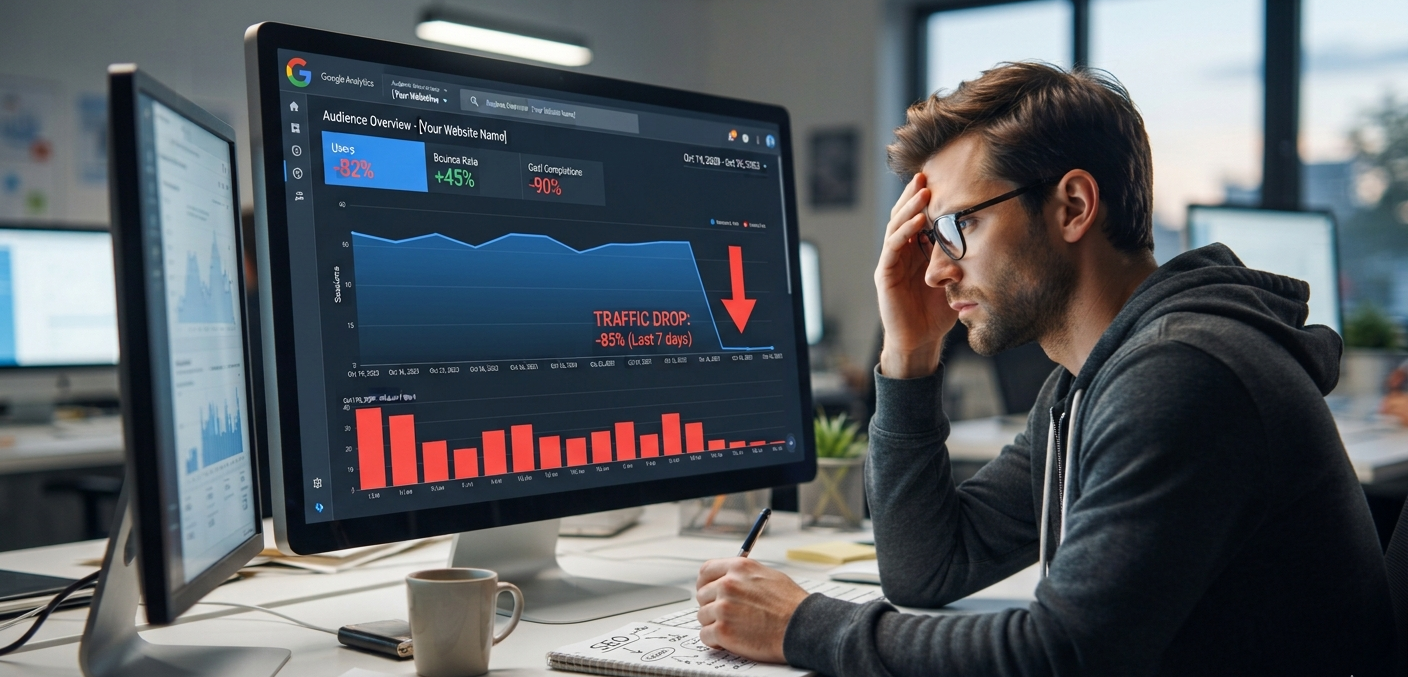
Don't try to fix all 12 problems at once.
Instead, work through the data.
Start With the Date
Find the approximate date when traffic changed.
Then ask:
What happened around that time?
Was there:
A website update?
A redesign?
A migration?
A Google update?
A major content change?
A technical problem?
The timing can provide a valuable clue.
Compare Google Search Console Data
Look at:
Clicks
Impressions
Average position
CTR
Then compare the affected period with an earlier period.
Identify the Pages That Lost Traffic
Don't only analyze the domain as a whole.
Find the specific URLs that experienced the biggest declines.
One page losing 80% of its traffic is a very different problem from hundreds of pages each losing 5%.
Analyze the Queries
Look at which search queries lost clicks and impressions.
This helps you understand whether the problem is:
A specific keyword
A specific topic
A specific page
or:
The entire website
What Not to Do After a Traffic Drop
A sudden traffic decline can create panic.
That often leads businesses to make too many changes too quickly.
Avoid immediately:
Deleting large amounts of content
Changing every page title
Stuffing pages with keywords
Buying large numbers of backlinks
Completely rebuilding the website
Making dozens of unrelated SEO changes
If you change everything at once, you make it much harder to determine what actually caused the problem.
Diagnose first.
Then make targeted changes.
When Should You Be Concerned?
Not every traffic fluctuation requires an emergency SEO campaign.
A small decline over a few days may simply be normal variation.
A much larger and sustained decline deserves investigation.
Pay particular attention if:
Organic clicks suddenly fall
Impressions fall significantly
Multiple important pages lose rankings
Your homepage disappears from important searches
Your website experiences indexing or crawl problems
The decline begins immediately after a technical change
Traffic remains down for several weeks
The bigger and more consistent the decline, the more important it is to investigate systematically.
How WebGrowthHub Can Help
A Google traffic decline is rarely just a number on an analytics dashboard.
For a business, fewer search visitors can mean fewer calls, form submissions, appointments, and sales opportunities.
This is where WebGrowthHub can help businesses connect their online visibility with the rest of their customer journey.
Instead of looking at your website, lead capture, CRM, follow-up, appointments, and customer communication as completely separate systems, WebGrowthHub helps bring these pieces together.
That gives businesses a clearer view of what happens after someone discovers them online.
Because recovering Google traffic is valuable.
But knowing whether that traffic is actually producing leads and customers is even more important.
Don't Panic. Diagnose the Drop.
A sudden Google traffic decline doesn't automatically mean your website has been penalized.
There could be a ranking change, technical problem, algorithm update, competitor improvement, seasonal shift, content issue, search-demand change, or even an analytics problem behind it.
The first step is to determine what changed.
Check your impressions.
Check your clicks.
Check your rankings.
Check your CTR.
Check your pages.
Check your search queries.
Check your technical SEO.
Then compare the timing against recent changes to your website and Google's search environment.
Once you understand the cause, you can make a much more informed decision about what to fix.
Don't treat a traffic drop as a reason to panic. Treat it as a reason to investigate.
And when you know exactly what changed, you have a much better chance of getting your Google traffic moving in the right direction again.


