

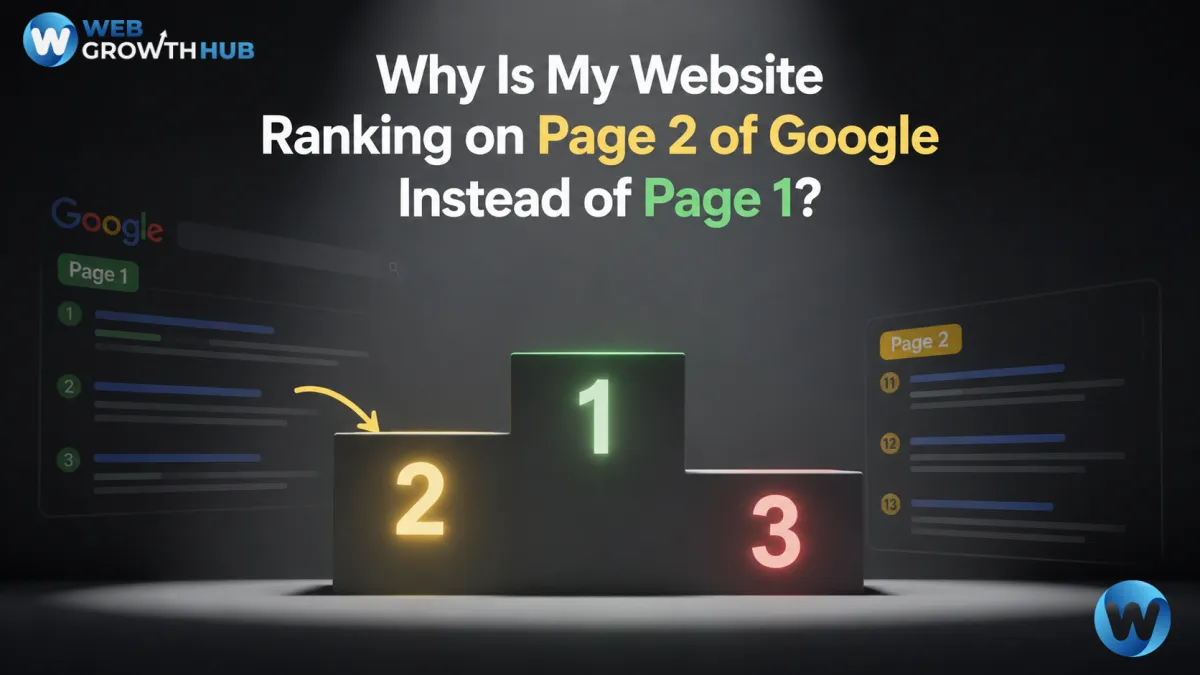
Why Is My Website Ranking on Page 2 of Google Instead of Page 1?
If your website is ranking on page 2 of Google, that is actually a good sign. It means Google already understands your website and considers it relevant enough to appear in the search results. The problem is that page 2 usually does not generate nearly as much visibility or traffic as page 1.
So why is your website stuck on page 2?
Usually, it is not because of one single SEO problem. Your website may need stronger content, better relevance, stronger authority, better internal linking, improved user experience, or more signals that help Google understand why your page deserves to move higher.
The good news is that a page 2 ranking gives you something to work with. Instead of starting from scratch, you can identify what is holding the page back and make targeted improvements.
What Does It Mean When Your Website Ranks on Page 2?
When a page appears somewhere between positions 11 and 20, Google has already decided that the page is relevant to the search query.
However, Google is also ranking other pages above it.
Think of it this way: your website has made it into the competition, but it has not yet convinced Google that it belongs among the strongest results.
This is why page 2 rankings can be valuable SEO opportunities.
If you are already ranking for a keyword, you may not need to create an entirely new page. Improving the existing page could potentially help it compete for higher positions.
1. Your Page May Not Fully Match Search Intent

One of the biggest reasons a page can get stuck on page 2 is that it does not completely satisfy what the person searching actually wants.
For example, imagine someone searches:
"how to improve my Google Business Profile ranking"
They probably want practical steps they can take to improve their visibility.
If your page mostly explains what a Google Business Profile is but provides very little actionable advice, Google may determine that other pages better satisfy the search.
Before trying to add more keywords, ask:
Does this page actually answer the question behind the search?
Look at the pages currently ranking on page 1 and consider what they provide that your page does not.
2. Your Content May Need More Depth
Ranking on page 2 can sometimes indicate that your page covers the topic but does not provide enough useful information compared with competing pages.
This does not mean you should simply make the article longer.
More words do not automatically mean better rankings.
Instead, look for information gaps.
Could you explain an important part of the topic that your competitors overlooked?
Could you provide examples?
Could you answer common follow-up questions?
Could you make the process easier for a business owner to understand?
The goal should be to make the page more useful, not simply longer.
3. Your Competitors May Have Stronger Content
Sometimes your website is perfectly healthy, but competing pages are simply stronger.
A competitor may have:
More comprehensive information
Better examples
Stronger topical coverage
Better internal linking
More relevant supporting content
Stronger authority
A better overall user experience
This is why checking the actual search results is important.
Do not optimize your page based only on what you think Google wants.
Look at what Google is already rewarding for that particular search.
4. Your Page May Need Better On-Page SEO

Your content can be useful while still having unclear signals about what the page is primarily about.
Review important elements such as your:
Page title
Main heading
Subheadings
Introduction
Body content
Internal links
Image alt text where relevant
URL
These elements should clearly communicate the topic of the page.
For example, if the target topic is "why is my website ranking on page 2 of Google", the page should clearly address that question rather than broadly discussing SEO without a specific focus.
The goal is not to repeat the keyword everywhere.
The goal is to make the page's purpose obvious.
5. Your Website May Need Stronger Internal Linking
Internal links help connect related pages on your website.
Suppose you have articles about:
Why Did My Google Rankings Drop?
How to Recover Lost Google Rankings
Why Is My Business Not Showing Up on Google Search?
How to Improve My Google Business Profile Ranking
These topics are closely related.
Linking them together where appropriate can help users discover additional information and help search engines understand how the pages relate to one another.
If a page ranking on page 2 has very few internal links pointing toward it, improving the site's internal linking structure may be worth considering.
6. Your Website May Not Have Enough Topical Authority
Google does not evaluate every page completely independently.
The broader content and structure of your website can help establish your expertise around a subject.
For example, if you want to compete for local SEO searches, having one article about local SEO may not be enough to build a strong topical presence.
A more useful content ecosystem could cover related subjects such as:
Google Business Profile
Local search visibility
Google Maps
Local SEO
Reviews
Website SEO
Search rankings
Local lead generation
These articles can then connect naturally through internal links.
Instead of creating isolated articles, build a collection of useful content around the problems your audience actually has.
7. Your Page May Need More Authority
Relevance is important, but competition matters too.
If the websites ranking on page 1 have stronger authority and more established reputations within the topic, moving from position 15 to position 5 may require more than simply editing the article.
This is where broader SEO efforts can matter, including building your website's authority and earning relevant mentions and links from reputable sources.
The important thing is to focus on quality and relevance rather than trying to acquire as many links as possible.
8. Your Website Experience Could Be Holding You Back
SEO is not just about text.
Your website should provide a good experience for people using it.
Check things such as:
Mobile usability
Page loading performance
Navigation
Readability
Intrusive pop-ups
Broken links
Poor formatting
Difficult-to-use forms
If someone arrives on your page and struggles to find the information they need, that is a problem regardless of how many keywords the page contains.
A strong SEO page should also be a good page for humans.
9. Your Page May Be Targeting the Wrong Keyword
Sometimes a page ranks on page 2 because the keyword itself is not the best opportunity.
For example, you may be trying to rank for a broad, highly competitive search when a more specific search would better match your business and audience.
Instead of automatically targeting the biggest keyword, consider:
Does this keyword represent something my potential customer actually wants?
A highly relevant keyword with realistic competition can be more valuable than a broad keyword that attracts visitors who are unlikely to become customers.
10. Your Page May Simply Need More Time

SEO changes do not always produce immediate results.
Google needs time to crawl, process, and reevaluate changes.
If you recently published a page or made significant updates, avoid changing everything again immediately because you do not see movement overnight.
Monitor the page and look at its performance over time.
Google Search Console can be particularly useful for identifying:
Search queries
Impressions
Clicks
Average position
Pages receiving search traffic
These insights can help you understand whether your page is gaining visibility and which searches are bringing people to it.
How to Move a Page From Google Page 2 to Page 1
There is no guaranteed formula for moving a page from position 15 to position 5.
But you can approach the problem systematically.
Start by analyzing the current page
Identify the keywords and searches for which the page is already receiving impressions.
Then determine whether the page actually provides the best possible answer for those searches.
Study the page-one results
Look at what the top-ranking pages are doing well.
Compare:
Content depth
Search intent
Structure
Examples
Topic coverage
Internal links
User experience
You are not trying to copy competitors.
You are trying to understand what users are being given and where your page can provide something better.
Improve the content
Update outdated information.
Add missing explanations.
Answer related questions.
Make important information easier to find.
Remove unnecessary sections that do not help the reader.
Improve internal linking
Find other relevant pages on your website and link to the page naturally.
Also add relevant links from the page to other useful resources.
Strengthen the overall topic
If the page is part of an important topic for your business, consider creating additional useful content around related questions.
Then connect those pages together.
Monitor the results
After making meaningful improvements, monitor the page rather than constantly changing it.
SEO is an ongoing process.
Don't Forget About Conversion

There is another important point that businesses sometimes overlook.
Ranking on page 1 is not the final goal.
The goal is to turn visibility into business.
Imagine your website moves from position 15 to position 6.
That is great.
But what happens when someone clicks?
If the website is confusing, the visitor cannot find what they need, there is no clear call to action, or the business has no system for following up with leads, the SEO improvement may not produce the business results you expected.
This is why SEO should be connected to the rest of your customer journey.
Get Found → Get Clicked → Capture the Lead → Follow Up → Convert
How WebGrowthHub Can Help
Getting your website onto page 1 is only one part of growing your business online.
Once someone finds your website, you need a way to turn that visitor into an actual opportunity.
WebGrowthHub brings your website, lead capture, CRM, follow-up, automation, communication, booking, reputation management, and other business-growth tools into one connected system.
That means your SEO and website efforts do not have to exist separately from the rest of your sales process.
A visitor can discover your business, visit your website, submit a form or book an appointment, enter your CRM, receive follow-up, and continue through your sales process.
The goal isn't simply to rank higher. It's to turn more of the people who find you into customers.
Final Takeaway
If your website is ranking on page 2 of Google, do not automatically assume that your SEO has failed.
In many cases, page 2 means Google already sees relevance in your page. The opportunity is to figure out why other pages are outperforming it.
Start by reviewing search intent, content quality, competitors, on-page SEO, internal links, topical authority, website experience, and the overall strength of your site.
Then make targeted improvements and monitor the results.
Moving from page 2 to page 1 is not about finding one secret SEO trick.
It is about making your page the most useful, relevant, trustworthy, and accessible result you can reasonably make it for the searcher.
And once you earn that visibility, make sure your website and follow-up system are ready to turn that traffic into real business.


