

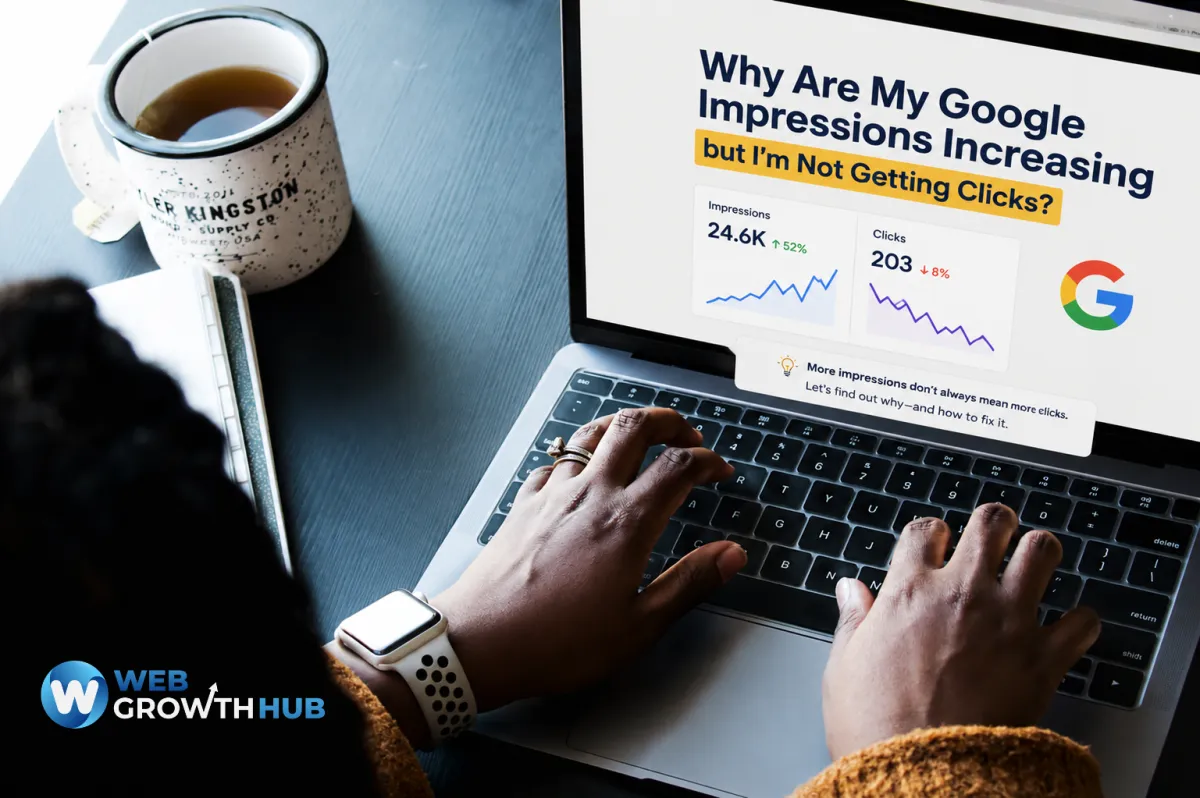
Why Are My Google Impressions Increasing but I’m Not Getting Clicks?
Seeing your Google Search impressions increase sounds like good news. And it usually is.
Your website is appearing in search results more often, which means Google is showing your pages to more people. But there is a frustrating problem: people are seeing your website, but they are not clicking it.
This can leave business owners wondering what is going wrong.
If your impressions are increasing while your clicks remain flat, the problem may not be that your SEO is failing. In fact, your visibility may be improving. The issue could be where your pages are appearing, what your search result looks like, whether your title matches the searcher's intent, or whether another result is more appealing.
The good news is that increasing impressions give you something valuable to work with.
Instead of trying to get Google to show your website more often, you may need to focus on getting more of the people who already see your website to click.
What Are Google Impressions?
A Google impression generally means your website appeared in a user's search results.
For example, imagine your website received:
10,000 impressions
but only:
150 clicks
That means your website was being seen, but relatively few people selected your result.
This is where click-through rate, or CTR, becomes useful.
CTR measures the percentage of impressions that resulted in clicks.
A simplified formula is:
CTR = Clicks ÷ Impressions × 100
So if you received 100 impressions and 5 clicks, your CTR would be 5%.
However, there is an important point to remember:
A low CTR does not automatically mean your website has an SEO problem.
You need to understand where those impressions are coming from before deciding what to change.
1. Your Website May Be Ranking Too Low
One of the most common explanations is simple: your website is getting impressions because it is appearing in search results, but it may be appearing too far down the page.
For example, a page ranking in position 3 has a very different opportunity to receive clicks than a page ranking in position 48.
Your impressions can increase even when your website is not ranking near the top.
Imagine Google starts showing your article for 20 related search queries. Your impressions may increase significantly, but if your average position is still around page 3 or page 4, most searchers may never reach your result.
This is why you should look at average position alongside impressions and clicks in Google Search Console.
Increasing impressions are useful, but you also need to know where those impressions are happening.
2. Your Page Is Showing for Searches That Don't Match Your Offer

Your website may be appearing for keywords that are related to your content but not closely aligned with what the searcher wants.
For example, suppose you run a marketing platform and have an article about customer retention.
Google might show your page for searches related to:
Customer retention strategies
Customer loyalty
Repeat customers
Customer service
Retention marketing
Some of those searches may be highly relevant to your business.
Others may not.
If your page receives impressions for searches that don't match the user's actual needs, people have less reason to click.
This is why search intent matters more than simply increasing the number of keywords you rank for.
3. Your Title May Not Be Compelling Enough
Your page title is one of the first things a searcher sees.
If your result appears alongside several competing pages, your title needs to clearly communicate why your page is worth opening.
Compare these two examples:
Customer Retention
versus:
How to Get More Repeat Customers: 10 Proven Strategies
The second title gives the searcher a clearer idea of what they will get.
A strong title should accurately describe the page while making the value of clicking obvious.
Avoid clickbait.
The goal isn't to trick someone into clicking.
The goal is to communicate:
"This page contains the information you're looking for."
4. Your Meta Description May Not Encourage the Click
The title is not the only part of your search result that matters.
Your meta description can also help explain what the page offers.
For example:
Learn why customers aren't coming back and discover practical ways to improve follow-up, customer experience, and repeat business.
This gives the searcher additional context.
A good meta description should support the title and match the actual content of the page.
Keep in mind that Google may sometimes generate a different search-result snippet instead of using the exact meta description you provide.
So think of the meta description as guidance, not a guarantee of exactly what Google will display.
5. Your Search Result May Not Stand Out
Even when your page ranks reasonably well, you are competing with other results.
The search results might contain:
Businesses
Blog articles
Directories
Videos
Forums
Maps
Featured snippets
Other search features
If the competing results provide a clearer or more attractive answer, searchers may skip your page.
Look at the actual search results for your important queries.
Ask:
If I were searching for this information, which result would I click and why?
That simple exercise can reveal problems with your title, topic, positioning, or search intent.
6. Your Content May Answer a Different Question

Sometimes a page receives impressions because Google thinks it is related to a search, but the content does not fully answer the question.
For example, someone searches:
"Why is my Google Business Profile ranking lower?"
Your article may mention Google Business Profile several times, but if most of the article discusses general SEO, the searcher may not find the answer they expected.
The result can be impressions without meaningful clicks.
When this happens, revisit the search intent.
Ask:
What does someone actually want to know when they search this phrase?
Then make sure the page delivers that answer clearly.
7. You May Be Ranking for Long-Tail Searches
Another reason impressions can increase without a dramatic increase in clicks is that your website may be appearing for many low-volume search variations.
Imagine your page starts appearing for 100 different long-tail queries.
Each query might generate only a few impressions.
Your total impressions increase, but your traffic may not increase proportionally.
This is not necessarily a bad thing.
In fact, it can be a sign that Google is beginning to understand your content more broadly.
You can use these new queries as opportunities to identify topics and search terms worth developing further.
8. Your Average Position May Be Misleading

Google Search Console reports an average position, but that number does not tell the entire story.
A page might rank very well for one query and poorly for another.
For example:
Keyword A: Position 5
Keyword B: Position 37
The overall average can hide those differences.
Instead of looking only at the average position, open the page or query data and investigate:
Which searches generate impressions?
Which searches generate clicks?
Which searches have high impressions but low CTR?
Which searches have strong rankings?
Which searches have weak rankings?
This can reveal where your biggest opportunities actually are.
9. Google Search Features May Be Taking Attention Away
Traditional organic results are no longer the only thing users see.
Depending on the search, Google may show features such as:
Featured snippets
Local results
Maps
Images
Videos
Shopping results
AI-generated search experiences
Other specialized search features
These can change how users interact with the page.
Your website can technically receive an impression while competing for attention against several other elements.
This is another reason you should evaluate the actual search results rather than looking at numbers in isolation.
10. Your Website May Be Visible but Not Relevant Enough
Increasing impressions can sometimes be an early indication that Google is testing your content for more searches.
But visibility alone does not mean the page has earned strong relevance for those searches.
Think of it as Google giving your page more opportunities to compete.
Your next job is to determine:
Which searches are producing those impressions, and are they the right searches?
If they are relevant, you can improve the page around those topics.
If they are irrelevant, you may need to improve your content's focus and search intent alignment.
What Should You Do When Impressions Increase but Clicks Don't?
Instead of immediately changing everything, start with Google Search Console.
Look at the specific pages and queries generating impressions.
Then work through the following process.
Step 1: Find Pages With High Impressions and Low CTR
These are your first opportunities.
A page that already receives significant impressions has visibility.
The goal is to improve the percentage of people who choose it.
Step 2: Check Average Position
If the page is ranking very low, improving the content and overall SEO may be more important than changing the title.
If the page is already ranking reasonably well but receiving few clicks, investigate the title, search intent, and search-result competition.
Step 3: Review the Search Queries
Look at the actual terms people are using.
You may discover that your page is appearing for searches you never specifically targeted.
Some of those could become valuable content opportunities.
Step 4: Improve the Title
Make the title:
Clear
Specific
Relevant
Useful
Compelling without being misleading
Step 5: Improve the Page
If the search queries reveal a mismatch, update the content so it answers the searcher's actual question more effectively.
Step 6: Monitor the Results
After making meaningful changes, give Google time to process and reevaluate the page.
Don't make ten different changes every few days.
You want to understand which improvements actually made a difference.
Don't Chase CTR Without Looking at the Bigger Picture
A higher CTR sounds great, but it should not be the only goal.
Suppose one page gets:
20,000 impressions and 3% CTR
while another gets:
2,000 impressions and 8% CTR
The second page has the higher CTR, but the first page generates more clicks.
This is why you should look at the complete picture:
Impressions + Position + CTR + Clicks + Search Intent + Conversions
And for a business, there is one more important metric:
What happens after the click?
Your Real Goal Is Not More Clicks. It's More Business.
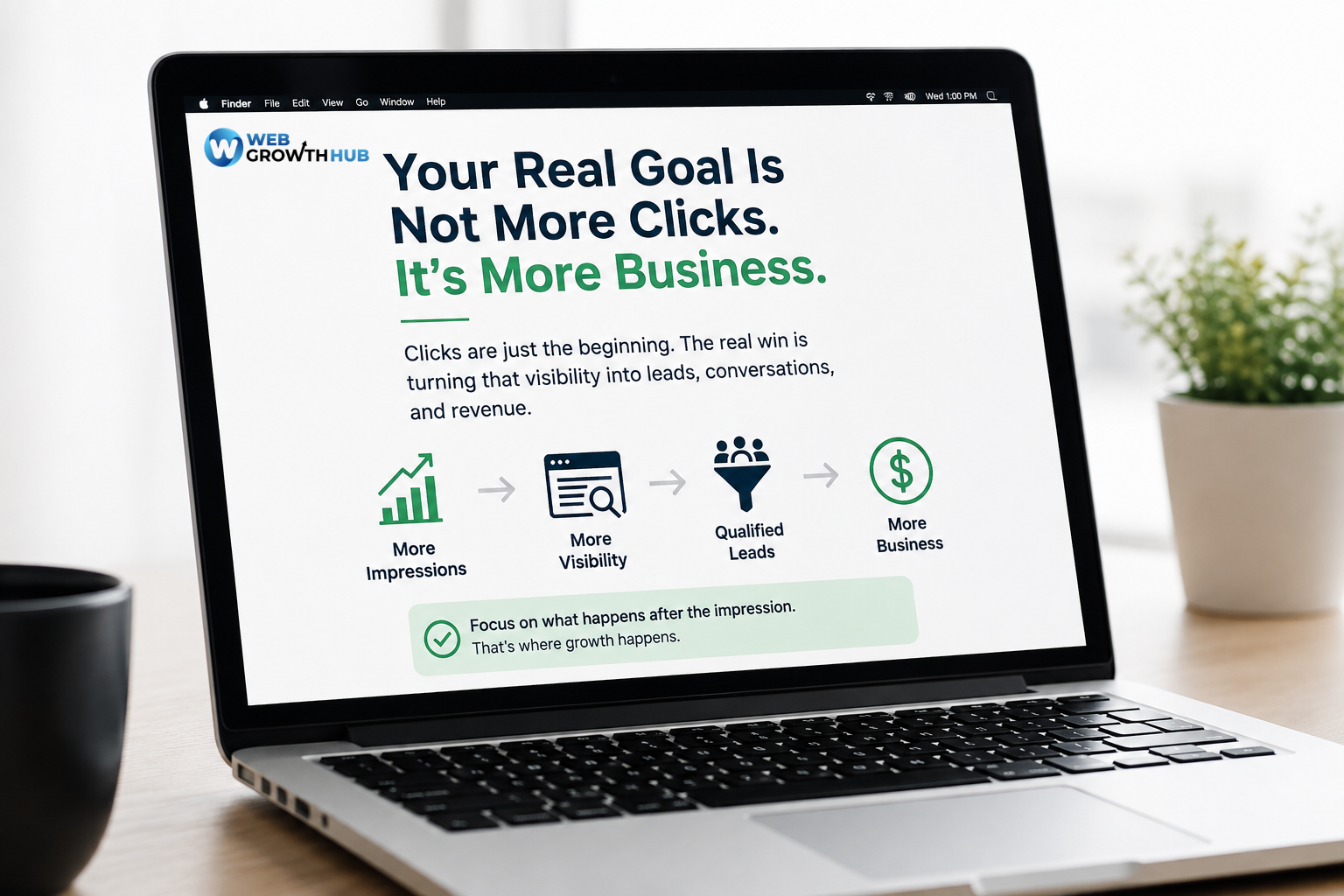
Getting more clicks is useful, but traffic by itself does not pay the bills.
If 1,000 people visit your website but nobody contacts you, books an appointment, requests a quote, or becomes a customer, the traffic has limited business value.
A stronger customer journey looks like:
Google Impression → Click → Website Visit → Lead Capture → Follow-Up → Appointment → Customer
This is where SEO becomes part of a larger growth strategy.
Your website needs to do more than attract visitors.
It needs to help turn those visitors into opportunities.
How WebGrowthHub Can Help
WebGrowthHub helps connect the different parts of that customer journey.
Your website can generate visibility and capture visitors, while the CRM helps organize leads and opportunities. Automation can help with follow-up, while booking, communication, reputation management, and other tools support the customer journey after someone discovers your business.
That means you don't have to treat SEO as something completely separate from your sales and marketing systems.
Get Found → Get Clicked → Capture → Follow Up → Convert → Retain
WebGrowthHub brings many of these functions together in one connected business growth platform.
Because improving your search visibility is valuable, but turning that visibility into actual customers is what ultimately matters.
Final Takeaway
If your Google impressions are increasing but your clicks are not, don't immediately assume that your SEO is failing.
Increasing impressions can mean that Google is showing your website for more searches.
The important question is whether those are the right searches and whether your search result gives people a compelling reason to click.
Start by reviewing your average position, search queries, CTR, page titles, search intent, content quality, and the actual Google results for your target searches.
Then make targeted improvements and monitor what happens.
More impressions mean more opportunities to be seen. The next step is turning those opportunities into clicks, leads, and customers.


