

Why Does My Competitor Rank Higher on Google With a Worse Website?
You invested in a professional website.
It looks modern. It works well on mobile. Your services are clearly presented, your branding looks better, and your business may even have a stronger reputation.
Then you search Google for one of your most important services.
A competitor with an outdated website is above you.
Their site may look like it hasn't been redesigned in years. The navigation is clunky. The branding isn't impressive. Maybe some of their pages barely look optimized at all.
So why does Google rank them higher?
The simple answer is that Google rankings are not a website design competition.
A professional website is important for building trust and converting visitors into customers, but appearance alone doesn't determine where a business ranks. Google considers many signals when deciding which result is most useful and relevant to a searcher.
Your competitor may have a worse-looking website while having stronger SEO signals behind it.
Here's what may actually be happening.
1. Their Website May Be More Relevant to the Search
Imagine you own a roofing company and want to rank for:
roof repair in your city
Your website might have a beautiful homepage explaining everything your company does.
Your competitor, meanwhile, might have a dedicated page specifically about roof repair in that location.
Their page may not look nearly as good as yours, but it may answer the search more directly.
That's an important distinction.
A visually impressive website doesn't automatically tell a search engine that a particular page is the best answer for a specific search.
Look at the pages your competitors are ranking with rather than comparing only your homepages.
Ask:
Does the competitor have a dedicated page for the service?
Is the topic explained in greater depth?
Does the page clearly establish where the business provides that service?
Does the content answer questions potential customers are likely to have?
Does the page naturally connect to other relevant pages on the site?
Sometimes the website that looks worse to a designer makes the purpose of a particular page clearer.
2. Their Website May Have More Authority
SEO strength can accumulate over time.
A competitor may have operated the same website for years. During that time, other websites may have linked to it, local organizations may have mentioned the business, directories may reference it, and individual pages may have earned visibility in search.
Your website could be significantly better from a design perspective while still having less established authority.
This is especially noticeable after launching a new website or changing domains.
A redesign doesn't automatically transfer every advantage simply because the new website looks better. In fact, poorly handled redesigns can create SEO problems of their own.
If you've recently rebuilt your site and noticed a change in visibility, read our guide on why Google rankings can drop after a website redesign.
The lesson is simple:
Newer doesn't automatically mean stronger.
3. Your Competitor May Have Better Backlinks
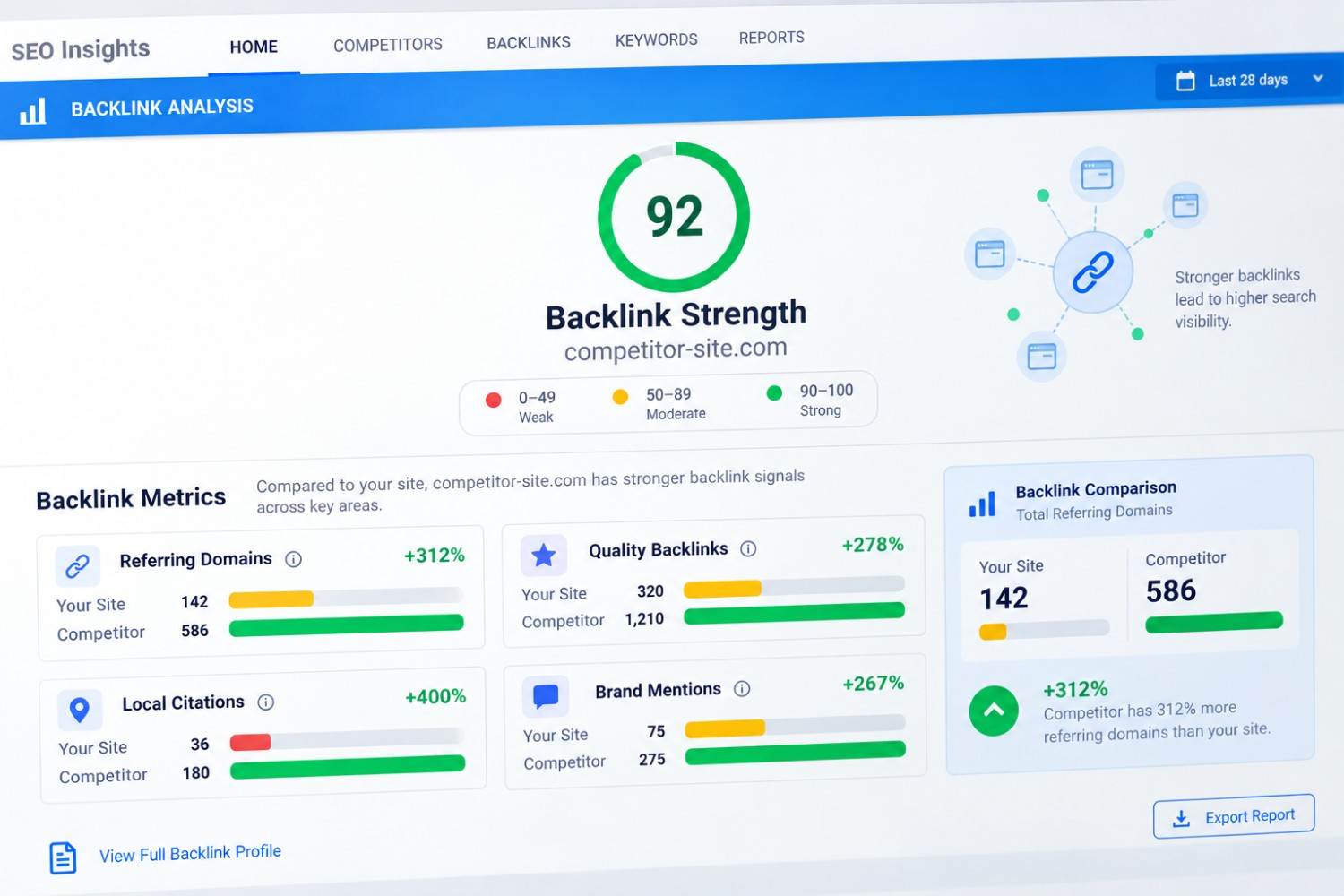
Backlinks are links from other websites pointing to a website or page.
Think about them as part of your business's broader presence across the web.
Google states that local prominence can be influenced by information it has about a business from across the web, including links, articles, and directories.
Your competitor might have links from:
Local organizations
Industry associations
Suppliers
News websites
Community websites
Business directories
Industry publications
Partners
You may have the better-looking website, but if significantly more relevant and reputable websites reference your competitor, that's an advantage your design can't replace by itself.
This doesn't mean you should chase hundreds of random backlinks.
Quality and relevance matter more than simply accumulating links.
4. Their Google Business Profile May Be Stronger
For a local business, the website isn't the entire picture.
Your competitor may have a stronger Google Business Profile.
Google explains that local results are primarily influenced by relevance, distance, and prominence.
That means a competitor may outperform you locally because Google has clearer or stronger information about what they do, where they're located, and how established the business appears.
A stronger profile may include accurate and complete business information, appropriate categories, current hours, reviews, photos, and other useful information about the business.
If local visibility is an important source of leads for you, don't evaluate your website separately from your Google Business Profile.
Our guide on how to improve your Google Business Profile ranking explains this in more detail.
5. They May Have More Reviews and a Stronger Local Reputation
Reviews can make the situation even more confusing.
You might compare the two websites and think:
“There's no way customers would choose that website over mine.”
But customers—and Google—have more information available than the website itself.
Google states that review count and positive ratings can contribute to local ranking.
Suppose your competitor has been operating for ten years and has accumulated hundreds of genuine customer reviews while your business has 25.
Their website could look significantly worse while the business itself has a much larger online reputation footprint.
Reviews also affect what happens after someone discovers the business.
A potential customer may see:
Business A: 4.8 stars with 327 reviews
versus:
Business B: 5.0 stars with 14 reviews
The website is only one part of that decision.
If you're wondering how negative feedback fits into the equation, we've also covered whether bad reviews can hurt your Google rankings.
6. Their Website May Have Better Service Pages

This is one of the most common differences worth checking.
Your competitor may have an ugly website with 30 useful pages.
You may have a beautiful website with five.
For example, a landscaping company's website might simply have:
Home
About
Services
Gallery
Contact
A competing site might have individual pages for:
Lawn care
Landscape design
Mulching
Tree trimming
Spring cleanup
Fall cleanup
Commercial landscaping
Residential landscaping
Those individual pages give the competitor more opportunities to provide useful information around specific customer needs.
This doesn't mean you should create hundreds of thin pages targeting every keyword variation.
It means your website architecture should reflect the services and information your customers are actually searching for.
7. Their Content May Answer Search Intent Better
Keywords alone aren't enough.
You also need to understand why someone searched.
Someone searching:
“emergency plumber near me”
probably doesn't want a 2,000-word history of plumbing.
They want to know:
Do you provide emergency service?
Do you serve their area?
Can they contact you now?
Can you solve their particular problem?
A competitor's basic-looking page might answer those questions immediately.
Your polished page might bury the important information under animations, branding statements, oversized images, or generic marketing copy.
Good SEO and good design should work together.
The page should look professional and help the visitor accomplish what they came there to do.
8. They May Be More Relevant to the Searcher's Location
Local rankings aren't identical for everyone.
Google identifies distance as one of the primary factors affecting local results.
That means you could search for your business from your office and see one set of competitors, while a customer several miles away sees something different.
This is why manually Googling one keyword from one location doesn't provide a complete picture of your local visibility.
Your competitor may simply have a geographic advantage for certain searches.
You can't redesign your way around physical distance.
What you can do is strengthen the factors you can influence: your website's relevance, your Business Profile, your reputation, your content, and your broader presence across the web.
9. Your Website Could Have SEO Problems You Can't See
A website can look perfect to a customer while having serious problems underneath.
For example:
Important pages may not be indexed correctly.
Internal links may be weak.
Pages may target the same search intent.
Redirects may have been handled incorrectly.
Important content may be difficult for search engines to discover.
Titles and page topics may be unclear.
Duplicate or near-duplicate pages may exist.
Important service pages may simply not have enough useful information.
None of these problems are obvious from the homepage design.
That's why asking whether your website “looks better” isn't enough.
You need to know whether Google can discover, understand, index, and appropriately rank the pages you want people to find.
If your pages are indexed but still aren't performing, see why a website may not rank even though it's indexed.
10. Your Competitor May Have Been Doing SEO Longer
SEO advantages often develop gradually.
Imagine two businesses.
One has consistently built useful service pages, earned mentions, collected customer reviews, maintained its Google Business Profile, and improved its website for six years.
The other launches a much better website today.
Which one should immediately rank higher?
The answer isn't automatically the business with the new website.
The newer business may eventually outperform the established competitor, but design alone doesn't erase years of accumulated search visibility.
This is why competitor analysis should examine more than what the website looks like today.
You need to understand the foundation behind it.
What Should You Compare Instead of Website Design?
If a competitor outranks you, don't begin by asking:
“Whose website looks better?”
Ask:
“What signals might be helping Google understand and trust their business or page more than mine?”
Start by comparing:
The Page That's Actually Ranking
Don't compare homepage to homepage unless those are the pages competing.
Look at the exact page Google ranks.
What topic does it cover? How thoroughly does it answer the search? How is it structured? What related pages support it?
Google Business Profiles
Compare business categories, information completeness, reviews, photos, services, and overall relevance to the searches you care about.
Reviews
Look beyond star ratings.
Consider the number of genuine reviews, how recently customers are leaving them, what customers say about the services, and how the businesses respond.
Backlinks and Mentions
Look at whether local organizations, industry websites, directories, publications, and other reputable sources reference the competitor.
Content Coverage
Does your competitor have useful pages covering services or customer questions you haven't addressed?
Technical Health
Make sure your important pages can be crawled and indexed and that redirects, internal links, canonicalization, and other technical elements aren't creating unnecessary problems.
Search Intent
Most importantly, determine whether your page is actually the best answer for the query you're targeting.
A prettier page that doesn't satisfy the searcher's needs is still a weaker page.
Don't Copy the Competitor's Bad Website
There's another mistake business owners make after discovering an outdated competitor outranking them.
They start copying them.
Don't.
If your competitor ranks with a bad design, that doesn't mean the bad design caused the ranking.
They may rank despite it.
Copying their outdated layout, stuffing keywords into pages, or recreating every piece of content won't necessarily reproduce the signals helping them perform.
Instead, identify what they're doing well and combine those strengths with a better experience for your customers.
That's the real opportunity.
You don't want:
Their SEO + their bad website.
You want:
Strong SEO + a professional website + a better customer experience.
Ranking Higher Is Only Half the Job
There's also a bigger business question that gets overlooked in SEO discussions.
What happens after you rank?
Suppose your competitor ranks first and you rank third.
They receive 100 visitors.
You receive 70.
But your website makes it easier for visitors to understand your services, trust your business, call, submit a form, or book an appointment.
You may still generate meaningful business from fewer visitors.
That's why rankings should never be the only goal.
The real customer journey looks more like:
Get Found → Get Contacted → Capture the Lead → Follow Up → Convert → Retain → Grow
SEO helps with the first part.
Your website, communication, lead management, and follow-up determine what happens next.
If traffic is reaching your website but isn't becoming business, our guide to why a website isn't getting leads can help you diagnose what may be happening after the click.
Build a Better Growth System, Not Just a Better-Looking Website
A modern website is valuable.
It can improve credibility, make your business easier to understand, create a better mobile experience, and help turn visitors into leads.
But the website shouldn't operate alone.
WebGrowthHub is designed around a connected approach to business growth.
Instead of treating your website, lead capture, CRM, customer communication, reviews, booking, and follow-up as separate systems, WebGrowthHub brings these parts of the customer journey together.
That means your goal isn't simply:
Get a prettier website.
It's:
Get found. Capture the lead. Follow up. Grow the business.
A strong online presence should help customers discover you, understand why they should choose you, contact you easily, and continue moving through the customer journey without opportunities falling through the cracks.
Final Thoughts
If your competitor ranks higher on Google with a worse website, don't assume Google prefers bad websites.
And don't assume your redesign failed simply because you're still below them.
Their advantage may come from stronger relevance, more established authority, backlinks, reviews, local prominence, better-targeted service pages, stronger content, location, or years of accumulated SEO work.
Your website's appearance is only one piece of the puzzle.
The better question isn't:
“Why does their ugly website beat my beautiful website?”
It's:
“What does their online presence communicate to Google that mine doesn't yet?”
Answer that question, fix the gaps you can control, and keep improving both sides of the equation:
Visibility and conversion.
Because getting found is important.
Turning that visibility into customers is what grows the business.


