

Can Bad Reviews Hurt Your Google Rankings?
If your business has started receiving more negative Google reviews, you may notice something else happening at the same time: fewer calls, fewer website visits, or less visibility in local search.
That naturally raises an important question:
Can bad reviews actually hurt your Google rankings?
The short answer is: they can matter, especially for local search, but not in the simple way many business owners assume.
A few negative reviews do not automatically cause Google to push your business down the search results. Google does not simply see a one-star review and decide that your business should lose its ranking.
The bigger issue is the relationship between review quality, review quantity, customer experience, relevance, trust, and local search visibility.
And there is another side to this that businesses sometimes overlook.
Even if negative reviews are not directly causing a ranking drop, they can still hurt your business by making potential customers less likely to choose you.
So if your reviews are getting worse, it is worth looking at both sides of the problem:
How might this affect your Google visibility?
And more importantly:
How might this affect the customers who find you?
Learn why your Google Business Profile ranking may be lower than before.
How Google Reviews Relate to Local Rankings
Google uses a variety of signals to determine which businesses appear prominently in local search.
For local results, Google considers factors such as relevance, distance, and prominence.
Reviews can contribute to the overall prominence and reputation of a business, which is why your review profile matters as part of your broader local SEO strategy.
However, there is an important distinction:
Google rankings are not determined by your star rating alone.
A business with a 4.8-star rating does not automatically outrank every business with a 4.5-star rating.
Google has to determine which businesses are most relevant to a particular search and location.
That means reviews should be viewed as one part of your local search presence, rather than a single ranking switch that is either turned on or off.
So, Can Bad Reviews Hurt Your Google Rankings?
Potentially, yes, but usually not because one negative review directly triggers a ranking penalty.
A pattern of poor reviews can affect how your business is perceived and can be associated with signals that influence local prominence.
More importantly, reviews can have a major impact on click-through behavior and customer decisions.
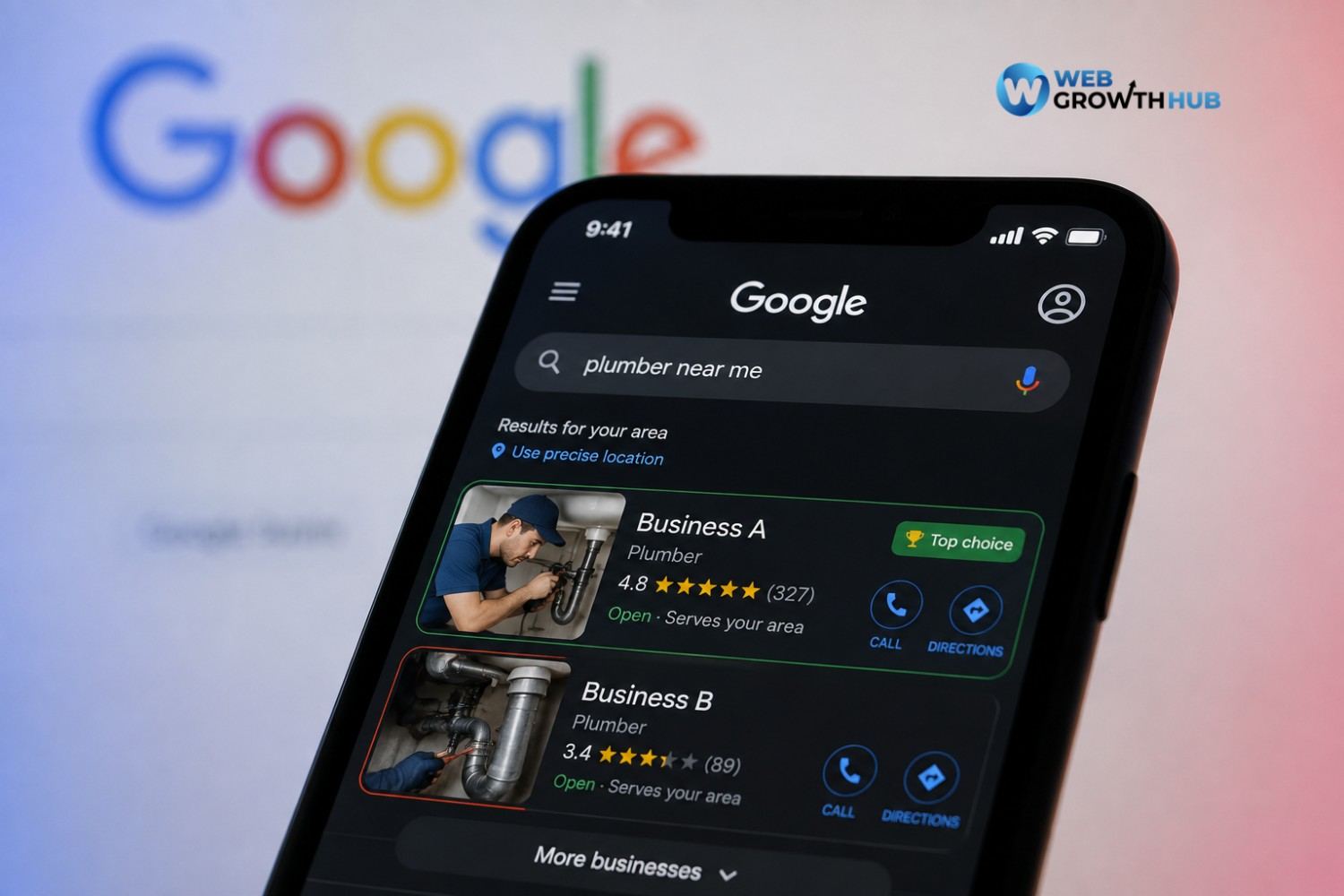
Imagine someone searches:
"plumber near me"
and sees two businesses.
Business A:
★★★★★ 4.8
327 reviews
Business B:
★★★☆☆ 3.4
89 reviews
Even if both businesses appear in the search results, the first business may immediately look like the safer choice.
The person may click Business A.
They may call Business A.
They may never visit Business B's website.
So even when a negative review is not directly responsible for a ranking change, your reputation can influence what happens after your business appears in search.
1. Your Overall Rating Matters
Your overall Google rating gives potential customers an immediate impression of your business.
A few negative reviews usually will not destroy a strong rating.
For example, a business with hundreds of positive reviews can receive an occasional one-star review without its entire reputation collapsing.
The problem becomes more significant when negative reviews become frequent enough to noticeably affect the overall rating.
If customers repeatedly see a low rating, they may question whether your business is worth contacting.
That can reduce the number of people who engage with your listing.
2. Review Quantity Matters Too
A business with 5 reviews and a 5.0 rating does not necessarily look more established than a business with hundreds of reviews and a slightly lower rating.
Review quantity provides context.
For example:
5.0 stars from 6 reviews
versus:
4.7 stars from 450 reviews
The second profile may communicate much more social proof.
This is one reason businesses should not focus exclusively on maintaining a perfect rating.
A healthier long-term strategy is to consistently provide a good customer experience and encourage genuine customers to share their experience.
3. Recent Reviews Can Shape Customer Perception
Reviews are not just about what happened years ago.
Potential customers often look at recent reviews to understand what your business is like now.
Imagine your business has hundreds of positive reviews from previous years, but the last 15 reviews are mostly negative.
A potential customer may wonder:
"Has something changed?"
Maybe your service changed.
Maybe your staff changed.
Maybe response times became slower.
Maybe customers are experiencing a recurring problem.
Whatever the reason, a recent pattern of negative feedback deserves attention.
4. Negative Reviews Can Hurt Click-Through Rates
This is where reputation and SEO become closely connected.
Your Google Business Profile may appear in search, but that does not guarantee people will choose it.
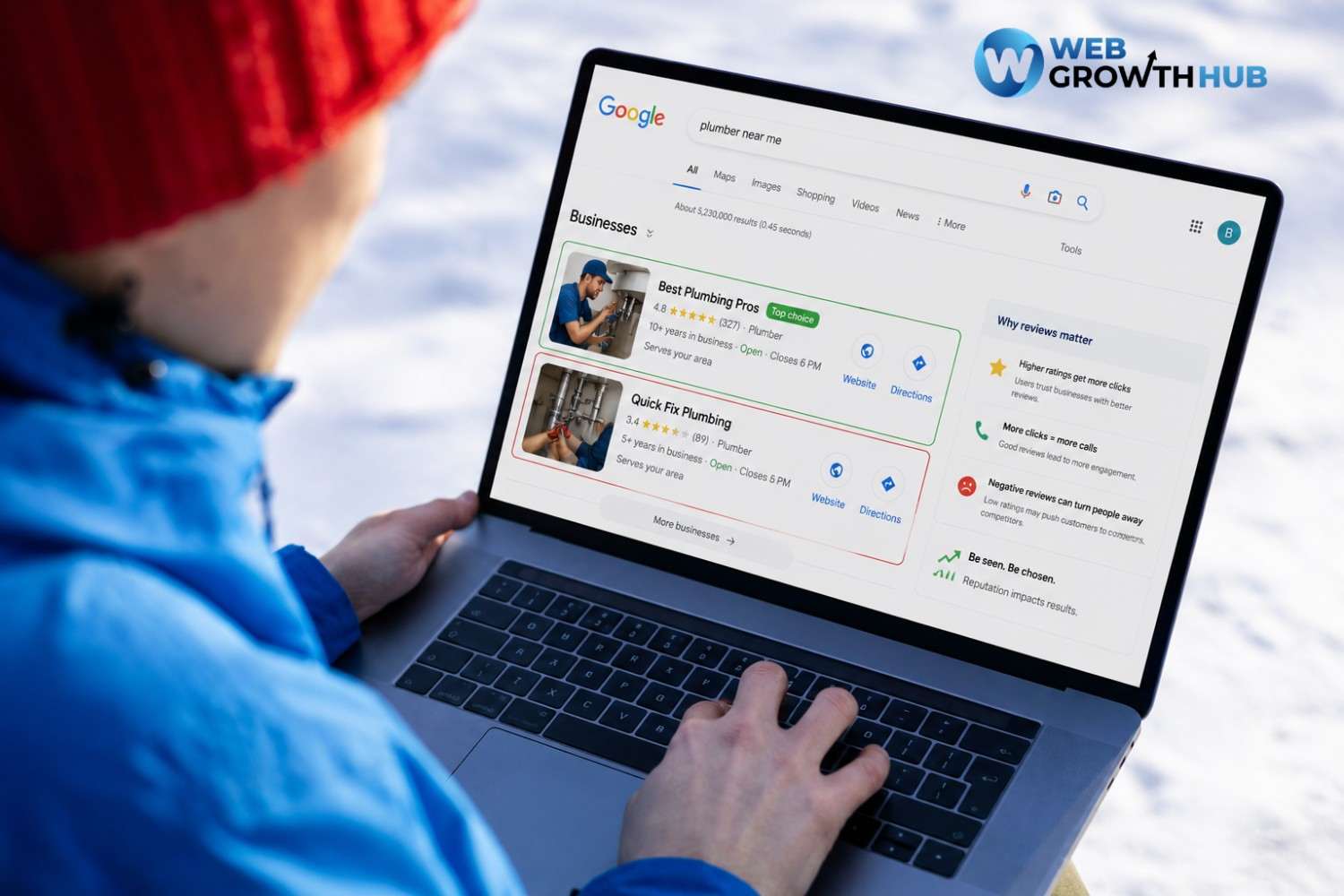
When users compare local businesses, they can see information such as:
Business name
Rating
Review count
Location
Services
Photos
Hours
Other profile information
Your reviews become part of that decision-making process.
If your rating is significantly lower than competitors, some searchers may simply choose another business.
That means your business can have visibility without getting the engagement you want.
This is similar to what happens with organic search when impressions increase but clicks do not.
Being seen is only the first step.
Your business can appear in Google search without generating the engagement you want. Learn why Google impressions can increase without generating more clicks.
5. Negative Reviews Can Reveal Real Business Problems
This is perhaps the most valuable way to think about bad reviews.
Instead of treating every negative review as an SEO problem, treat it as customer feedback.
Look for patterns.
Are customers repeatedly complaining about:
Slow response times?
Missed appointments?
Poor communication?
Unexpected pricing?
Unfinished work?
Difficulty getting a response?
If multiple customers mention the same issue, your reviews may be telling you something important about your business.
And fixing the underlying problem is often more valuable than simply trying to generate more positive reviews.
6. Your Response to Negative Reviews Matters
A negative review does not have to become a permanent stain on your reputation.
How you respond can influence how future customers perceive your business.
Compare these two approaches.
Response A
"This is not true. We did everything correctly."
Response B
"We're sorry to hear about your experience. We take this feedback seriously and would like to understand what happened. Please contact our team so we can review the situation and work toward a resolution."
The second response demonstrates professionalism.
Even if the original reviewer never changes their opinion, other potential customers can see that your business is willing to address problems.
Your response is not just for the person who left the review.
It is also for everyone who reads it afterward.
7. Don't Try to Hide Negative Reviews
A common reaction to bad reviews is to try to bury them with an enormous number of new reviews.
Generating more genuine reviews can certainly strengthen your overall reputation, but the objective should not be to manipulate your review profile.
You should focus on earning authentic feedback from real customers.
And if there is a legitimate policy violation, such as spam or content that does not relate to an actual customer experience, you can use Google's available reporting process.
But legitimate negative feedback should not simply be treated as something that needs to disappear.
Your goal should be to improve the customer experience and build a healthier reputation over time.
8. Don't Buy or Fake Reviews
This is one of the worst approaches a business can take.
Buying reviews or creating fake reviews may seem like a quick way to improve your rating.
It creates a much bigger problem if discovered.
Your review strategy should be based on real customers sharing genuine experiences.
A smaller number of authentic reviews is far more valuable than a large collection of suspicious ones.
The goal isn't to manufacture a perfect reputation.
The goal is to build a reputation that accurately reflects the quality of your business.
9. Make It Easy for Happy Customers to Leave Reviews

Many businesses have satisfied customers who simply never think about leaving a review.
They finish the job, go home, and move on with their day.
That doesn't necessarily mean they weren't happy.
Sometimes they simply weren't asked.
A simple review request after a successful interaction can make it easier for satisfied customers to share their experience.
This is where automation can become useful.
Instead of relying on your team to remember every customer manually, you can create a consistent process for requesting feedback after completed jobs, appointments, or purchases.
The important part is that the process should remain authentic and should not pressure customers into leaving only positive feedback.
WebGrowthHub Can Help You Build a Better Review Process
This is one area where reputation management connects directly with automation.
With WebGrowthHub, businesses can build systems that help manage what happens after the customer interaction, rather than leaving everything to manual follow-up.
For example, after a completed service, your business can have a structured follow-up process that keeps communication going with the customer and encourages them to share their experience.
That same customer journey can connect with your CRM and follow-up systems, helping your team keep track of customer interactions rather than relying on spreadsheets, sticky notes, or memory.
The important distinction is that automation should not manufacture positive reviews.
It should help your business consistently ask real customers for genuine feedback.
And when negative feedback comes in, your team can have a process for responding and addressing the underlying issue.
10. Reviews Are Only One Part of Local SEO
If your Google Business Profile isn't performing well, don't assume reviews are the only problem.
Your local visibility can also depend on other factors, including:
How relevant your business is to the search
Your business information
Your website
Local content
Business prominence
Links and mentions
Your Google Business Profile optimization
Customer reviews
Overall online presence
This is why improving your local SEO should be approached as a complete strategy.
If your Google Business Profile ranking has declined, for example, you may need to investigate several factors rather than simply trying to collect more reviews.
Learn how to improve your Google Business Profile ranking.
What Should You Do If Your Reviews Are Getting Worse?
Start by looking for patterns.
Don't obsess over one isolated negative review.
Instead, examine your overall review profile.
Ask yourself:
Is our average rating declining?
Are negative reviews becoming more frequent?
Are customers mentioning the same problem repeatedly?
Are we responding to reviews professionally?
Are we consistently asking satisfied customers for honest feedback?
Are we monitoring our reviews regularly?
Then address the underlying customer experience.
If customers are complaining about slow communication, improve communication.
If they're complaining about missed appointments, improve scheduling and reminders.
If they're complaining about poor follow-up, create a better follow-up process.
The best reputation management strategy starts with delivering a better experience.
Can Positive Reviews Improve Your Google Rankings?
It's tempting to turn this into the opposite question:
"If bad reviews can hurt rankings, can positive reviews guarantee higher rankings?"
Not exactly.
Positive reviews are valuable, but there is no simple formula where getting a certain number of five-star reviews guarantees a specific Google ranking.
Reviews are one part of a much larger local search ecosystem.
What positive reviews can do is strengthen your reputation, provide social proof, help potential customers feel more confident, and contribute to your overall local presence.
That's why a strong review strategy should be viewed as part of a broader marketing and customer experience strategy.
Getting found on Google is only the beginning. Learn how to get more customers from Google Search by connecting visibility with the rest of your customer journey.
Your Goal Shouldn't Be a Perfect Rating
A business with hundreds of genuine reviews and a 4.7-star rating may actually look more credible than a business with a handful of suspiciously perfect reviews.
Real businesses occasionally receive criticism.
What matters is how you respond.
Do you learn from it?
Do you fix recurring problems?
Do you communicate professionally?
Do you continue delivering a good experience?
Do you make it easy for your customers to share honest feedback?
That is a much more sustainable approach to reputation management.
How WebGrowthHub Helps With Reputation and Customer Follow-Up
Your Google reviews are the visible result of what happens throughout your customer journey.
That's why WebGrowthHub approaches reputation management as more than simply asking customers for reviews.
Your business can use connected systems for lead management, communication, follow-up, CRM, appointment management, and reputation workflows.
This allows you to create a more consistent experience from the first interaction through the completed service and beyond.
A better process can look like:
Lead → Customer → Service Completed → Follow-Up → Feedback → Review → Repeat Customer
And when something goes wrong, your team has an opportunity to identify the issue and address it before that customer experience becomes a larger reputation problem.
The goal isn't to hide bad reviews. It's to build a business that earns more good ones.
Final Takeaway
So, can bad reviews hurt your Google rankings?
They can play a role in your local search presence, but a single negative review does not simply trigger a Google ranking penalty.
The bigger picture is your overall reputation, customer experience, business prominence, relevance, and how customers interact with your business online.
More importantly, negative reviews can influence whether potential customers trust your business enough to click, call, book, or buy.
That's why reputation management should not be treated as an SEO-only task.
Improve the customer experience. Respond professionally. Ask real customers for honest feedback. Monitor your reputation. And build systems that help you stay connected with customers after the sale.
Because better reviews are not just an SEO goal.
They're a reflection of a better customer experience.


