

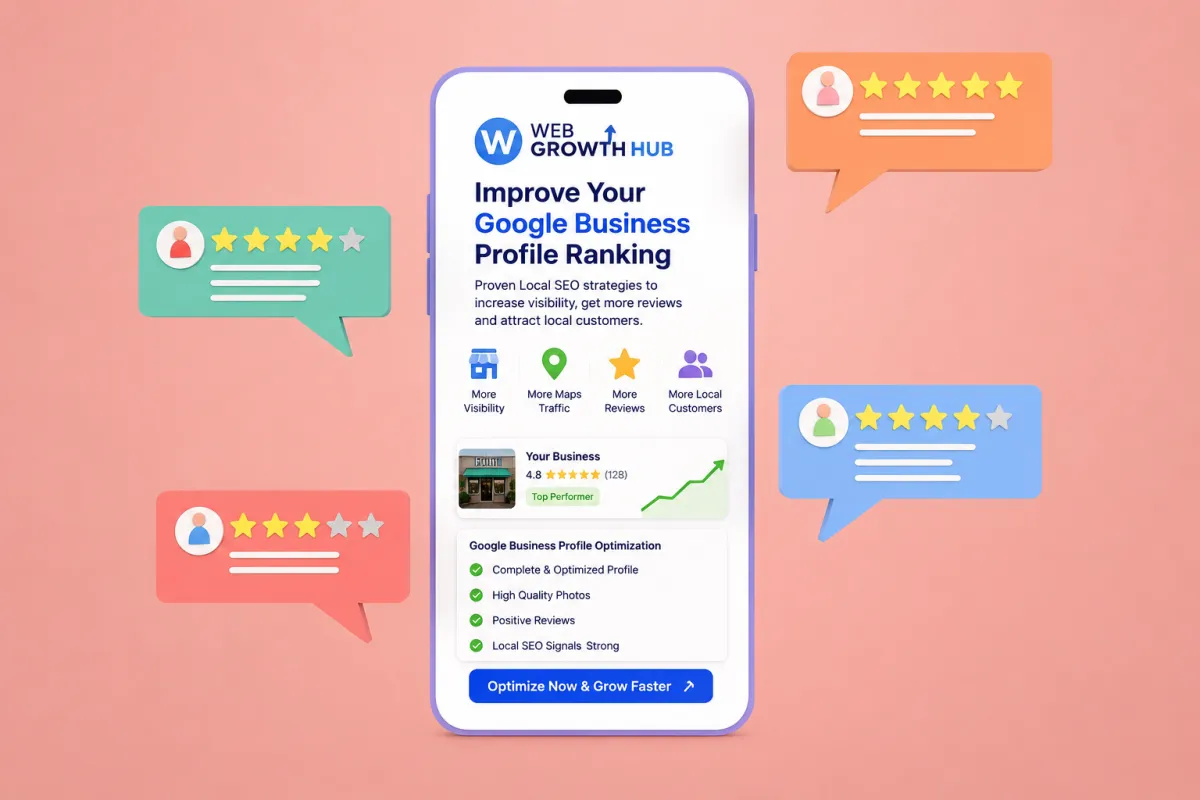
How to Improve Your Google Business Profile Ranking
If you've ever searched for your business on Google Maps and noticed your competitors appearing above you, you're not alone.
It's one of the most common frustrations local business owners face.
You know you offer excellent service. Your customers are happy. You've invested in your website and even claimed your Google Business Profile. Yet when potential customers search for the services you provide, another business gets the visibility, the clicks, and ultimately the phone calls.
So what are they doing differently?
The answer isn't usually a secret trick or a hidden setting inside Google Business Profile. Businesses that consistently rank at the top of local search results have simply built stronger trust signals over time. They've optimized every part of their profile, stay active online, collect customer reviews consistently, and make it easy for Google to understand exactly who they are and where they serve.
The good news is that improving your Google Business Profile ranking doesn't require a massive marketing budget. It requires consistency, attention to detail, and a strategy focused on helping both Google and potential customers trust your business.
In this guide, you'll learn the most effective ways to improve your Google Business Profile ranking, increase your visibility in Google Search and Google Maps, and attract more local customers.
Understand How Google Business Profile Rankings Work
Many business owners believe Google randomly chooses which businesses appear first in local search results.
In reality, Google follows a clear set of principles.
Whenever someone searches for a local service like "plumber near me," "roof repair," or "family dentist," Google evaluates thousands of businesses in just a fraction of a second. Its goal isn't to promote the business that spends the most on marketing. Instead, it wants to recommend the business that's most likely to give the searcher the best experience.
To make that decision, Google primarily looks at three factors:
Relevance
Relevance measures how closely your business matches what someone is searching for.
If a customer searches for "commercial landscaping company," Google wants to show businesses that clearly identify themselves as commercial landscapers, not just general lawn care providers.
Your business categories, services, business description, website content, and even customer reviews all help Google understand what your business does.
The clearer and more complete your profile is, the easier it is for Google to match you with relevant searches.
Distance
Distance is exactly what it sounds like.
Google considers how close your business is to the person searching.
If someone searches for "coffee shop near me," Google naturally prioritizes businesses located nearby.
You can't change your physical location, but you can accurately define your service areas and make sure your business information is complete so Google knows exactly where you operate.
For service-based businesses that travel to customers, setting up your service areas correctly is especially important.
Prominence
Prominence is where businesses have the greatest opportunity to improve.
This reflects how well-known and trustworthy your business appears online.
Google looks at signals like:
Customer reviews
Review quality
Review frequency
Website authority
Local backlinks
Business citations
Google Business Profile activity
Photos
Website quality
Brand mentions across the web
Think of prominence as your online reputation.
The stronger your reputation becomes, the more confidence Google has in recommending your business to potential customers.
Many businesses focus entirely on their website while neglecting these other signals. Meanwhile, their competitors steadily improve each area, making it easier for Google to trust them.
Complete Every Section of Your Google Business Profile

One of the easiest ways to improve your ranking is also one of the most overlooked.
Many businesses create their profile, add a phone number and address, then never touch it again.
An incomplete profile leaves Google with unanswered questions.
What services do you offer?
Which areas do you serve?
What makes your business unique?
When are you open?
Can customers book appointments online?
The more complete your profile is, the more confidence Google has in recommending your business.
Make sure every section is fully completed, including:
Business name
Primary category
Secondary categories
Business description
Services
Products (if applicable)
Service areas
Business hours
Holiday hours
Phone number
Website
Appointment links
Attributes
Questions and answers
Don't rush through these sections.
Each one provides another opportunity to help Google better understand your business while giving potential customers the information they need to choose you over a competitor.
Remember, your Google Business Profile isn't just a listing. It's often the first impression someone has of your business.
A complete profile builds trust before a customer even visits your website.
Get More Google Reviews (The Right Way)

If there is one factor that separates top-ranking Google Business Profiles from the rest, it's customer reviews.
Think about your own buying habits.
Whether you're looking for a restaurant, dentist, HVAC contractor, or auto repair shop, chances are you compare reviews before making a decision. A business with hundreds of recent five-star reviews immediately feels more trustworthy than one with only a handful of outdated ratings.
Google knows this.
Reviews don't just influence customers. They help Google determine whether your business is active, reliable, and consistently delivering a positive customer experience.
However, many business owners misunderstand how reviews affect rankings.
It's not simply about having the highest number of reviews. Google evaluates several signals together.
These include:
The total number of reviews.
Your average rating.
How recently reviews were posted.
Whether customers upload photos.
The quality and detail of each review.
Your responses to customer feedback.
Imagine two local plumbing companies.
The first has 250 reviews, but most of them were left three years ago.
The second has 120 reviews, but new customers leave thoughtful feedback every week, complete with photos of finished projects.
The second business often appears more active and relevant because it continues to earn trust over time.
Consistency matters more than occasional bursts of activity.
Instead of asking for reviews only when you remember, make it part of your customer experience. After every completed job or successful appointment, send a polite follow-up asking for honest feedback. Over the course of a year, those small efforts can dramatically strengthen your online reputation.
Just as importantly, respond to every review, whether it's positive or negative. A simple thank-you shows future customers that you value feedback, while thoughtful responses to concerns demonstrate professionalism and accountability.
Keep Your Google Business Profile Active
Many businesses claim their Google Business Profile, fill in the basics, and then leave it untouched for months or even years.
Meanwhile, their competitors treat it like a living marketing asset.
Google wants to recommend businesses that appear active and engaged with their customers. Every update tells Google that your business is operating, maintaining accurate information, and continuing to serve its community.
One of the easiest ways to demonstrate activity is by publishing regular Google Posts.
These updates can include:
Seasonal promotions.
New services.
Completed projects.
Company news.
Community events.
Helpful tips related to your industry.
Links to recent blog articles.
For example, a landscaping company might publish seasonal lawn care advice during spring, while an HVAC company could share energy-saving tips before summer begins.
These posts aren't just useful for customers. They also show Google that your business is continually providing fresh, relevant information.
In addition to posting updates, make it a habit to review your profile regularly.
Check that your:
Business hours are accurate.
Holiday hours are updated.
Services reflect what you currently offer.
Contact information is correct.
Business description remains relevant.
Small updates performed consistently are far more valuable than making large changes once a year.
Upload Photos That Build Trust

Photos are one of the most overlooked ranking and conversion opportunities available to local businesses.
Customers want to know who they're hiring.
They want to see your work, your team, your office, your equipment, and the quality you deliver before they make contact.
Google recognizes this behavior.
Businesses that regularly upload high-quality images often create stronger engagement because people spend more time viewing their profiles, browsing photos, and interacting with listings.
Instead of uploading a few images when you first create your profile, continue adding new content throughout the year.
Great photo ideas include:
Recently completed projects.
Before-and-after transformations.
Team members at work.
Company vehicles.
Office or storefront images.
Equipment and tools.
Customer success stories (with permission).
Community events or sponsorships.
Fresh photos demonstrate that your business is active and help potential customers visualize the experience they'll receive when working with you.
The goal isn't to upload hundreds of images overnight.
It's to consistently add authentic, high-quality photos that reflect your business as it grows.
Your Website Plays a Bigger Role Than You Think
Many business owners assume their Google Business Profile operates independently from their website.
In reality, the two work together.
When someone clicks from your Google Business Profile to your website, Google wants that experience to reinforce the information in your listing.
If your profile says you provide commercial roofing services, your website should clearly explain those services.
If you serve multiple cities, those locations should be reflected on your website through dedicated service area pages.
Google looks for consistency between your profile and your website.
That means your business name, address, phone number, services, and overall messaging should align across both platforms.
Your website should also provide a positive user experience by:
Loading quickly.
Working well on mobile devices.
Including clear calls to action.
Featuring detailed service pages.
Publishing helpful blog content.
Displaying customer testimonials.
Making it easy to contact your business.
Your Google Business Profile may attract the click, but your website often determines whether that visitor becomes a lead.
A strong website strengthens your local SEO, reinforces your credibility, and gives Google additional confidence in recommending your business.
Build Local Authority Beyond Your Google Business Profile

Optimizing your Google Business Profile is essential, but it's only one piece of the puzzle.
Google doesn't evaluate your profile in isolation. It looks across the web to determine whether your business appears trustworthy and well-established.
Think of your online presence like a reputation that extends beyond your own website. Every mention of your business helps Google build confidence that you're a legitimate company serving real customers.
This is where local authority comes into play.
Local authority is built through signals such as:
Consistent business listings across trusted directories.
Mentions from local organizations.
Links from reputable websites.
Community involvement.
Local news coverage.
Partnerships with other businesses.
For example, imagine two roofing companies in the same city.
Both have optimized Google Business Profiles and similar review ratings.
However, one company is listed on local Chamber of Commerce websites, has been featured in a local newspaper, sponsors community events, and has earned backlinks from construction industry websites.
The other company has none of these signals.
Which one appears more established?
To Google, the first business demonstrates stronger authority because independent sources across the web reinforce its credibility.
Building authority isn't about collecting hundreds of random backlinks. It's about earning genuine mentions that reflect your involvement in your community and industry.
Some practical ways to strengthen local authority include:
Joining your local Chamber of Commerce.
Getting listed in reputable business directories.
Sponsoring local events or sports teams.
Partnering with complementary businesses.
Contributing articles to local publications.
Participating in community initiatives.
Each of these activities creates another signal that helps Google understand your business is active, reputable, and relevant to your local market.
Keep Your Business Information Consistent Everywhere
One of the simplest mistakes businesses make is having inconsistent information across the internet.
Perhaps your website lists one phone number while Facebook displays another.
Maybe your Google Business Profile says "ABC Roofing LLC," while another directory lists "ABC Roofing."
Small inconsistencies may seem harmless, but they can create uncertainty for both customers and search engines.
Google wants confidence that every mention refers to the same business.
That's why maintaining consistent NAP information is so important.
NAP stands for:
Name
Address
Phone Number
These details should match across every online platform, including:
Your website.
Google Business Profile.
Facebook.
LinkedIn.
Apple Maps.
Bing Places.
Local business directories.
Industry-specific directories.
Consistency also applies to:
Website URL.
Business hours.
Service areas.
Categories.
Branding.
Logos.
Think of it this way.
If someone asked ten different people where your business is located and received ten different answers, they'd naturally become less confident.
Google behaves similarly.
The more consistent your information is across the web, the easier it becomes for Google to trust your business and confidently recommend it to potential customers.
Automation Helps You Stay Consistent

Most business owners understand the importance of reviews, follow-ups, and customer communication.
The challenge isn't knowing what to do.
It's finding the time to do it consistently.
When you're busy serving customers, managing employees, and running daily operations, tasks like requesting reviews, publishing updates, or following up with leads often move to the bottom of the priority list.
Unfortunately, inconsistency slows growth.
This is where automation becomes one of your biggest competitive advantages.
Instead of relying on memory, automated workflows can handle many routine tasks for you.
For example:
A customer completes a project.
They automatically receive a thank-you message.
A review request is sent at the appropriate time.
Your team is notified if a review isn't completed.
Future follow-ups can be scheduled automatically.
Missed phone calls trigger an instant text message so potential customers receive a response even when you're unavailable.
Automation doesn't replace personal service.
It simply ensures that important customer interactions happen consistently, even during your busiest days.
This consistency improves the customer experience while also strengthening many of the trust signals Google values.
Why an All-in-One Platform Makes Local SEO Easier
Many businesses manage local SEO using several disconnected tools.
One platform for the website.
Another for email marketing.
A separate CRM.
Another system for review requests.
Another dashboard for analytics.
While each tool may perform its individual task well, switching between multiple platforms often creates unnecessary complexity.
Information becomes fragmented.
Leads are overlooked.
Follow-ups become inconsistent.
Performance is difficult to measure.
An all-in-one business growth platform removes those barriers by bringing everything together in one place.
With WebGrowthHub, your website, Google Business Profile strategy, CRM, lead capture, automation, customer communication, review requests, and reporting all work together within a single connected ecosystem.
When someone submits a form, they're automatically added to your CRM.
Follow-up emails and text messages can begin immediately.
Appointments can be scheduled.
Review requests can be triggered after completed jobs.
Every customer interaction becomes organized and measurable.
Instead of spending time connecting different tools, you can focus on what matters most: delivering exceptional service and growing your business.
The result isn't just greater efficiency.
It's a more consistent online presence that helps both customers and Google see your business as active, reliable, and trustworthy.
Final Thoughts
Improving your Google Business Profile ranking isn't about finding shortcuts or trying to outsmart Google's algorithm.
It's about building a business that consistently demonstrates relevance, trust, and authority.
Complete your profile thoroughly.
Collect genuine customer reviews on a regular basis.
Upload fresh photos.
Publish helpful updates.
Keep your business information consistent across the web.
Support your profile with a fast, informative website.
Strengthen your local authority through community involvement and trusted online mentions.
Most importantly, create systems that help you maintain these efforts consistently rather than only when you have spare time.
Businesses that rank well in Google Maps rarely achieve those positions overnight. They earn them through steady improvements that build trust month after month.
With the right strategy and an integrated platform like WebGrowthHub, you can simplify these ongoing tasks, stay organized, and create the strong online presence needed to attract more local customers and grow your business for years to come.
Frequently Asked Questions
How long does it take to improve my Google Business Profile ranking?
There is no fixed timeline. Some improvements, such as updating your profile or adding photos, can have an immediate impact on customer engagement. Stronger ranking improvements from reviews, website optimization, and local authority typically develop over several weeks or months as Google recognizes consistent activity.
Do Google Posts help improve rankings?
Google has not confirmed that Google Posts are a direct ranking factor. However, posting regularly keeps your profile active, provides useful information to customers, and demonstrates ongoing business activity, all of which contribute to a stronger overall presence.
How often should I upload photos to my Google Business Profile?
Adding fresh, high-quality photos every few weeks is a good practice. Businesses that regularly showcase completed projects, team members, products, or services often create more engagement than profiles with outdated images.
Can I rank in multiple cities with one Google Business Profile?
Yes, especially if you're a service-area business. Optimizing your service areas, creating dedicated location pages on your website, and producing locally relevant content can help you appear in searches across multiple areas you serve.
Does WebGrowthHub help with Google Business Profile optimization?
Yes. WebGrowthHub provides the tools businesses need to support stronger local visibility by combining professional websites, CRM, lead management, automation, customer communication, review request workflows, and analytics into one connected platform. This integrated approach helps businesses maintain the consistency and organization that support long-term local SEO success.


