


Why Is My Competitor Ranking Higher Than Me on Google? How to Close the Gap
Why Is My Competitor Ranking Higher Than Me on Google? How to Close the Gap
It is a common and deeply relatable frustration for many business owners. You provide a superior service, your customers are genuinely happier, and you’ve invested significantly in your online presence. Yet, when you search for your primary services on Google, your competitor—the one with the outdated website or fewer reviews—consistently appears above you in the search results or the coveted Google Maps "Local Pack."
It feels unfair, and it can be tempting to assume the system is rigged or that they are somehow "gaming" the search engine. However, Google’s rankings are not a direct reflection of who is the "better" business in the physical world. Instead, they are a reflection of which business provides the strongest digital signals to Google’s algorithm.
This guide from Web Growth Hub will demystify why your competitors are outranking you, break down the critical ranking factors that actually matter, and provide a strategic, step-by-step roadmap to help you close the gap and reclaim your visibility.
Why Your Competitor is Ranking Higher Than You
If a competitor is outranking you, it is rarely due to a single factor. Google uses a complex combination of signals to determine which business is the most relevant, trustworthy, and prominent for a specific search query. Understanding these signals is the first step toward improvement.
The Myth of the "Better" Business
Google does not have a way to personally experience your service or verify the quality of your work. It relies entirely on the data it can crawl and analyze across the web. A competitor might rank higher because they have been more consistent in their digital efforts, even if their actual service is inferior.
Proximity: The Uncontrollable Factor
In local search, proximity is one of the most significant factors. If a competitor’s physical office is closer to the searcher or the geographic center of the search area, Google may prioritize them, even if their listing is otherwise weaker. While you cannot move your building, you can strengthen other signals to compensate for a distance disadvantage.
Key Ranking Factors in Local and Organic Search
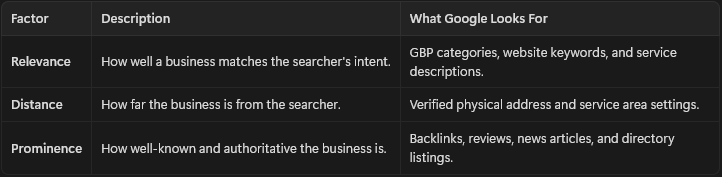
Google’s ranking algorithm for local businesses is primarily built on three pillars: Relevance, Distance, and Prominence.
How Google Business Profile and Reviews Affect Rankings
Your Google Business Profile (GBP) is the single most important asset for local search visibility. It serves as your digital storefront and the primary source of information for Google Maps.
The Power of the Primary Category
The primary category you select for your GBP is the #1 ranking factor for local search [3]. If your competitor has chosen a more specific or accurate primary category that matches the user’s search, they will likely outrank you.
Review Velocity and Diversity
While the total number of reviews is important, Google also looks at review velocity (how frequently you get new reviews) and review diversity (reviews across different platforms like Yelp, Facebook, and industry-specific sites). A competitor with 50 recent, detailed reviews might outrank a business with 200 reviews that are all two years old.
How Website and Content Quality Influence Visibility
Your website is the foundation of your online presence. Even if your GBP is perfect, a weak website can hold back your overall rankings.
Content Depth and User Intent
Google prioritizes websites that provide comprehensive, helpful answers to user queries. If your competitor has a blog that answers common customer questions or detailed service pages that explain their process, Google views them as a more authoritative resource.
Technical SEO and Mobile Performance
A slow, clunky website that is difficult to navigate on a mobile phone will be penalized. Google uses mobile-first indexing, meaning it primarily looks at the mobile version of your site to determine rankings. If your competitor’s site loads faster and is easier to use, they have a significant advantage.
The Role of Consistency, Citations, and Authority
Beyond your own website and GBP, Google looks at how the rest of the internet views your business.
NAP Consistency
Your Name, Address, and Phone number (NAP) must be identical across every directory, social media profile, and map listing. Inconsistent information creates "data friction," which makes Google less confident in displaying your business.
Domain Authority and Backlinks
Backlinks—links from other reputable websites to yours—act as votes of confidence. A competitor with links from local news outlets, industry associations, or community organizations will have higher domain authority, making it much easier for them to rank for competitive keywords.
Common Mistakes That Hold Businesses Back
Many businesses unknowingly sabotage their own rankings through easily avoidable errors:
•Keyword Stuffing: Overloading your business name or content with keywords can lead to suspensions or ranking drops.
•Duplicate Listings: Having multiple profiles for the same location confuses Google and splits your ranking power.
•Ignoring Negative Reviews: Failing to respond to feedback signals to Google (and customers) that you are not active or responsive.
•Neglecting Local Citations: Failing to list your business in relevant local directories like the Chamber of Commerce or Yelp.
How to Audit Your Own Presence vs. Competitors
To close the gap, you must first understand exactly where the gap is. A basic SEO audit should include:
1.Keyword Gap Analysis: Identify which keywords your competitors are ranking for that you are not.
2.GBP Comparison: Compare your primary category, number of photos, and review frequency to the top three competitors in the "Local Pack."
3.Backlink Audit: Use tools to see which websites are linking to your competitors and try to acquire similar links.
4.Website Speed Test: Use Google PageSpeed Insights to compare your site’s performance against your competitors.
Practical Steps to Improve Your Rankings
Closing the ranking gap is a process of consistent improvement.
•Optimize Your GBP: Ensure your primary category is perfect, add new high-quality photos weekly, and utilize Google Posts to share updates.
•Enhance Your Content: Create detailed service pages and a blog that addresses the specific questions your local customers are asking.
•Clean Up Your Citations: Use a service or manual audit to ensure your NAP information is 100% consistent across the web.
•Build Local Authority: Reach out to local organizations for sponsorship or partnership opportunities that include a link back to your website.
How Web Growth Hub Can Help
Understanding why a competitor is winning is one thing; building the system to beat them is another.
Businesses that want a clearer path to better rankings can benefit from a strategy built by Web Growth Hub. We specialize in deep competitor analysis and the implementation of robust local SEO systems. Web Growth Hub helps businesses strengthen the systems behind search visibility, local SEO, and digital growth, ensuring that your business doesn't just compete, but dominates its local market.
Conclusion: Reclaiming Your Spot at the Top
Seeing a competitor rank higher than you is a call to action, not a reason for despair. By focusing on the signals that Google actually values relevance, consistency, and authority you can systematically close the gap.
Don't let a weaker competitor capture the leads that belong to you. Start by auditing your current presence, identifying the gaps, and taking the practical steps outlined in this guide. If you’re ready to stop guessing and start growing, explore how Web Growth Hub can help you build the visibility your business deserves.


