

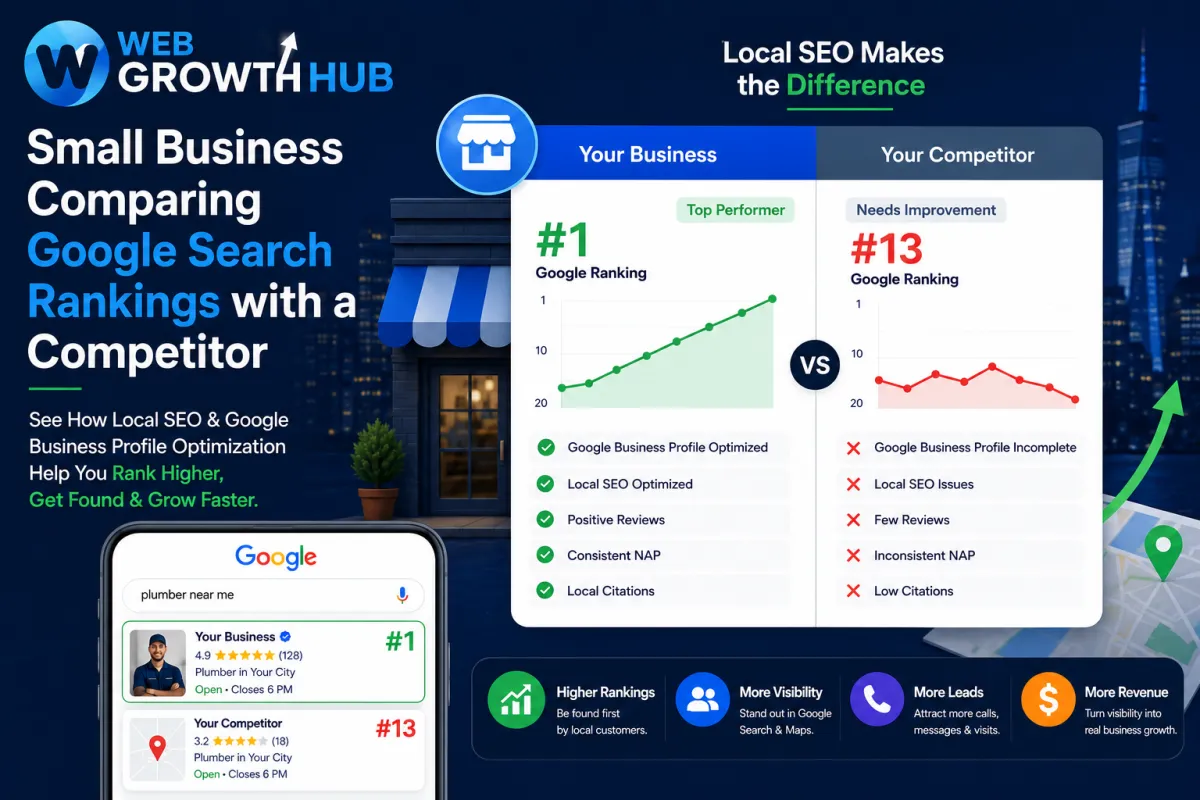
Why Does My Competitor Rank Above My Business? 10 Reasons (And How You Can Catch Up)
Have you ever searched for your own business on Google, only to see your competitor listed above you?
It's frustrating.
You know your team does excellent work. You have years of experience, loyal customers, and a reputation you're proud of. Yet when someone searches for the services you offer, another business appears first and gets the click before customers even know you exist.
For many small business owners, this leads to an obvious question:
"Why does my competitor rank above my business?"
The first assumption is usually that Google is rewarding the company with the biggest marketing budget or the oldest business in town.
In reality, that's rarely the case.
Google doesn't rank businesses based on who has been around the longest or who claims to offer the best service. Its goal is much simpler: show searchers the businesses that are most likely to provide the best experience.
To determine that, Google looks at hundreds of different signals. Some relate to your website. Others come from your Google Business Profile, customer reviews, local citations, website performance, and even how people interact with your business online.
The encouraging news is that many of these factors are completely within your control.
Understanding why your competitors are ranking higher is the first step toward improving your own visibility. Once you know what Google values, you can begin making strategic improvements that help your business appear in more searches, attract more visitors, and generate more leads.
Google Doesn't Rank the "Best" Business
One of the biggest misconceptions about SEO is that Google somehow knows which company provides the highest quality service.
It doesn't.
Google has never hired your business.
It hasn't seen your workmanship.
It doesn't know that your customer service is exceptional or that you've spent years building a great reputation in your community.
Instead, Google relies on measurable signals that help it predict which business is most likely to satisfy the searcher's intent.
Think of Google as a recommendation engine.
When someone searches for "plumber near me" or "commercial roofing company," Google evaluates thousands of businesses in seconds and asks questions like:
Which business is the most relevant to this search?
Which business has the strongest reputation?
Which company appears to be the most active?
Which website provides the best information?
Which business has earned the trust of other customers?
The businesses that answer these questions most effectively are usually the ones that appear at the top of the search results.
This means your competitor doesn't necessarily have to be better than you.
They simply have to send Google stronger trust signals.
What Google Looks At When Ranking Local Businesses

Although Google's algorithm is incredibly complex, most local rankings are influenced by a handful of core factors.
Relevance
Google wants to know whether your business actually matches what someone is searching for.
If your website clearly explains your services, includes helpful content, and uses language that reflects what customers search for, Google can understand your business much more easily.
Businesses with detailed service pages, FAQs, blogs, and location-specific content often outperform websites with only a basic homepage.
Distance
For local searches, location matters.
If someone searches for "HVAC repair near me," Google naturally prioritizes businesses that serve the searcher's area.
This is why having clearly defined service areas and an optimized Google Business Profile is so important.
Prominence
This is where many businesses fall behind.
Prominence refers to how established and trustworthy your business appears online.
Google looks at signals like:
Customer reviews
Review quality
Review frequency
Website authority
Local citations
Business mentions
Backlinks
Online activity
Businesses that consistently maintain these signals often outperform competitors that rarely update their online presence.
Your Competitor Is Probably Building More Trust Than You Realize
Many business owners assume their competitors are investing thousands of dollars every month into SEO.
Sometimes they are.
But more often, they're simply doing the small things consistently.
For example, imagine two local landscaping companies.
Both provide excellent service.
Both have similar pricing.
Both have professional websites.
The difference is that one business:
Requests a Google review after every completed job.
Uploads new project photos every week.
Publishes helpful blog articles.
Keeps its Google Business Profile updated.
Responds to every customer review.
Adds new service pages regularly.
Shares seasonal updates online.
Meanwhile, the second business updates its website once every few years and only remembers to ask for reviews occasionally.
Over time, Google begins to see one business as active and authoritative while the other appears relatively inactive.
The gap between them grows larger, even if both companies provide the same quality of work.
Consistency often beats intensity.
Small improvements repeated every week usually produce better long-term results than occasional bursts of marketing activity.
Your Website Might Be Sending the Wrong Signals

Your website plays a much bigger role in rankings than many business owners realize.
A modern website isn't just a digital brochure.
It's one of Google's primary sources for understanding who you are, what you do, and where you operate.
If your website is slow, outdated, difficult to navigate, or missing important information, Google has fewer reasons to recommend it.
Ask yourself:
Does every service have its own dedicated page?
Do you have pages for the cities you serve?
Is your website mobile-friendly?
Does it load in just a few seconds?
Is it easy for visitors to contact you?
Are your page titles and descriptions optimized?
Do you regularly publish helpful content?
If the answer to several of these questions is "no," your website could be limiting your visibility without you even realizing it.
Fortunately, these are all areas that can be improved with a clear strategy and ongoing optimization.
Reviews Matter More Than Most Business Owners Realize

Imagine you're searching for a local electrician.
Two businesses appear side by side in Google.
The first has 18 reviews with an average rating of 4.4 stars.
The second has 247 reviews, a 4.9-star rating, recent customer photos, and thoughtful responses from the owner.
Which one would you call?
Most people don't hesitate.
They naturally trust the business with the stronger reputation.
Google sees this behavior every day.
While reviews are only one part of Google's ranking algorithm, they are a powerful trust signal. They help Google understand that your business is active, serves real customers, and consistently delivers a positive experience.
It's not just about how many reviews you have.
Google also considers:
The quality of your reviews.
How recently they were posted.
Whether customers include photos.
The keywords customers naturally mention.
Whether you respond to reviews.
How consistently new reviews are coming in.
A business that receives a few new reviews every week often appears healthier than one that gained a hundred reviews years ago but hasn't received any recent feedback.
That's why successful local businesses don't ask for reviews occasionally. They build review requests into every completed job.
Over time, those small, consistent actions create a reputation that both customers and Google trust.
Your Google Business Profile Is Working Harder Than You Think
Many business owners claim their Google Business Profile, add their phone number, upload a few photos, and never look at it again.
Meanwhile, their competitors treat it like another marketing channel.
They regularly:
Upload new project photos.
Publish Google Posts.
Update services.
Answer customer questions.
Respond to reviews.
Add seasonal offers.
Keep business hours current.
Each of these updates tells Google something important:
This business is active.
Google wants to recommend businesses that are engaged with their customers, not businesses whose profiles have been sitting untouched for two years.
Your Google Business Profile should evolve just like your website.
Think of it as your digital storefront.
If your physical storefront had broken signs, outdated business hours, and dusty windows, customers might hesitate before walking inside.
The same principle applies online.
A complete, regularly updated profile builds confidence before a customer even visits your website.
The Businesses Winning Online Usually Have Better Systems
Here's something many business owners don't realize.
Your competitor probably isn't spending every evening manually updating Google, sending follow-up emails, requesting reviews, posting on social media, and tracking every lead in a spreadsheet.
More likely, they've built systems that do much of the work automatically.
When a customer completes a project, the system sends a thank-you message.
A day later, it requests a Google review.
A few months later, it sends a maintenance reminder.
If someone submits a quote request, the business responds immediately, even if the owner is busy on another job.
These aren't random marketing activities.
They're automated workflows designed to keep the business active, responsive, and consistently visible.
This consistency creates better customer experiences while also sending stronger trust signals to Google.
Businesses that automate routine tasks often appear more organized because they are.
Instead of relying on memory, sticky notes, or manual follow-ups, they use technology to ensure every customer receives the same level of attention.
AI Is Changing How Local Businesses Compete

Artificial intelligence is quickly becoming another competitive advantage for businesses that embrace it.
Not because AI replaces people, but because it helps businesses stay consistent.
Today, AI can help business owners:
Draft helpful blog articles.
Respond professionally to customer reviews.
Generate ideas for Google Business Profile posts.
Create frequently asked questions.
Write email campaigns.
Personalize follow-up messages.
Organize customer conversations.
Analyze marketing performance.
This doesn't eliminate the human element.
Instead, it gives small businesses the ability to accomplish more with the same team.
For many local businesses, AI levels the playing field.
You don't need a large marketing department to stay active online. With the right tools, you can consistently publish content, engage customers, and improve your online presence without dramatically increasing your workload.
Why an All-in-One Platform Gives Businesses a Competitive Advantage
Many businesses try to manage their online presence using a collection of disconnected tools.
One platform for the website.
Another for email marketing.
A separate CRM.
Another system for reviews.
Another for analytics.
While each tool may work well individually, managing them together often creates unnecessary complexity.
Information becomes fragmented.
Leads get overlooked.
Follow-ups are delayed.
Reporting becomes inconsistent.
An all-in-one platform solves this by bringing every essential tool together.
With WebGrowthHub, your website, CRM, lead capture, automation, communication, review management, and analytics all work within one connected ecosystem.
When a visitor submits a form, they're automatically added to your CRM.
Follow-up messages can begin immediately.
Appointments can be scheduled.
Review requests can be triggered after a completed job.
Performance can be tracked from a single dashboard.
Instead of spending time moving information between systems, you can focus on serving customers and growing your business.
More importantly, this connected approach creates the consistency that Google and your customers both value.
Final Thoughts
If your competitor ranks above your business, it doesn't automatically mean they provide better service.
In many cases, they're simply making it easier for Google to understand, trust, and recommend them.
They're earning reviews consistently.
They're keeping their Google Business Profile updated.
They're publishing helpful content.
They're maintaining a fast, informative website.
They're following up with leads promptly.
And increasingly, they're using automation and AI to ensure these activities happen consistently.
The encouraging news is that none of these strategies are exclusive to large companies with massive marketing budgets.
With the right systems in place, any business can strengthen its online presence, improve its visibility, and compete more effectively in local search.
Success isn't about finding one secret ranking factor. It's about consistently doing the small things that build trust over time.
When your website, customer experience, reviews, local SEO, and automation all work together, you give both Google and potential customers more reasons to choose your business over the competition.
Frequently Asked Questions
Why does my competitor rank higher than my business on Google?
Google ranks businesses based on many factors, including relevance, location, website quality, customer reviews, Google Business Profile optimization, local SEO, and overall online authority. Higher rankings usually reflect stronger digital signals rather than better products or services.
Do more Google reviews improve search rankings?
Reviews are one of several important local ranking factors. Businesses with a steady stream of genuine, high-quality reviews and active engagement often build greater trust with both customers and search engines.
Can I outrank competitors without spending a fortune on marketing?
Yes. Consistently improving your website, earning reviews, publishing helpful content, optimizing your Google Business Profile, and maintaining accurate business information can significantly improve your visibility over time without requiring a massive advertising budget.
Does AI help businesses improve their online visibility?
AI can help businesses create content, respond to reviews, automate customer communication, organize leads, and maintain a more consistent online presence. Used strategically, it allows small businesses to compete more efficiently.
How does WebGrowthHub help businesses compete online?
WebGrowthHub combines website management, CRM, lead capture, automation, review management, communication tools, and analytics into one platform. By connecting these systems, businesses can respond faster, stay organized, improve customer engagement, and build the consistent online presence that supports long-term growth and stronger search visibility.


