

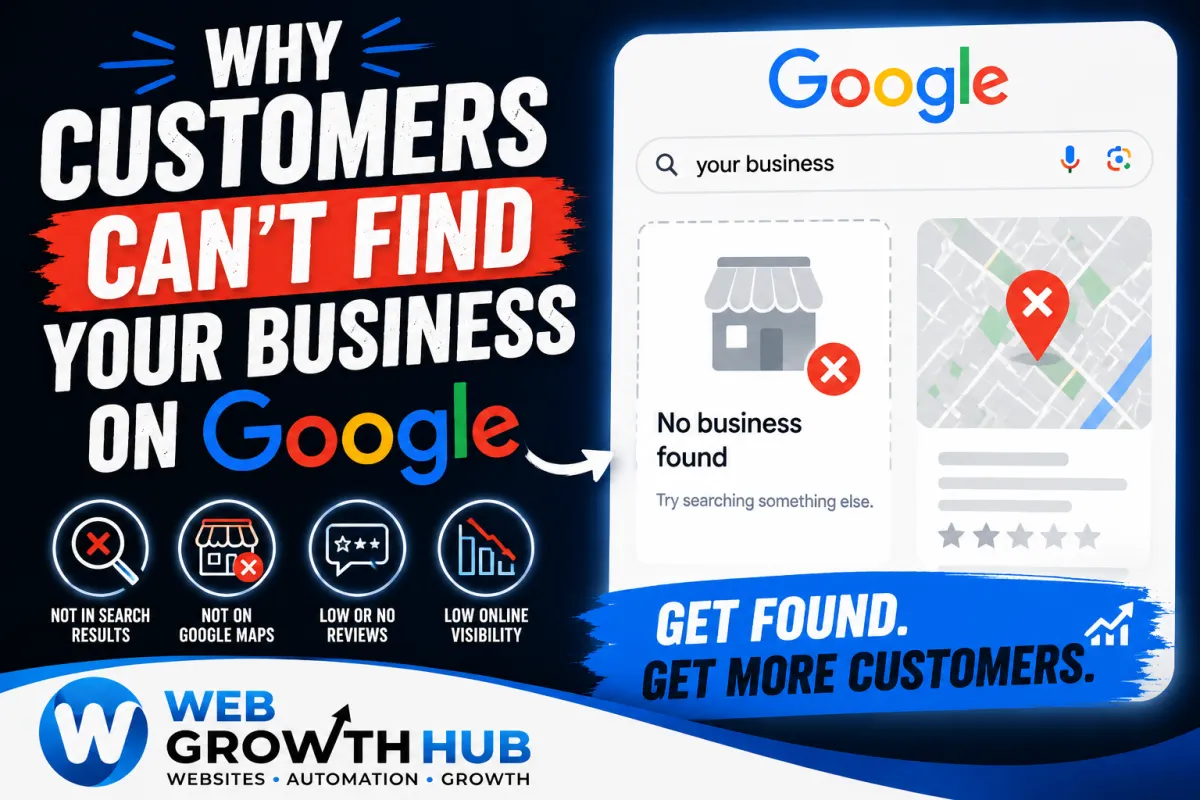
Why Can't Customers Find My Business on Google? Your Guide to Local Visibility
Why Can't Customers Find My Business on Google? Your Guide to Local Visibility
It’s a common, frustrating scenario for many business owners: you’ve poured your heart and soul into building a great business, you have a fantastic website, and you know your customers love what you do. Yet, when you or a potential customer types your business name or service into Google, you’re nowhere to be found. You’re in business, but you’re not visible where it matters most – on Google Search and Google Maps. This isn't just a minor inconvenience; it's a significant barrier preventing potential customers from discovering you, leading to missed opportunities and lost revenue. Understanding why customers can’t find your business on Google is the first step toward unlocking your true online potential.
What It Means When Customers Cannot Find Your Business
When your business doesn't appear in Google search results or on Google Maps, it essentially means you are invisible to a vast majority of potential customers. According to recent data, a staggering 88% of people use Google Maps to find local services, and 76% of those who search for a local service on their phone visit or call a business within 24 hours. If you aren't showing up, you are handing those customers directly to your competitors.
There are generally two types of visibility problems you might be facing:
1.Complete Invisibility: Your business doesn't show up at all, even when someone searches for your exact business name. This is a critical issue, often indicating that your profile is suspended, unclaimed, or violating Google's guidelines.
2.Poor Ranking (Optimization Issues): Your business appears somewhere on Google Maps or in search results, but not in the top spots (like the "Local Pack" – the top three businesses shown with map pins). While you might get some traffic, your competitors are capturing the lion's share of the attention.
The Most Common Reasons Your Business Isn't Found on Google
Several factors can contribute to your business's low visibility on Google. Understanding these common pitfalls is crucial for addressing them effectively:
1. Missing or Unoptimized Google Business Profile (GBP)
Your Google Business Profile (GBP) is arguably the most critical component for local search visibility. If you haven't claimed and verified your GBP, or if it's incomplete and unoptimized, Google has very little information to display about your business. Over half of all local businesses haven't taken this crucial step. A fully optimized GBP includes accurate business name, address, phone number (NAP), hours of operation, services offered, and high-quality photos.
2. Inconsistent Business Information (NAP) Across the Web
Google values consistency. If your business name, address, and phone number (NAP) are inconsistent across various online directories (like Yelp, Facebook, or even your own website), it confuses Google's algorithm. This lack of uniformity signals unreliability and can negatively impact your local ranking. Even minor discrepancies, such as "Street" vs. "St.", can cause issues.
3. Your Website Isn't Indexed or Has Weak SEO
For customers to find your business through Google Search, your website needs to be indexed by Google. If Google hasn't discovered your site, or if technical issues (like a robots.txt file blocking crawlers) prevent indexing, your site won't appear in search results. Beyond indexing, weak local SEO on your website, such as poor keyword optimization, slow page speed, or a lack of mobile responsiveness, can significantly hinder your online visibility.
4. Lack of Reviews and Online Engagement
Reviews play a significant role in both Google Business Profile and overall local SEO. Businesses with more positive reviews and higher star ratings tend to rank higher. Google also considers the recency and quantity of reviews. A lack of reviews or negative feedback can deter potential customers and signal to Google that your business is less prominent or trustworthy.
5. Google Guideline Violations or Suspensions
Google has strict guidelines for businesses listed on its platform. Unknowingly violating these rules – such as keyword stuffing your business name, using a P.O. Box instead of a physical address, or having fake reviews – can lead to penalties, including suspension or removal of your business listing. Frequent or significant changes to your GBP can also trigger manual reviews, causing temporary invisibility.
6. High Competition in Your Industry or Area
In highly competitive industries or densely populated areas, even well-optimized businesses might struggle to appear in the top search results. The sheer volume of similar businesses vying for the same keywords and customer attention can make it challenging to stand out. This highlights the importance of a robust and continuous SEO audit and strategy.
7. New Business Age
New businesses often face an uphill battle in gaining visibility. Google tends to favor established businesses with a longer history of consistent information, reviews, and online presence. It takes time to build the authority and trust that Google's algorithm values. Patience and consistent effort in applying local SEO strategies are key for new businesses.
How Google Decides What Businesses to Show
Google’s local search algorithm is complex, constantly evolving to provide the most relevant results to users. It primarily relies on three core pillars to determine which businesses appear in local search results and their ranking:
1. Proximity
Proximity refers to the physical distance between the searcher and the business. The closer a business is to the user’s location (or the location they are searching for), the more likely it is to appear in search results. While businesses can't change their physical location, ensuring your Google Business Profile and other listings have accurate Name, Address, and Phone Number (NAP) is crucial for Google to correctly assess your proximity to potential customers.
2. Relevance
Relevance measures how well a business listing matches the user’s search query. This involves factors like your business categories, keywords used on your website, and user-generated content such as reviews. A business that closely aligns with a search term is more likely to rank higher. Key local ranking factors contributing to relevance include local listings and citations, on-page signals (including content), your Google Business Profile, backlinks, and personalization signals.
3. Prominence
Prominence assesses how well-known and trusted a business is within its community or industry. This factor is influenced by external signals like backlinks, social media mentions, and the quantity and quality of online reviews. Businesses with a strong reputation and frequent mentions across the web tend to achieve higher rankings in local searches. Reviews, Google Business Profile and other listings, backlinks, and behavioral signals all contribute to prominence.
These three factors form the foundation of Google’s local ranking system. The relative importance of these factors can shift, but they consistently remain the pillars of local search visibility. For instance, the 2026 Local Search Ranking Factors survey highlights that Google Business Profile (32%) and Reviews (20%) are the top two factors for Local Pack/Maps rankings, while On-page (33%) and Links (24%) are most important for Local Organic rankings.
How to Check and Fix Visibility Issues: Practical Steps to Improve Your Online Presence
If you're struggling with Google visibility, the good news is that most issues are fixable. Here’s a step-by-step guide to diagnose and improve your business’s presence on Google Search and Maps:
Step 1: Verify Your Google Business Profile (GBP)
This is the absolute first step. Many businesses are invisible simply because their GBP is unclaimed or unverified. Go to Google Business Profile and search for your business. If you find it, claim it. If not, create a new listing. Fill out every section completely and accurately, including your business name, address, phone number, hours, and services. Verification usually involves a text message, phone call, or postcard from Google.
Step 2: Ensure NAP Consistency Across All Platforms
Conduct an audit of your business information across all online platforms – your website, social media profiles (Facebook, Instagram, X), and online directories (Yelp, Yellow Pages, Bing Places). Ensure your Name, Address, and Phone Number (NAP) are identical everywhere. Even minor variations can confuse Google. Standardize your information to build trust with search engines and customers alike.
Step 3: Optimize Your Google Business Profile
Once claimed and verified, optimize your GBP for maximum impact:
•Add High-Quality Photos: Include professional images of your storefront, team, products, and services. Listings with visuals get significantly more views.
•Select Accurate Categories: Choose the most specific and relevant categories for your business. This helps Google understand what you do and match you with appropriate searches.
•Write a Compelling Description: Clearly explain what your business offers, its location, and what makes it unique. Avoid vague language.
•Keep Hours Up to Date: Ensure your operating hours are always current, especially during holidays.
•Utilize GBP Features: Post updates, respond to reviews, and use the Q&A section to engage with potential customers.
Step 4: Check Your Website’s Indexing and SEO Health
To see if your website is indexed by Google, simply type site:yourwebsite.com (replace with your actual domain) into the Google search bar. This will show you all the pages Google has indexed for your site. If your site isn’t appearing, or if important pages are missing, investigate potential technical SEO issues such as:
•robots.txt and noindex tags: These can block Google from crawling or indexing your pages.
•Sitemap Submission: Ensure your XML sitemap is submitted to Google Search Console.
•Page Speed: A slow website can deter both users and search engines. Use tools like Google PageSpeed Insights to identify and fix performance issues.
•Mobile-Friendliness: Google prioritizes mobile-friendly websites. Ensure your site is responsive and provides a good user experience on all devices.
•Keyword Optimization: Integrate relevant keywords naturally into your website content, meta titles, descriptions, and headings. Each page should have a clear purpose and address user intent.
Step 5: Actively Solicit and Manage Reviews
Encourage satisfied customers to leave reviews on your Google Business Profile. Respond to all reviews, both positive and negative, professionally and promptly. This demonstrates excellent customer service and signals to Google that your business is active and engaged. The recency and quantity of reviews are significant ranking factors.
Step 6: Build Local Citations and Backlinks
Ensure your business is listed accurately in relevant online directories and industry-specific platforms. These local citations reinforce your NAP consistency and build authority. Additionally, seek opportunities for high-quality backlinks from reputable local websites or industry partners. While link signals have seen some decline in importance for local pack rankings, they remain a factor for local organic search.
Step 7: Monitor and Adapt
SEO is not a one-time task; it’s an ongoing process. Regularly monitor your Google Business Profile insights, Google Search Console data, and local search rankings. Stay informed about changes in Google’s algorithm and adapt your strategy accordingly. Tools like local ranking grids can help you track your performance over time .
Common Mistakes Businesses Make When Trying to Rank
While focusing on best practices is essential, it's equally important to be aware of common mistakes that can hinder your Google visibility:
•Ignoring Google Business Profile: Many businesses either don't claim their GBP or leave it incomplete. This is a fundamental error, as an optimized GBP is the cornerstone of local SEO.
•Inconsistent NAP Information: Failing to maintain consistent Name, Address, and Phone Number across all online platforms is a major red flag for Google and can severely impact your rankings.
•Keyword Stuffing: Overloading your business name or descriptions with keywords in an attempt to manipulate rankings can lead to penalties or even suspension of your GBP.
•Neglecting Reviews: Not actively soliciting reviews or failing to respond to them can make your business appear less credible and negatively affect your prominence.
•Poor Website Performance: A slow, non-mobile-friendly website with a bad user experience will not rank well, regardless of other SEO efforts.
•Violating Google’s Guidelines: Unknowingly or knowingly breaking Google’s rules can result in severe penalties, including complete removal from search results.
•Setting Unrealistic Service Areas: For service-area businesses, setting an overly broad or inaccurate service area can lead to Google penalizing your listing.
•Expecting Instant Results: SEO is a long-term strategy. Many businesses give up too soon, not realizing that it takes consistent effort and time to see significant improvements in rankings.
When to Expect Results
Improving your Google visibility is not an overnight process. It requires consistent effort and patience. While some immediate improvements can be seen from fixing critical issues like an unverified Google Business Profile, significant changes in rankings and organic traffic typically take time. Expect to see noticeable results within 3 to 6 months for consistent local SEO efforts. Factors like the competitiveness of your industry, your starting point, and the resources you dedicate will influence this timeline. The key is to remain consistent and continuously monitor your progress.
How Web Growth Hub Helps Businesses Improve Online Visibility
For businesses that want a clearer path to visibility and sustained digital growth, Web Growth Hub offers expert guidance and comprehensive solutions. We understand the intricacies of Google’s algorithms and the specific challenges faced by local businesses, service providers, and growing brands. Our services are designed to:
•Optimize Google Business Profiles: We ensure your GBP is fully optimized, verified, and consistently updated to maximize your presence in local search results.
•Enhance Local SEO Strategies: From on-page optimization to building high-quality local citations and managing online reviews, we implement tailored strategies to improve your local rankings.
•Address Technical SEO Issues: We identify and resolve technical barriers that prevent your website from being indexed and ranking effectively.
•Develop Content Strategies: Our team helps you create valuable, keyword-rich content that resonates with your target audience and signals relevance to Google.
•Provide Ongoing Support and Analytics: We offer continuous monitoring, detailed reporting, and strategic adjustments to ensure your business maintains and improves its online visibility over time.
Web Growth Hub helps businesses strengthen the systems behind search visibility and local SEO, transforming online invisibility into tangible growth.
Conclusion: Your Path to Google Visibility Starts Now
Being found on Google is no longer a luxury; it’s a necessity for any business looking to thrive in today’s digital landscape. If customers can’t find your business on Google, you’re missing out on invaluable opportunities to connect with potential clients and grow your brand. The good news is that with a clear understanding of Google’s local search algorithm and a proactive approach to optimizing your online presence, you can turn invisibility into impactful visibility.
Start by claiming and optimizing your Google Business Profile, ensuring NAP consistency, and addressing any technical SEO issues on your website. Actively solicit and manage reviews, build local citations, and continuously monitor your progress. Remember, consistent effort yields lasting results.
Don’t let your business remain a hidden gem. Take the first step towards unlocking your full online potential. If you’re ready to transform your Google visibility and drive sustainable growth, explore how Web Growth Hub can partner with you to achieve your digital marketing goals.


