

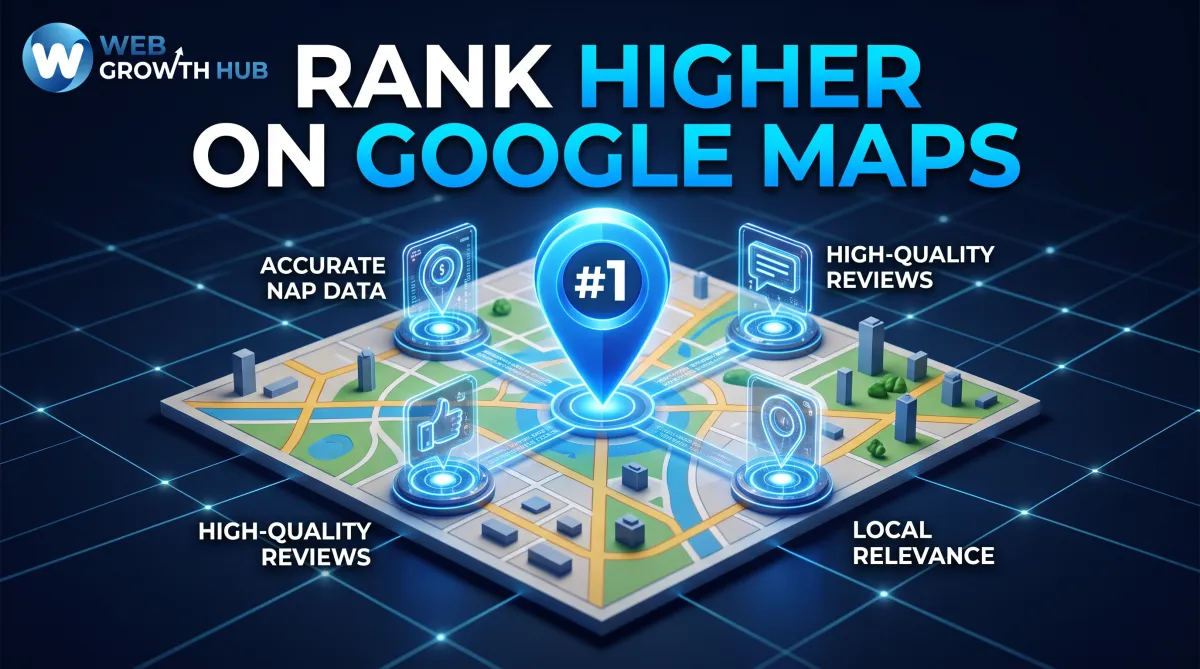
What Makes a Business Rank Higher on Google Maps? A Strategic Guide to Local Visibility
What Makes a Business Rank Higher on Google Maps? A Strategic Guide to Local Visibility
Imagine a customer in your city searching for exactly what you offer. They pull out their phone, type in a quick search—perhaps "emergency plumber near me" or "best Italian restaurant"—and within seconds, Google presents them with a map and three prominent business listings. This is the "Local Pack," and for the vast majority of local customers, the journey ends right here. They click one of those top three results, check the reviews, and hit the "Call" or "Directions" button. They rarely scroll down, and they almost never click "More businesses."
If your business isn't in those top three spots, you are effectively invisible to nearly half of your potential local market. In fact, recent studies indicate that the top three results in the Google Map Pack capture a staggering 44% of all clicks for local searches. This isn't just about vanity; it is about the direct flow of calls, visits, and revenue to your doorstep. The good news is that ranking higher on Google Maps is not a game of luck. It is the result of a clear, three-pillared algorithm that rewards relevance, proximity, and prominence.
In this guide from Web Growth Hub, we will pull back the curtain on what actually moves the needle for Google Maps rankings in 2026. We will explore the core factors Google considers, the advanced signals that separate the winners from the rest and provide a practical roadmap to help you claim your spot at the top.
What Are Google Maps Rankings and Why Do They Matter?
Google Maps rankings refer to the position your business occupies when users perform a local search on Google or within the Google Maps app. Unlike traditional search results, which are a long list of blue links, local search is dominated by the Map Pack. This feature is designed to connect users with physical locations or service providers in their immediate vicinity.
The importance of these rankings cannot be overstated. For small business owners and local service providers, Google Maps is often the primary source of new leads. Because these searches carry high "local intent"—meaning the user is looking to visit or hire someone right now—the conversion rates are significantly higher than general web searches. When you rank higher, you aren't just getting more traffic; you are getting more qualified traffic that is ready to buy.
The Three Core Pillars: Relevance, Distance, and Prominence
Google has officially confirmed that its local ranking algorithm is built on three fundamental pillars. Every optimization tactic you implement should aim to strengthen at least one of these signals.
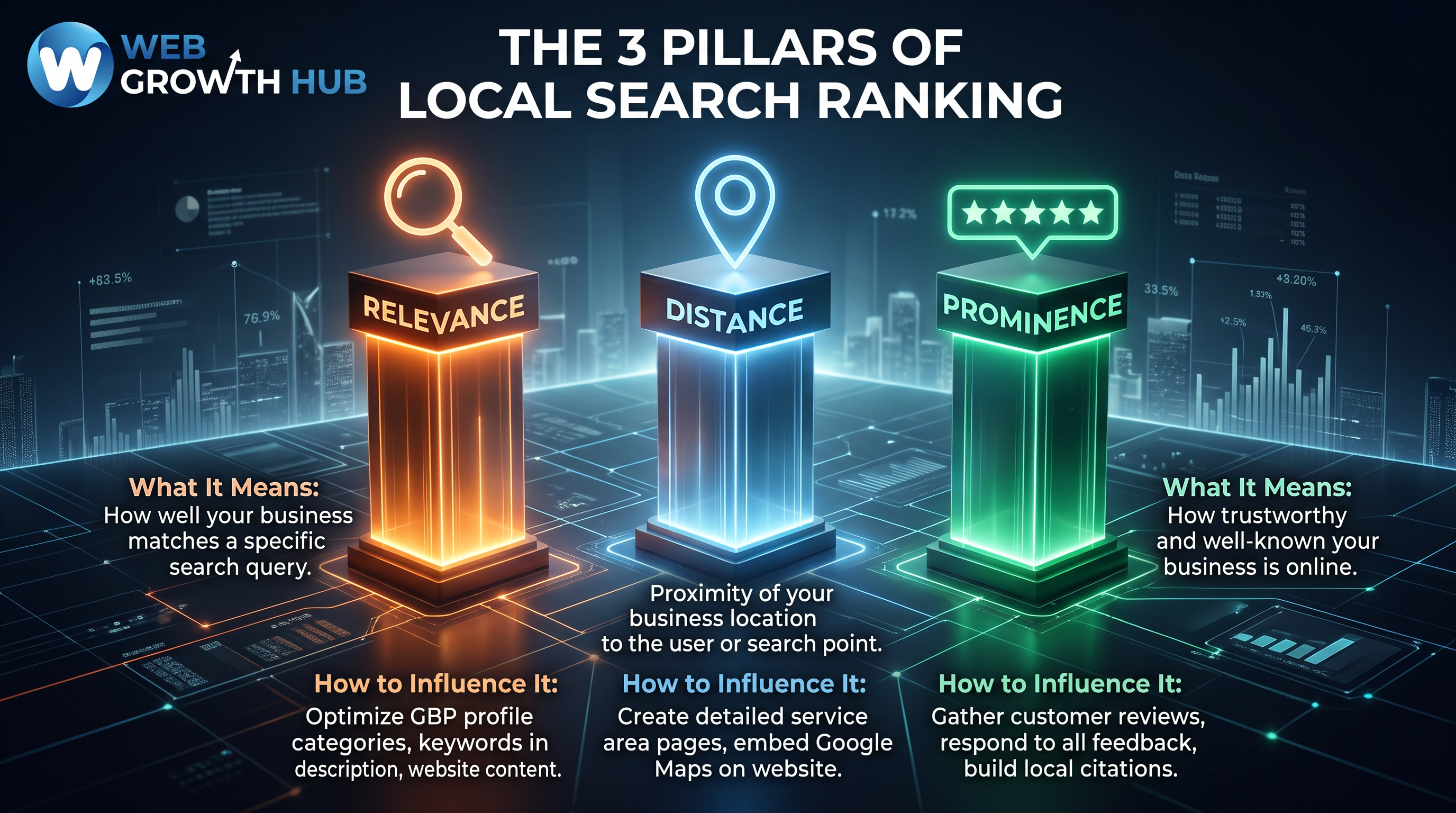
While you cannot change your physical location to improve Distance, you have immense control over Relevance and Prominence. By mastering these two, you can often outrank competitors who are physically closer to the searcher but have a weaker digital presence.
The Central Hub: How Your Google Business Profile Affects Visibility
Your Google Business Profile (GBP) is the "source of truth" for the local algorithm. It is the first place Google looks to understand what you do and where you are. A half-finished or neglected profile is a signal to Google that your business might not be the best answer for its users.
The single most impactful decision you make within your profile is your Primary Category. In 2026, specificity is king. If you own a pizza shop, choosing "Pizza Restaurant" is far more effective than the generic "Restaurant." Google uses this category as the primary filter for relevance. Beyond the category, every field—from your business description to your specific services list—provides context that helps Google’s AI, including Gemini-powered features like "Ask Maps," understand your expertise.
The Trust Multiplier: Why Reviews Matter for Local Rankings
Reviews are the heartbeat of prominence. Google’s algorithm doesn't just look at your average star rating; it analyzes the quantity, quality, recency, and velocity of your reviews. A business with 200 reviews and a 4.6-star rating will almost always outrank a business with 10 reviews and a perfect 5.0-star rating.
Google also values "review velocity"—the consistency with which you receive new feedback. A sudden burst of 50 reviews followed by months of silence looks suspicious to the algorithm. In contrast, a steady stream of two or three reviews per week signals that your business is active and consistently providing good service. Furthermore, in 2026, Google’s AI "reads" the text within your reviews to identify specific amenities or services. If multiple customers mention your "fast Wi-Fi" or "emergency drain cleaning," Google is more likely to rank you for those specific terms.
The Foundation of Trust: Accurate and Consistent Business Information
Google’s primary concern is providing accurate information. If it finds conflicting data about your business online, it loses trust in your listing. This is why NAP Consistency (Name, Address, Phone Number) is critical. Even minor discrepancies—such as "Suite 100" on your website versus "Ste 100" on Yelp—can fragment your "entity signal" and suppress your rankings.
This consistency must extend beyond your own website to third-party directories and social platforms. These mentions, known as local citations, act as a vote of confidence. When Google sees the same, accurate information across a dozen reputable sites, it becomes confident in your business's legitimacy and location, which directly boosts your prominence.
Advanced Signals: Categories, Services, and Attributes
To truly stand out, you must go beyond the basics. Google provides numerous tools within the GBP dashboard to help you define your business.
•Secondary Categories: While your primary category is most important, adding relevant secondary categories (e.g., "Catering Service" for a restaurant) expands the range of searches you can appear for.
•Service Menus: Don't just list your main service. Use the detailed service descriptions to write short, clear sentences about every specific task you perform. This "chunked" data is easily parsed by AI search engines.
•Attributes: These are specific tags like "Women-led," "Wheelchair accessible," or "Outdoor seating." These help you appear in filtered searches and provide the "facts" that AI assistants use to answer customer questions.
Building Prominence: Photos, Posts, and Activity Signals
In 2026, a static profile is a dying profile. Google now heavily weights Interaction Prominence—how much users engage with your listing. If customers are clicking through your photos, reading your posts, and spending time on your profile, Google views you as a popular and relevant choice.
High-resolution photos are no longer optional. Google’s Vision AI now "scans" your images to understand your business. A landscaper who uploads a clear photo of a new patio installation is signaling their expertise to the algorithm without writing a single word. Similarly, Google Posts act like mini-social media updates that keep your profile fresh and provide Google with a constant stream of new keywords and topics to associate with your business.
The Support System: How Your Website Influences Maps Rankings
Your website and your Google Maps listing are not independent; they are deeply interconnected. Google uses your website’s authority to help determine your Maps prominence.
•Local Content: Creating pages that mention your city, neighborhood, and local landmarks reinforce your geographic relevance.
•LocalBusiness Schema: This is a piece of code on your website that tells search engines exactly what your business data is in a language they understand. It must match your GBP data character-for-character.
•Mobile Performance: Since most Maps searches happen on mobile devices, a slow or broken mobile website will actively hurt your local rankings. Google wants to send users to sites that provide a seamless mobile experience.
Common Mistakes That Hurt Google Maps Performance
Even well-meaning business owners can accidentally sabotage their rankings. Avoid these common pitfalls:
1.Keyword Stuffing the Business Name: Adding "Best Plumber in Dallas" to your business name is a violation of Google’s terms and, in 2026, is a fast track to a profile suspension.
2.Fake Reviews: Google’s AI detection for fake reviews is incredibly sophisticated. A single sweep can delete years of ill-gotten gains and permanently damage your trust score.
3.Neglecting Negative Reviews: Leaving a negative review unanswered signals to both Google and customers that you are unresponsive. A professional, helpful response can actually improve your prominence.
4.Using a P.O. Box or Virtual Office: Google requires a physical location where you can meet customers. Using a virtual address is a common reason for listing removal.
A Simple Google Maps Optimization Checklist
Improving your visibility doesn't have to happen all at once. Follow this simple checklist to start moving the needle:
Claim and Verify: Ensure you have full ownership of your Google Business Profile.
Select Specific Categories: Choose the most accurate primary category and relevant secondary ones.
Audit Your NAP: Make sure your Name, Address, and Phone number are identical on your website and GBP.
Optimize Your Description: Write a clear, 750-character description that naturally includes your city and main services.
List All Services: Add every service you offer with a brief, factual description for each.
Upload "Action" Photos: Add at least 5-10 high-quality photos of your work, your team, and your storefront.
Implement a Review System: Use a tool or a simple process to ask every happy customer for a review.
Respond Weekly: Set a schedule to respond to all new reviews and post at least one update to Google Posts.
Check Your Schema: Ensure your website’s LocalBusiness schema is accurate and matches your GBP.
How Web Growth Hub Can Help
Navigating the ever-changing world of local SEO can be overwhelming for business owners who are focused on serving their customers. You don't have to figure it all out on your own.
Businesses that want a clearer path to better Google Maps visibility can benefit from a local SEO strategy built around their profile, reviews, content, and customer journey. Web Growth Hub helps businesses organize these systems into a practical digital growth plan. We specialize in improving the systems behind local visibility, including Google Business Profile optimization, review generation workflows, local content strategy, and marketing automations. Our goal is to turn your local presence into a consistent lead-generation engine.
Conclusion: Claim Your Spot at the Top
Ranking higher on Google Maps is one of the most effective ways to grow a local business in the modern economy. By focusing on the three pillars of relevance, distance, and prominence, you can build a digital presence that earns the trust of both Google and your future customers.
Visibility is not just about being seen; it is about being the first choice. Start with the checklist above, stay consistent with your updates, and focus on providing a great customer experience that earns genuine reviews. Ready to build a stronger local SEO system for your business? Explore how Web Growth Hub can help you master your local market and turn search visibility into long-term growth.


