

What Actually Matters Most for Local Google Rankings?
What Actually Matters Most for Local Google Rankings?
A business owner can read dozens of SEO articles, try new tips, and still be unsure what is moving the needle. Should the business publish more Google Posts? Add more keywords? Rewrite every page title? Create profiles on another twenty directories?
Google uses many signals, and local results change by location, device, query, and competition. Most businesses do not need every tactic; they need the fundamentals in the right order.
So, what actually matters most for local Google rankings? In practical terms, it is the combination of a clear and accurate Google Business Profile, strong relevance to the search, genuine customer trust, consistent business information, useful website content, and authentic local prominence. This guide prioritises those factors so you can stop guessing and focus your time wisely.
Why Local Ranking Advice Feels So Confusing
Local SEO advice often mixes Google guidance, professional experience, and speculation. It may also treat every business as if it operates in the same search environment.
A restaurant, mobile locksmith, regional trades company, and professional practice have different customer journeys and relationships with distance. Results also vary because Google Maps and the local pack respond to location and intent.
The useful question is: which improvements make the business easier for Google to understand and customers to trust?
The Three Core Local Ranking Factors
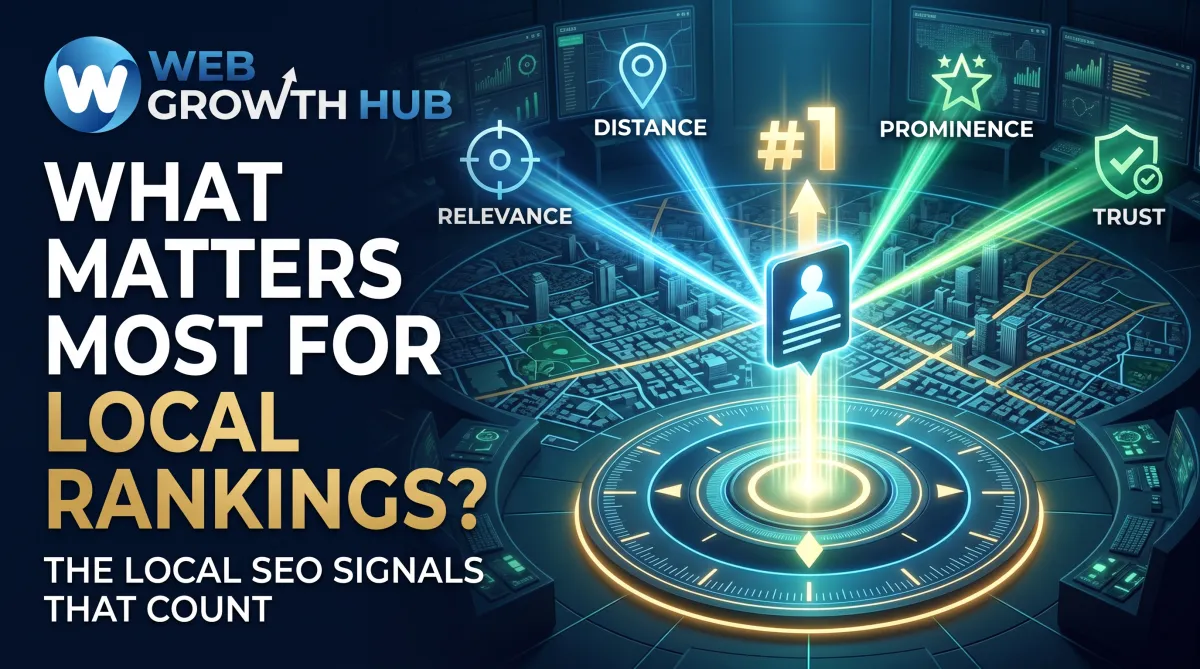
Google says local results are mainly based on relevance, distance, and prominence. These are the best framework for understanding local Google rankings.
Factor | What it means | How to think about it |
Relevance | How well your business matches the search | Is it clear that you provide the service the customer wants? |
Distance | How close you are to the searcher or searched location | Are your location or service-area details accurate? |
Prominence | How well-known and trusted the business appears | Do reviews, links, mentions, and customer experience support credibility? |
You can influence relevance and prominence substantially. Distance is partly outside your control because the same business may appear differently for searchers in different places. No ethical provider can guarantee a number-one position for every local search.
What Actually Matters Most for Local Google Rankings
1. A Complete and Accurate Google Business Profile
For many local businesses, the Google Business Profile is the most important starting point. Google says verification helps establish that the business is authorised to represent itself, and complete, accurate information helps it appear for relevant local searches.
Review your business name, address or service area, phone number, website, regular hours, holiday hours, description, booking links, and attributes. Remove outdated details and check the profile whenever the business changes.
Accuracy matters more than promotional language. Customers should understand what you do, where you operate, when you are available, and what to do next. Old numbers or incorrect hours create friction and weaken trust.
Google’s representation guidance also recommends using the real-world business name consistently, keeping the address or service area accurate, using the fewest appropriate categories, and avoiding multiple profiles for one business where they are not justified.
2. The Right Primary and Secondary Categories
Categories are among the clearest ways to tell Google what your business is. Your primary category should describe the core business accurately. Secondary categories should represent genuine additional services or business functions.
Do not choose categories simply because they have high search demand. An unrelated category may create temporary visibility for the wrong searches, but it can confuse customers, create poor experiences, and put the profile at policy risk.
A specialist optician should use the category that best describes the main business and add only genuinely offered services. A home-services company should distinguish its core trade from adjacent work.
Categories support relevance, but they do not replace good information. They work best alongside clear services, a useful description, accurate attributes, and a website that confirms what the business offers.
3. Genuine Customer Reviews and Professional Responses
Customer reviews help people decide whether to contact a business and can contribute to prominence. Google says more reviews and positive ratings can help local ranking. Treat reviews as more than a number.
Consider four dimensions:
•Quantity: A profile with a meaningful history of customer feedback may be more persuasive than one with only a few ratings.
•Quality: Detailed, experience-based reviews give potential customers useful information.
•Recency: Recent feedback shows that the business is active and serving customers now.
•Responses: Thoughtful replies show that the business listens and takes responsibility for the experience.
Request honest feedback after a completed service or purchase through a review link or QR code. Reviews must represent genuine experiences, and incentives for posting, changing, or removing reviews are prohibited.
Never buy reviews, write them for customers, pressure people to leave a particular rating, or hide negative experiences through review gating. These tactics damage credibility and create policy risk. A genuine review system creates a more durable trust asset.
4. Consistent Name, Address, and Phone Information
Your business information should tell the same story everywhere. Check your website, directories, industry profiles, social pages, local publications, and partner listings for consistent name, address, and phone details.
A previous address, old phone number, inconsistent business name, or conflicting opening hours can confuse customers and search platforms. This does not mean every punctuation difference causes a ranking problem. It means important facts should be accurate and recognisably the same.
Keep one master record of official details and update important listings after a move, rebrand, phone-number change, or service-area change. Prioritise reputable sources rather than hundreds of low-quality directories.
5. Website Relevance and Useful Local Content
Your profile may introduce the business, but your website often explains the offer and turns interest into an enquiry. It should clearly state what you do, who you help, where you operate, how to contact you, and what happens next.
Create useful service pages for commercially important work. Add local information about coverage, travel areas, project examples, or service limitations. Avoid near-identical location pages that only replace a town name.
Your website should be mobile-friendly, reasonably fast, accessible, and easy to navigate. A customer who cannot find the phone number or booking action may leave even if the profile earned the visit.
LocalBusiness structured data can help Google understand details such as business type, address, hours, and other information on an eligible page. Google recommends validating structured data and allowing time for crawling and re-indexing; it does not guarantee rankings or rich results.
6. Proximity to the Searcher
Distance is one of the core local ranking factors, but it is frequently misunderstood. A business cannot optimise its way into being physically closer to someone. Google considers the distance between the searcher and the business, or the location specified in the search.
A profile may appear strongly in one part of a town and less prominently several miles away. For service-area businesses, accurate service-area information sets expectations but does not create a physical presence everywhere.
Do not use a fake address, a virtual office that customers cannot visit, or a misleading service area to manipulate proximity. Honest location information protects the profile and gives customers a more reliable experience.
7. Authority Signals: Local Citations, Links, and Mentions
Prominence is partly about how well-known a business appears beyond its own profile. Google says information such as websites linking to the business and the number of reviews can contribute to local prominence.
Useful authority-building opportunities include reputable local citations, professional associations, trade directories, chambers of commerce, local news, genuine sponsorships, and partnerships. Relevant links can help people discover the business and reinforce its local connection.
Quality matters more than volume. Avoid paid link schemes, automated submissions, and low-quality directories. Build relationships that would still make sense without Google.
What Matters Less Than Most People Think
Some activities can be useful, but they are often given too much importance when the fundamentals are incomplete.
Exact Keyword Density
There is no useful target percentage for repeating a phrase across a profile or web page. Use natural language that explains the service. Keyword stuffing can make content harder to read and may look misleading, especially when it is inserted into a business name.
Minor Profile Tweaks
Changing a comma, rearranging a short description, or editing a small attribute may be appropriate, but these changes rarely compensate for an incomplete profile, weak reviews, incorrect categories, or poor customer experience.
Posting Frequency Alone
Google Posts and updates can keep a profile useful, but posting frequently by itself does not guarantee a higher Google Maps ranking. Prioritise accuracy and helpfulness over filling a calendar with repetitive content.
Small Metadata Changes Without Broader Improvements
Page titles, headings, and metadata should be clear and relevant, but a minor edit will not solve a website with thin service content, confusing navigation, slow mobile pages, or inaccurate contact details.
How to Prioritise Local SEO Efforts
Use an impact-first sequence. Fix issues that could prevent customers from finding or trusting the business before spending time on refinements.
1.Make the business eligible and accurate. Verify the profile and correct major information.
2.Clarify relevance. Choose accurate categories and describe the real services.
3.Build trust. Create a genuine review process and respond professionally.
4.Align the ecosystem. Make the website and local citations agree with the profile.
5.Strengthen prominence. Earn relevant links, local mentions, and community recognition.
6.Measure business outcomes. Track calls, direction requests, website visits, bookings, and leads.
7.Refine over time. Add useful content, photos, updates, and technical improvements after the foundations are sound.
What Matters Most: A Local Ranking Priority Checklist
High priority: do these first
•Claim and verify the Google Business Profile.
•Complete and update contact information, hours, address, or service area.
•Choose the most accurate primary and relevant secondary categories.
•Build a consistent system for earning genuine customer reviews.
•Respond to reviews professionally and consistently.
•Keep name, address, and phone information accurate everywhere.
Medium priority: do these next
•Add detailed services, products, attributes, and authentic photos.
•Create useful local content and service pages.
•Improve mobile usability, page speed, and clarity of offers.
•Build ethical local citations and relevant backlinks.
•Connect profile visitors to clear contact, booking, or quote actions.
Lower priority: do these over time
•Publish useful Google Posts and updates.
•Add more current photos and keep the profile active.
•Refine metadata and minor on-page SEO details.
•Test small improvements after measuring higher-impact work.
Common Mistakes That Waste Time and Hurt Visibility
The most damaging mistakes include keyword stuffing the business name, using an inaccurate address, claiming a misleading service area, creating duplicate profiles, choosing irrelevant categories, buying reviews, and ignoring customer feedback.
Do not expect immediate movement after every update. Local results vary by location and query, so compare meaningful periods and track business actions rather than checking one search repeatedly.
How Web Growth Hub Can Help
Businesses that want clarity on what matters most for local rankings can benefit from a focused local SEO strategy built around their profile, reviews, content, and customer journey. Web Growth Hub helps businesses organise these systems into a practical digital growth plan.
That may include Google Business Profile optimisation, review-generation workflows, local content, accurate listings, conversion tracking, and marketing follow-up. The goal is to improve visibility and customer acquisition without chasing every SEO rumour.
Conclusion: What Actually Matters Most for Local Google Rankings
The answer to what actually matters most for local Google rankings is not one hidden setting or a perfect keyword formula. The highest-impact work is making your business relevant, accurate, trusted, and genuinely connected to its service area.
Start with the Google Business Profile, categories, reviews, and consistent business information. Then improve your website, local content, mobile experience, citations, and authority. Treat posting frequency and minor metadata changes as supporting work, not substitutes for the fundamentals.
Local SEO is a process of building evidence that your business is the right match for a customer’s local search. If you need help turning your profile, reviews, website, and marketing workflows into one practical system, Web Growth Hub can help you plan the next step.


