


How to Outrank Local Competitors on Google: A Practical Local SEO Strategy
How to Outrank Local Competitors on Google: A Practical Local SEO Strategy
A potential customer searches for a service in your area. Google displays three local businesses at the top of the page, and the customer clicks one without scrolling further. Your business offers excellent service, but it appears below the map pack—or not at all.
Local rankings do not always reflect which business is “best” overall. They reflect the clearest signals for a particular search, location, and moment. If a competitor is more visible, study the gap and improve the signals Google and customers can evaluate rather than chasing a guaranteed position.
This guide explains how to outrank local competitors on Google through practical competitor analysis, stronger local SEO, better content, genuine reviews, accurate listings, and a more useful customer journey.
What Does It Mean to Outrank Local Competitors?
“Outranking” is not one permanent position. Local results change according to the searcher’s location, device, query, history, and intent. A business may rank first in Google Maps for “emergency plumber near me” from one neighborhood but appear lower several miles away. It may also rank well in organic search for a service page while a different business leads the Local Pack.
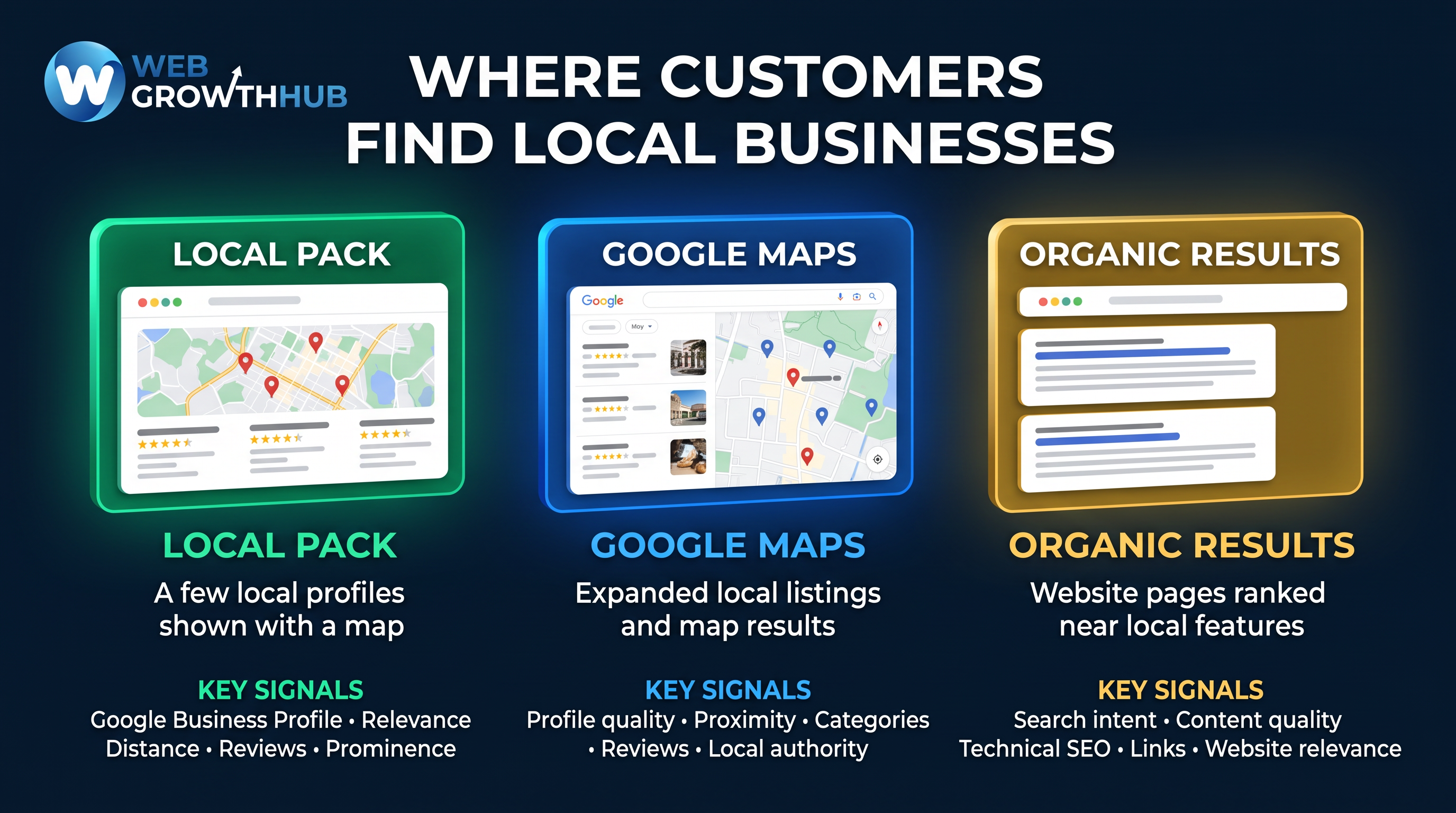
The objective is to improve visibility for valuable searches and turn it into calls, visits, enquiries, bookings, and directions.
Why Local Rankings Matter for Revenue
Local search often captures customers close to taking action. Someone searching for an accountant may be comparing firms, while someone searching for a garage open now may need help immediately. A clear profile improves your chance of earning action.
A higher position can increase profile views, calls, website clicks, directions, and enquiries. Ranking is only one part of the journey: a competitor may still win with clearer services, better photos, or faster response.
The Three Core Local Ranking Factors
Google states that local results are mainly based on relevance, distance, and prominence. These three factors provide a useful framework for understanding why a local competitor may appear above you.
Relevance
Relevance means how closely your business matches what the customer searched for. Google looks at information in your Business Profile, website, and other sources to understand your services and category.
If your profile says only “professional services” while your competitor clearly identifies specific services such as tax preparation, bookkeeping, and payroll support, the competitor may send a stronger relevance signal for those searches.
Distance
Distance refers to how far the business is from the searcher or the location included in the search. This is the factor you can influence least because you cannot move a legitimate business closer to every customer.
You can communicate your real service area accurately, keep your address current, and create useful location content for areas you genuinely serve. You should not use a false address, a virtual office that does not meet Google’s requirements, or duplicate listings to manipulate proximity.
Prominence
Prominence describes how well-known and trusted the business appears to be. Google notes that reviews and links from websites can contribute to prominence. Local mentions, reputable citations, positive customer experiences, and useful content can strengthen the overall picture.
Prominence is built through consistent activity and credibility, not a one-time trick. A competitor with years of genuine reviews and local mentions may have an advantage that takes time to close.
Start With Local Competitor Analysis
Before making changes, identify the businesses you are actually competing with online. The business closest to your premises may not be the business that outranks you. Search your most important services with your town, suburb, neighbourhood, and “near me” variations. Check Google Search and Google Maps from relevant locations.
Create a list of the three to five businesses that appear repeatedly. Record the keyword, location, result type, position, and search overlap. Results vary by location, so use a local rank tracker or compare several nearby points.
Ask: Where is their presence clearer, more credible, or more useful than mine?
Audit Your Google Business Profile Against Competitors
Compare your Google Business Profile with the profiles that consistently outrank you. Look at the following areas:
•Primary and secondary categories.
•Listed services and attributes.
•Business description and website link.
•Address, service area, phone number, and opening hours.
•Photos of the team, premises, products, vehicles, or completed work.
•Google Posts and meaningful updates.
•Review volume, average rating, recent reviews, and response quality.
•Booking, messaging, menu, product, or appointment features where relevant.
Google recommends verifying a profile, keeping business details complete and current, responding to reviews, and adding photos and videos. These actions also help customers decide whether to contact you.
Do not add unrelated categories or keywords to your business name. Use the real-world name of the business and choose only categories and services that accurately describe what you offer.
Improve Relevance for the Searches That Matter
Your profile and website should make the same clear promise. Choose priority searches based on customer intent and business value. A landscape gardener might target garden design, patio installation, and garden maintenance, while a law firm may need pages for major practice areas.
Update your Business Profile services and description using natural language. Then improve the corresponding website pages. Explain what the service includes, who it helps, how the process works, what areas you serve, and what the customer should do next.
Avoid repeating a keyword in every sentence. Search engines can understand related language, and customers quickly notice awkward writing. Clear explanations are more useful than keyword density.
Build Content Depth That Competitors Cannot Easily Copy
Study competitor websites for content gaps, not just word counts. Do they answer questions you ignore, show real projects, explain pricing, publish case studies, or address objections?
Create content from your actual experience, such as:
•Service guides that explain options and preparation.
•Local case studies with outcomes and practical details.
•FAQs based on questions your team receives.
•Comparisons that help customers choose between approaches.
•Maintenance or planning advice.
•Location pages that describe a genuine service connection to a town or neighborhood.
A page that only replaces a city name in a generic template is unlikely to be useful. Local content should explain something real about customers, properties, travel, or service conditions in that market.
Strengthen Reviews and Reputation
Customer reviews influence trust, conversions, and local prominence. Compare your review profile with recurring competitors, but do not focus only on the total number. Examine average rating, recency, detail, and the themes customers mention.
If competitors receive praise for punctuality, communication, and clear pricing, those themes may reveal what customers value in your market. Use the insight to improve operations—not to manufacture similar wording.
Build a simple, ethical review-generation workflow. Ask customers for honest feedback after a completed service, provide a direct link, and make the request easy to understand. Respond to positive and negative feedback professionally. Never buy reviews, write reviews yourself, selectively suppress genuine criticism, or pressure customers to leave a particular rating.
Improve the Distance Advantage You Can Control
You cannot change your physical location, but you can make your legitimate service coverage easier to understand. Set service areas accurately in your profile. Use location pages only for areas you genuinely serve and where you can provide useful information.
An appliance repair company might explain travel coverage and response expectations for nearby towns. A restaurant might focus on neighborhood access, parking, delivery zones, and local occasions.
Do not create dozens of thin pages for areas you do not serve. Misleading location signals may create poor customer experiences and undermine trust.
Build Prominence with Citations, Links, and Local Mentions
Local citations are mentions of your business details on directories, trade associations, chambers of commerce, review sites, and community pages. Audit your name, address, and phone number across important listings, correct outdated records, and remove duplicates where possible.
Backlinks are hyperlinks from other websites to yours. Relevant links from local publications, suppliers, associations, event pages, charities, and community organizations can support authority and referral traffic. Moz recommends focusing on websites relevant to both geography and niche.
Earn links through real activity: sponsor an appropriate community initiative, contribute expertise to a local publication, partner with complementary businesses, publish original research, or create a resource others can reference. Avoid automated backlink packages, private networks, and irrelevant directories.
Make the Website Faster and Easier to Use
A competitor may rank higher because its website communicates value more clearly and works better on mobile. Test your site as a customer would. Can someone find the service, understand the offer, trust the business, and submit an enquiry quickly?
Check page speed, mobile layout, HTTPS, forms, phone links, navigation, broken links, and intrusive pop-ups. Use clear page titles, headings, internal links, descriptive URLs, compressed images, and strong calls to action. Technical SEO does not replace useful content, but technical problems can prevent customers and search engines from accessing it properly.
Use Customer Behavior as a Diagnostic Tool
Track profile views, website clicks, phone calls, direction requests, bookings, and enquiries. These actions help reveal whether your visibility is attracting the right audience and whether the customer journey is working.
If your competitor receives more calls despite similar rankings, inspect the listing experience. Perhaps its services are clearer, reviews address common concerns, photos show the work better, or the business responds faster. Improve the reason customers should choose you rather than attempting to manipulate one isolated signal.
A Simple Local Competitor Outranking Checklist
Use this checklist to turn competitor analysis into an ongoing process:
1.Identify your top three to five competitors in Google Search and Maps.
2.Record the searches, locations, result types, and recurring competitors.
3.Compare categories, services, profile completeness, photos, posts, and attributes.
4.Compare review count, rating, recency, themes, and responses.
5.Audit website speed, mobile usability, service clarity, and calls to action.
6.Compare local keywords, service pages, FAQs, case studies, and location content.
7.Complete and accurately update your own Google Business Profile.
8.Create a consistent, ethical review-generation process.
9.Standardize your name, address, and phone number across key citations.
10.Improve useful local content and internal linking.
11.Earn relevant links and mentions through partnerships and community activity.
12.Track rankings, profile actions, calls, directions, leads, and conversions monthly.
13.Run a deeper competitor review each quarter and adjust priorities.
Common Mistakes That Keep Businesses Behind
The biggest mistake is treating local SEO as a checklist completed once. Competitors publish content, earn reviews, change services, and improve their websites.
Other common errors include copying a competitor’s wording, targeting every possible location, using the wrong Google Business Profile category, adding keywords to the business name, ignoring negative reviews, allowing inconsistent directory information, and measuring only one ranking screenshot.
Do not buy reviews or links. Do not use a false address, hidden text, misleading content, or spammy location pages. These shortcuts do not create the trust required for sustainable business visibility.
How Web Growth Hub Can Help
Businesses that want a clearer path to outranking local competitors can benefit from a local SEO strategy built around their profile, reviews, content, and customer journey. Web Growth Hub helps businesses organize these systems into a practical digital growth plan.
This may include Google Business Profile optimization, competitor analysis, review workflows, local content, website improvements, and marketing workflows. The purpose is to identify valuable gaps, improve the customer experience, and build visibility over time—not promise a fixed ranking.
Conclusion: How to Outrank Local Competitors on Google
Learning how to outrank local competitors on Google starts with studying the market accurately. Identify the businesses that appear for your highest-value searches, compare their profiles and websites, and look for gaps in relevance, prominence, customer experience, and local coverage.
You cannot control every factor—especially the searcher’s distance—but you can make your services clearer, earn genuine reviews, improve your website, maintain accurate listings, publish useful local content, and build credible relationships that lead to mentions and links.
Start with the checklist and focus on a few high-impact improvements rather than trying to change everything at once. If you want support organizing local SEO, review systems, content strategy, and digital growth workflows, explore how Web Growth Hub can help you build a practical plan.


