

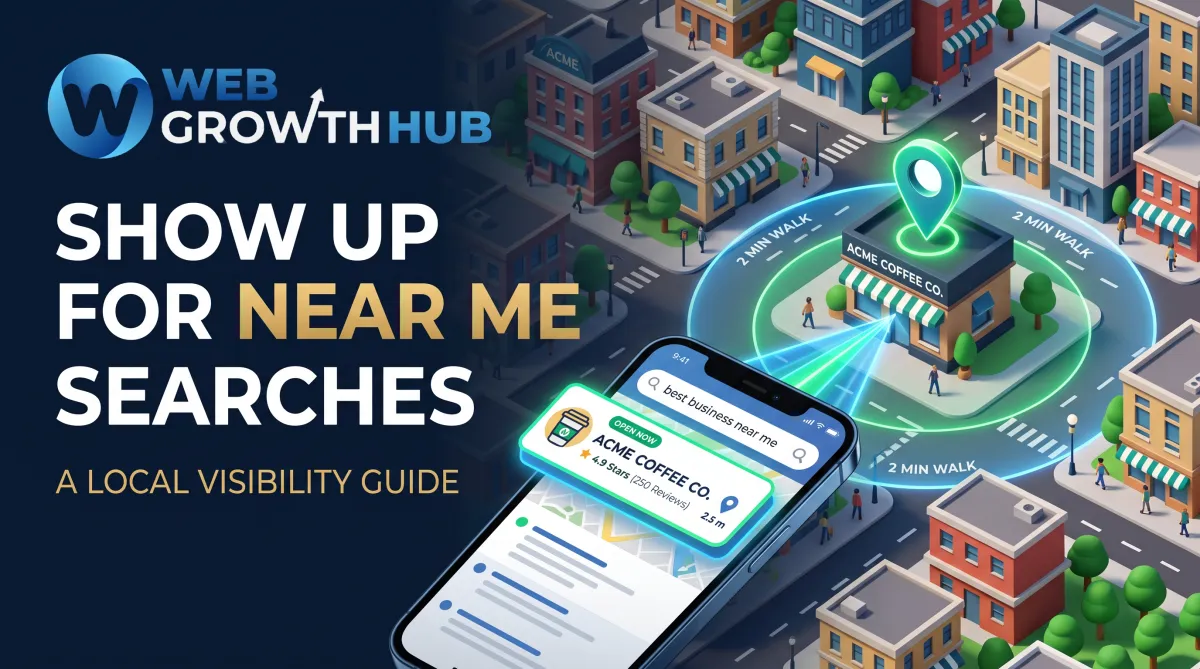
How to Get Your Business to Show Up When Someone Searches “Near Me”
How to Get Your Business to Show Up When Someone Searches “Near Me”
A customer pulls out their phone, searches for a service “near me,” and chooses one of the first local results without scrolling very far. If your business does not appear, you may be invisible to nearby customers even when your shop, office, or service area is only a few minutes away.
This is why near me searches matter. They often happen when someone is ready to visit, call, book, or buy. The good news is that appearing in these searches is not based on luck alone. Google evaluates whether your business is relevant to the query, close enough to the searcher, and prominent enough to trust.
This guide explains how to get your business to show up when someone searches “near me”. You will learn how Google evaluates local businesses, how to improve your Google Business Profile, why reviews and consistent information matter, and how your website and customer experience support local visibility.
What “Near Me” Searches Are and Why They Matter
A “near me” search is a local-intent query, such as “plumber near me” or “coffee shop near me.” The words do not need to appear on your website; they tell Google that location should influence the results.
Google can also understand local intent when a searcher types a town, postcode, neighbourhood, or service without “near me.” Results may appear as map listings, the local pack, or organic pages.
This visibility reaches people at the moment of need. A strong listing can provide directions, calls, hours, photos, reviews, booking links, and a website visit.
How Google Decides Which Businesses to Show
Google says local results are mainly based on relevance, distance, and prominence. These factors work together rather than operating as a simple checklist.
Local factor | What it means | What you can improve |
Relevance | How well your profile matches what the searcher wants | Categories, services, description, website content, and accurate details |
Distance | How far the business is from the searcher or the location in the query | Accurate address or service area; realistic expectations about coverage |
Prominence | How well-known and trusted the business appears | Reviews, links, citations, local content, activity, and customer experience |
Relevance
Google needs to understand what you do. A complete profile with an accurate primary category, appropriate secondary categories, service details, attributes, and a clear description gives Google more context.
Relevance does not mean adding every possible category or repeating keywords unnaturally. Choose the fewest categories that accurately describe your core business. Use normal language to explain your services, who you help, and the areas you genuinely serve.
Distance
Distance is largely determined by the searcher’s location and the location Google associates with your business. You cannot make a business appear equally close to every searcher, and no legitimate optimisation can guarantee visibility in every neighbourhood.
A physical business should publish its accurate address. A service-area business should define its service area honestly and follow Google’s eligibility and representation rules. Do not create false addresses or virtual locations simply to appear closer.
Prominence
Prominence reflects how established and recognised a business appears. Google notes that signals can include links from other websites, review quantity, and positive ratings. This is where local SEO becomes a long-term business activity rather than a one-time profile edit.
How Google Business Profile Affects Near-Me Visibility
Your Google Business Profile is one of the most important assets for local search. Google says verified businesses are more likely to show in results, while complete and accurate information helps customers understand what the business does, where it is, and when it is open.
Work through these areas carefully:
Complete and Accurate Information
Add your real business name, address or service area, phone number, website, opening hours, holiday hours, business description, and booking or service links. Check the profile whenever your details change.
Your information should agree with the rest of your digital presence. Google recommends representing the business consistently, keeping the address or service area accurate, and maintaining one profile per business where appropriate.
Categories, Services, and Attributes
Your primary category should describe the main business, not a keyword you wish to rank for. Add relevant services and attributes that help customers understand what you offer. A home renovation company, for example, may need to distinguish between kitchen renovations, bathroom renovations, extensions, and general building work if those services are genuinely provided.
Photos and Videos
High-quality photos show that the business is active and help customers make a decision. Add images of the premises, team, products, completed work, vehicles, or service process, depending on your business model. Keep them accurate and current rather than relying on generic stock photography.
Posts and Updates
Use profile updates to share useful news, seasonal information, events, new services, and practical advice. Posts are not a shortcut to a higher position, but they can keep the profile informative and give customers another reason to choose you.
Why Reviews Matter for Local Searches
Reviews influence both customer confidence and local prominence. Google states that more reviews and positive ratings can help a business’s local ranking. A healthy review profile also gives potential customers evidence that real people have used the business.
Focus on four qualities:
•Quantity: A meaningful volume of genuine reviews gives customers more evidence than a profile with only one or two ratings.
•Quality: The overall rating matters, but detailed experiences are often more useful than one-word comments.
•Recency: A steady flow of recent feedback shows that the business remains active.
•Responses: Helpful responses demonstrate that the business pays attention to customer feedback.
Ask customers at a natural point after a completed purchase or successful service. Provide a direct review link, explain that honest feedback is welcome, and avoid buying reviews, offering incentives in exchange for ratings, or telling customers exactly what to write. Genuine review generation is safer and more valuable than a sudden, artificial increase.
Keep Your Business Information Consistent Across the Web
Your business name, address, and phone number—often called NAP information—should be consistent across your website, directories, social profiles, industry listings, and local publications.
Small formatting differences are not always serious, but significant conflicts create uncertainty. An old phone number, previous address, inconsistent hours, or different business names can weaken trust.
Create a master record of your official details. Review important listings periodically and update them after a relocation, rebrand, change of number, or change in service area.
How Your Website Supports “Near Me” Rankings
Your Business Profile and website should reinforce one another. A profile may earn the click, while the website answers the customer’s questions and creates the conversion.
Make sure your website has:
•A clear page for each important service.
•Accurate contact details and opening hours.
•A contact, booking, or quote action that is easy to find on mobile.
•Useful local information where it genuinely helps the customer.
•Testimonials or case studies presented honestly.
•Internal links between service, location, and contact pages.
•Fast, accessible, mobile-friendly pages.
Create location pages only when you can provide genuinely useful information for each location. Copying the same page and swapping town names can create a poor experience and may not help visibility. Explain the areas you serve, the problems you solve, travel expectations, local project examples, or service limitations.
You can also use LocalBusiness structured data to provide search engines with information such as business type, address, phone number, hours, and other details. Google recommends validating structured data and allowing time for crawling and re-indexing; structured data supports understanding but does not guarantee a ranking or rich result.
Citations, Directories, and Local Links
Local citations are mentions of your business in directories, trade associations, chambers of commerce, review platforms, and relevant local websites. They can support prominence when the source is reputable and the information is accurate.
Prioritise quality over quantity. A small number of trusted, relevant listings is more useful than submitting your details to hundreds of low-quality directories. Look for opportunities such as:
•Local business associations.
•Professional or trade directories.
•Community organisations.
•Sponsorships with a genuine local connection.
•Local news, events, or partnership pages.
•Supplier and professional network profiles.
A relevant local backlink can also help people discover your business and provide context about your area and expertise. Do not pay for schemes that promise guaranteed local rankings or create links solely to manipulate search results.
How Customer Behaviour Influences Local Visibility
Customers interact with your listing in ways that reveal whether it is useful. They may click to your website, call, request directions, view photos, read reviews, or save the business. These actions are not a formula you can manufacture, but they are a reason to improve the customer journey.
Make the profile accurate enough that the right customer wants to act. Use a phone number that is answered, keep hours current, show useful photos, provide booking information, and make the website easy to use. Local search optimisation works best when it improves the real experience rather than attempting to create artificial signals.
Common Mistakes That Hurt “Near Me” Visibility
•Creating a fake office, virtual location, or duplicate profile.
•Adding locations that the business does not genuinely serve.
•Stuffing keywords into the business name.
•Choosing categories that do not accurately represent the business.
•Leaving hours, phone numbers, or service links out of date.
•Ignoring legitimate customer reviews.
•Buying or incentivising reviews.
•Using duplicate or thin location pages.
•Relying on one profile edit and expecting instant results.
•Treating local SEO as separate from customer service.
Google’s guidelines require businesses to represent themselves accurately and warn that policy violations can lead to changes, removal, or suspension of business information.
A Simple “Near Me” Visibility Checklist
Use this checklist monthly or whenever your business changes:
•Claim and verify your Google Business Profile.
•Choose the most accurate primary and secondary categories.
•Write a clear, natural, keyword-aware business description.
•Add accurate hours, phone number, address, and service areas.
•Add relevant services and attributes.
•Upload current photos of your business, team, products, and work.
•Publish useful updates when you have news, events, or seasonal information.
•Encourage genuine customer reviews and respond consistently.
•Keep your business name, address, and phone number consistent across the web.
•Check important directories and local citations for outdated details.
•Build service and location content that is genuinely useful.
•Make sure your website works well on mobile and has clear contact actions.
•Monitor calls, website visits, direction requests, reviews, and profile insights.
•Improve the customer experience rather than trying to manipulate rankings.
How Web Growth Hub Can Help
Businesses that want a clearer path to appearing in “near me” searches can benefit from a local SEO strategy built around their profile, reviews, content, and customer journey. Web Growth Hub helps businesses organise these systems into a practical digital growth plan.
That may include Google Business Profile optimisation, review-generation workflows, local content, consistent business information, conversion tracking, and follow-up automation. The aim is not to promise a particular position. It is to build a reliable foundation that makes the business easier to understand, easier to trust, and easier for nearby customers to contact.
Conclusion: How to Get Your Business to Show Up When Someone Searches “Near Me”
The practical answer to how to get your business to show up when someone searches “near me” is to make your business the clearest, most accurate, and most trustworthy match for the customer’s local intent.
Start with a verified and complete Google Business Profile. Strengthen relevance with accurate categories and services, support prominence with genuine reviews and relevant local references, and make distance information honest. Then connect the profile to a useful, mobile-friendly website and a customer experience that earns real engagement.
Local visibility is built over time, not guaranteed by a single trick. If you want help organising your Google Business Profile, review system, local content, and follow-up workflows, explore how Web Growth Hub can support your next stage of digital growth.


