

How to Get Your Business on the First Page of Google
How to Get Your Business on the First Page of Google: A Realistic SEO Roadmap
A potential customer searches for the service you provide. Google displays a page of results, and they click one of the first few businesses they see. They may never reach page two, browse through every directory listing, or search your company name separately. If your business is not visible near the top, the customer may choose a competitor before discovering what you offer.
That is why so many owners want to know how to get your business on the first page of Google. The answer is not a secret setting, a single keyword, or a guaranteed ranking package. First-page visibility is built over time through relevance, trust, useful content, local presence, and a technically sound website.
This guide explains the realistic paths to better visibility in Google Search and Google Maps. It also provides a practical roadmap you can use to decide what to improve first—without relying on vague promises or shortcuts that could damage your website.
What Does “First Page of Google” Actually Mean?
The first page can look different depending on the search, the searcher’s location, the device being used, and the intent behind the query. For a local business, there are three important areas to understand.
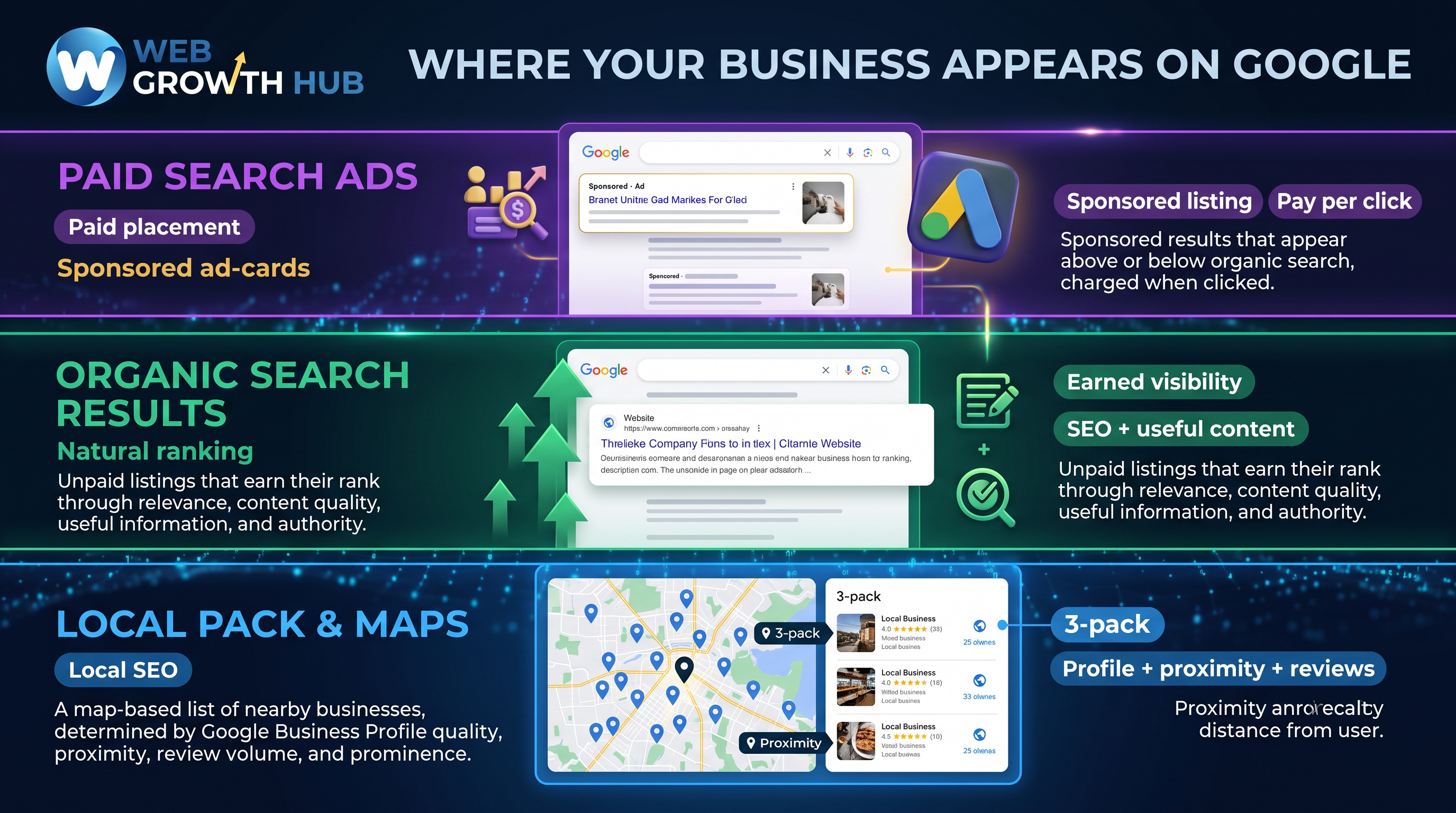
These areas can work together, but they are not interchangeable. Paid advertising can provide immediate exposure, yet visibility usually stops when the budget stops. Organic search and local SEO take longer to build, but they create long-term digital assets that can continue attracting customers.
Google explains that it does not accept payment to crawl websites more frequently or rank organic pages higher [1]. That means no legitimate provider can guarantee a first-page position for every keyword. The goal is to build a stronger, more relevant presence than competing pages and profiles over time.
Why First-Page Visibility Matters for Business Growth
Search visibility matters because it places your business in front of people who are already looking for an answer, product, or service. Someone searching “emergency electrician near me” has a different level of intent from someone casually browsing a social media post.
A stronger position can increase website visits, phone calls, direction requests, enquiries, bookings, and store visits. However, ranking alone is not the goal. A page that ranks for an irrelevant keyword may generate traffic without producing customers. The best SEO strategy targets searches that match your services, location, and customer journey.
How Google Decides What to Show on the First Page
Google uses automated systems that evaluate many signals across pages and websites. Its process begins with crawling, where Google discovers and retrieves content. It then indexes content by analyzing text, media, metadata, and structure. Finally, it serves results that it considers relevant and useful for a specific search.
This has two practical implications. First, Google must be able to access and understand your website. Second, your page must give searchers a better answer than the alternatives. Important signals may include relevance to the query, content quality, links, usability, freshness where appropriate, originality, location, device, and trust.
For local search, Google identifies three central factors: relevance, distance, and prominence. Relevance means how closely your business matches the search. Distance refers to how near you are to the searcher or the location in the query. Prominence reflects how well-known and trusted your business appears online and in the real world.
Step 1: Choose the Right Keywords and Search Intent
Before optimizing a page, decide what search it should serve. Start with the language customers use when they describe their problem—not necessarily the internal wording your business uses.
For example, a roofing company may offer “residential exterior restoration,” while customers search for “roof repair in [city].” The customer’s phrase is usually the stronger starting point for keyword research.
Then identify the intent behind each query:
•Informational intent: The searcher wants to learn, such as “how often should a roof be inspected?”
•Commercial intent: The searcher is comparing options, such as “best roofing companies in [city].”
•Transactional intent: The searcher is ready to act, such as “hire a roofer near me.”
•Navigational intent: The searcher wants a specific business or website.
Map each important keyword to the page that best satisfies it. A service page should target a service decision. A guide should answer a question. A location page should explain how you serve that area. Avoid creating several thin pages that target nearly identical phrases; they can confuse users and dilute your website’s structure.
Step 2: Improve Your Website’s On-Page SEO
On-page SEO helps people and search engines understand what each page is about. It should clarify the page’s purpose without making the writing unnatural.
Start with your page title. Make it specific, accurate, and useful. Include the primary topic naturally, preferably near the beginning. Your meta description should summarize the benefit of the page and give searchers a reason to choose it. Google may rewrite descriptions, and meta descriptions are not a direct ranking guarantee, but a clearer search snippet can improve click-through rate.
Use one clear H1 heading, followed by logical H2 and H3 sections. Organize the page around the questions customers are likely to ask. Keep URLs short and descriptive, using hyphens rather than long strings of numbers or unnecessary words.
Internal links are also important. Link from helpful articles to relevant service pages, from service pages to related services, and from location pages to useful customer resources. Descriptive link text helps users understand where a link leads and helps Google interpret relationships between pages.
Images should be compressed so they do not slow the page. Use descriptive filenames and accurate alt text when the image communicates useful information. Do not treat alt text as a place to insert a list of keywords; describe the image for accessibility and context.
Step 3: Create Content Customers Actually Need
Publishing content does not automatically improve Google rankings. Content works when it solves a real problem, demonstrates experience, and helps someone make a decision.
Look at questions your sales team hears, objections that delay purchases, mistakes customers make, and issues that require explanation. Turn those insights into practical guides, comparisons, checklists, case examples, FAQs, and maintenance advice.
For example, a cleaning company could publish “How Much Does a Deep Clean Cost in [City]?” and explain what affects pricing, what is included, how long it takes, and what customers should prepare. This is more useful than repeating the phrase “best cleaning company” throughout a generic article.
Build topical depth gradually. One comprehensive guide supported by several focused articles can create a more useful content structure than dozens of unrelated posts. Refresh important content when services, prices, regulations, products, or local conditions change.
Step 4: Strengthen Your Local SEO Presence
If your business serves a specific area, local SEO can be one of the fastest ways to improve relevant search visibility. Begin with a complete and verified Google Business Profile.
Use the most accurate primary category and relevant secondary categories. Add your services, operating hours, service area, phone number, website, attributes, and a clear description. Keep the information accurate, especially during holidays or changes to your location.
Customer reviews can support local prominence, particularly when they are genuine, recent, and reflect real customer experiences. Ask satisfied customers for feedback after a completed job, make the process easy, and respond professionally to both positive and negative reviews. Never buy reviews, write reviews for yourself, or pressure customers to use specific wording.
Check your business information across important directories, industry associations, chambers of commerce, and social profiles. Consistent name, address, and phone details help reinforce trust. Prioritize quality and relevance over submitting your business to hundreds of low-value directories.
Step 5: Fix Technical SEO and Website Experience
A strong strategy can underperform if Google cannot reliably crawl, index, or use your website. Check that important pages are not blocked by robots.txt or noindex instructions. Submit an XML sitemap through Google Search Console and review indexing reports for errors.
Your website should work well on mobile devices, load efficiently, and use HTTPS. Test forms, menus, phone links, and booking tools on an actual phone. Remove broken links, duplicate pages, confusing redirects, and unnecessary pop-ups.
Technical SEO is not about chasing a perfect score. It is about removing barriers that prevent customers and search engines from accessing your content. Prioritize pages that generate leads or support important commercial searches.
Step 6: Build Authority Through Ethical Links and Brand Signals
Links from other relevant, trustworthy websites can help Google understand that your business is credible. The best links are earned naturally through useful resources, local partnerships, industry contributions, community involvement, original research, and newsworthy activity.
A local service provider might earn mentions from a chamber of commerce, community organization, supplier, local publication, or professional association. An e-commerce brand might publish original product research that other sites want to reference.
Avoid buying spammy backlink packages, using automated link networks, or publishing low-quality guest posts solely to insert a keyword-rich link. Sustainable authority comes from being genuinely useful and visible in the communities your customers trust.
Step 7: Improve Click-Through Rates From Existing Impressions
You may already be appearing in Google Search but receiving fewer clicks than expected. Use Google Search Console to compare impressions, clicks, average position, and click-through rate for important queries.
If a page receives impressions but few clicks, test a clearer title, a stronger benefit, or a more specific description. For a service page, “Same-Day Boiler Repair in Manchester | Call for Availability” may communicate value more clearly than “Our Services.” Keep the wording accurate and avoid clickbait. Better clicks are valuable only when the landing page fulfills the promise made in the search result.
A Simple First-Page Roadmap
Use the following sequence to turn broad SEO advice into a manageable plan.
Step 1: Audit your current visibility
Search your priority services and locations. Review your website, Google Business Profile, listings, mobile experience, and current rankings. Set up Google Search Console and analytics if they are not already in place.
Step 2: Identify priority keywords
Choose a small group of realistic phrases based on customer intent, location, business value, and competition. Start with specific service, product, and local searches rather than trying to rank immediately for broad national terms.
Step 3: Optimize key pages
Improve titles, descriptions, headings, URLs, copy, images, calls to action, and internal links on your most commercially important pages.
Step 4: Publish genuinely useful content
Answer real customer questions with original examples, practical explanations, and clear next steps. Link each piece of content to the relevant service or product page.
Step 5: Strengthen local signals
Complete your Google Business Profile, correct inconsistent listings, add relevant photos, earn genuine customer reviews, and publish useful local content.
Step 6: Improve technical performance
Fix crawl issues, broken links, mobile usability problems, security warnings, slow-loading assets, and confusing site structures.
Step 7: Earn authority
Develop relationships with relevant local organizations, suppliers, publications, and industry partners. Create resources worth mentioning rather than pursuing volume for its own sake.
Step 8: Measure and refine
Review performance monthly. Keep what works, improve pages that are gaining impressions, and investigate pages that remain invisible after technical and content checks.
How Long Does It Take to Reach the First Page?
There is no universal timeline. A local business may see movement for low-competition searches within weeks after fixing an incomplete profile or correcting a major technical issue. A new website competing for national, high-volume keywords may need much longer.
A practical benchmark is three to six months for measurable organic progress, with early work focused on research, technical fixes, content, and local foundations [4]. More competitive terms can take six to twelve months or longer. Your domain history, competition, content quality, authority, resources, and consistency all influence the pace.
Measure progress beyond a single ranking position. Growing impressions, more keywords in the top 20, improved local actions, qualified organic traffic, phone calls, leads, and revenue are all useful indicators. Rankings can fluctuate by location, device, and personalization, so evaluate trends rather than one isolated search.
Common Mistakes That Keep Businesses Off the First Page
The most damaging mistakes are usually strategic rather than complicated. Businesses often target keywords that are too broad, publish thin content, ignore search intent, leave their Google Business Profile incomplete, or fail to maintain accurate business information.
Other risks include keyword stuffing, hidden text, copied content, fake reviews, misleading location pages, spammy backlinks, and making promises the page cannot support. These tactics may create temporary movement, but they do not build trust and can create lasting problems.
How Web Growth Hub Can Help
Businesses that want a clearer path to first-page visibility can benefit from an SEO strategy built around their website, content, local presence, and customer journey. Web Growth Hub helps businesses organize these systems into a practical digital growth plan.
That may include local SEO, Google Business Profile support, website optimization, content strategy, review workflows, lead response systems, and ongoing performance tracking. The goal is not to promise a shortcut. It is to create a repeatable system that makes your business easier to find, understand, and trust.
Conclusion: Build Your Way to the First Page
Learning how to get your business on the first page of Google starts with realistic expectations. There is no guaranteed formula, but there is a reliable direction: match the right search intent, improve your website, publish content that helps customers, strengthen your local presence, earn genuine authority, and measure progress consistently.
Start with the audit and roadmap above. Fix the highest-impact issues first, then keep improving one page, profile, and customer touchpoint at a time. If you want support building a sustainable SEO and digital growth system, explore how Web Growth Hub can help turn your search visibility goals into a practical plan.


