

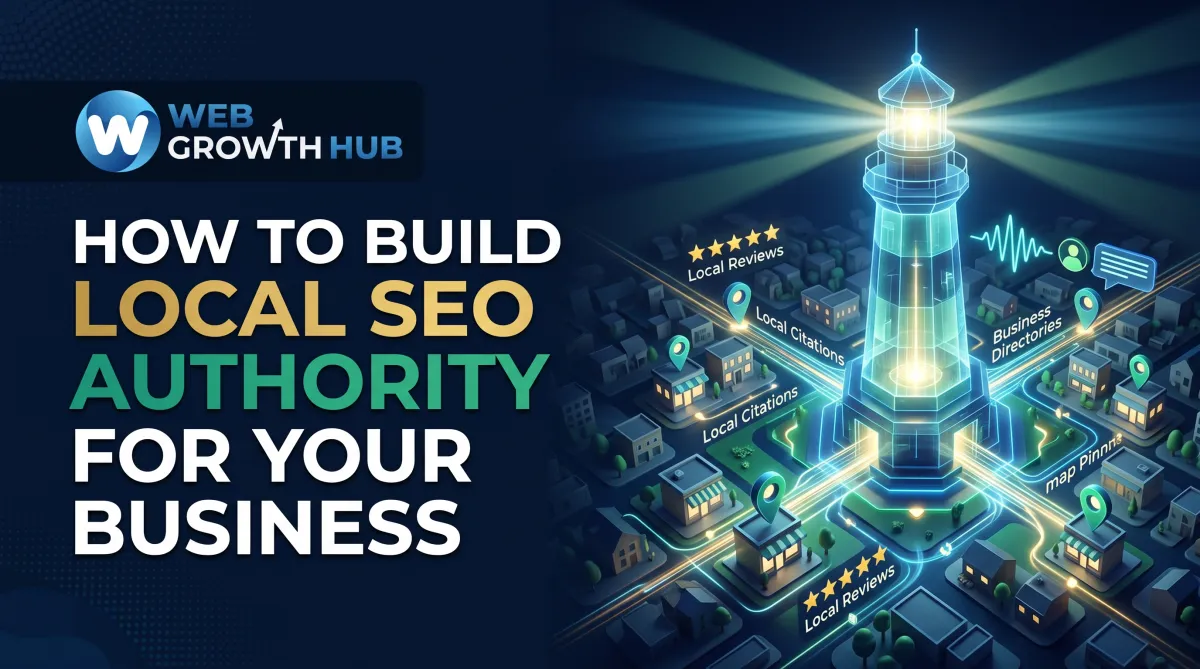
How to Build Local SEO Authority for Your Business
How to Build Local SEO Authority for Your Business
Two businesses offer the same service in the same town. Both have capable teams, fair prices, and satisfied customers. Yet one appears repeatedly in Google Search and Google Maps, receives more calls, and is often the first name customers mention. The other is difficult to find unless someone searches for its exact business name.
That difference is rarely luck. It is usually local SEO authority: evidence that helps Google and customers understand who a business serves, what it does, where it operates, and whether people trust it.
Authority does not come from keyword stuffing or random directory links. It comes from accurate information, useful content, genuine customer experiences, and consistent activity. This guide explains how to build local SEO authority for your business, even in a competitive market.
What Is Local SEO Authority?
Local SEO authority is the strength and credibility of your business across the online places customers use to make decisions. Those places include Google Business Profile, Google Maps, your website, review platforms, local directories, social profiles, and relevant community or industry websites.
A business with strong local authority sends a consistent message everywhere: it is real, relevant to local searches, recognized by customers and reputable organizations, and easy to understand and contact.
Google does not publish a single “authority score” for local businesses. Instead, it evaluates many pieces of information to decide which businesses best match a search. Strong authority improves your chances of being considered for the local pack, Google Maps results, and location-based organic searches. It can also improve business visibility before a customer ever visits your website.
Authority is not a one-time project. It grows as your information, reputation, content, and customer experience reinforce one another.
How Google Evaluates Local Businesses for Trust and Relevance
Google’s official local ranking guidance groups the main factors into relevance, distance, and prominence. These factors work together to identify the best match for a particular search.
Relevance asks whether your business matches what the customer is looking for. A complete profile, accurate category, detailed services, and useful website pages help Google understand that match.
Distance considers how far each potential business is from the searcher or the location included in the query. You cannot completely control this factor. A business in one neighborhood may naturally be more visible to a searcher nearby than an equally good business across the city.
Prominence describes how well-known a business appears to be. Google says prominence can be influenced by information such as reviews and links from other websites. More positive reviews and credible references can help establish that a business is recognized in its market.
This explains why there is no reliable tactic that guarantees a number-one Google Maps ranking. A business can improve relevance and prominence, but it cannot move its physical location closer to every searcher. Google also says businesses cannot request or pay for a better organic local ranking.
How to Build Local SEO Authority for Your Business Through Google Business Profile
Your Google Business Profile is often the first impression a customer receives. It can appear when people search for your business, your services, or local phrases such as “plumber near me.” A neglected profile creates uncertainty. A complete and accurate profile makes the business easier to understand and contact.
Start by claiming and verifying the profile, using the real-world business name, choosing the most accurate primary and secondary categories, and adding a correct address or service area. Complete hours, contact details, services, products, and useful attributes such as accessibility or parking. Google’s guidelines emphasize accurate representation and the fewest categories needed to describe the core business.
Add authentic photos and videos of the storefront, team, completed work, products, equipment, or service experience. Real images are more useful than generic stock photography.
Google specifically recommends complete information, review responses, and photos as ways to improve a Business Profile and help customers understand the business. Posts and updates can also keep customers informed about seasonal services, new offerings, events, or practical announcements. Treat these updates as customer communication, not as a place to repeat keywords.
A monthly routine is enough: review hours and services, add photos, check questions, and publish useful updates.
Build Authority Through Customer Reviews
Reviews are both a reputation asset and a source of first-hand information for prospective customers. They help people compare businesses and can contribute to the prominence of a local listing. Google also states that reviews must reflect genuine experiences and prohibits incentives offered in exchange for reviews or review changes.
Focus on a sustainable review system rather than a short-term request for a large number of ratings. After a completed job, purchase, appointment, or project milestone, send a polite message with a direct review link. Make the request easy to complete, but do not tell the customer what rating or wording to use.
For example:
Thank you for choosing [Business Name]. If you have a moment, we would appreciate an honest review of your experience on Google: [review link]. Your feedback helps us improve and helps future customers make an informed decision.
A strong review process asks eligible customers consistently, encourages honest and specific feedback, continues over time, and includes professional responses.
Google recommends keeping review replies short, relevant, conversational, and non-promotional. For negative reviews, protect the customer’s privacy, acknowledge valid concerns, apologize when appropriate, and invite the person to continue the conversation privately.
Do not buy reviews, ask staff or friends to pose as customers, offer discounts for positive feedback, or pressure customers to remove criticism. Those tactics weaken trust and may violate platform policies. A balanced review profile is more credible than an artificially perfect one.
Build Authority Through Your Website
Your website gives Google and customers a deeper explanation of your business than a profile can provide. It should make three things immediately clear: what you offer, where you offer it, and why a customer should contact you.
Create a clear page for each important service. A service page should explain the problem it solves, who it is for, what the process involves, the areas served, and how to take the next step. Avoid creating dozens of nearly identical pages that change only the city name. That approach can create a poor user experience and thin, repetitive content.
If you serve multiple locations, create location pages only when you can provide genuinely useful local information. A useful page might describe the neighborhoods served, access considerations, common local needs, project examples, travel expectations, or service availability. Each page should stand on its own for a customer who has never visited your website.
Use on-page SEO to improve clarity rather than to repeat phrases. Include the main service and location naturally in the page title, heading, introduction, URL, image descriptions, and internal links when appropriate. Add a clear phone number, contact option, service area, and calls to action that work well on mobile devices.
Technical quality supports authority because it affects whether people can use the site and whether search engines can understand it. Check that pages load reliably, work on mobile screens, use HTTPS, have descriptive titles, avoid broken links, and are not blocked from crawling or indexing. Google’s SEO guidance emphasizes useful, unique, well-organized, people-first content and explains that search improvements can take weeks or months to become visible.
For a physical location, consider accurate LocalBusiness structured data on the relevant page. It can help Google understand business details, but it does not guarantee a rich result or higher ranking and must match visible information.
Build Authority Through Citations and Local Backlinks
A local citation is an online mention of your business name, address, and phone number. Citations may appear in directories, maps, social platforms, industry websites, and local publications. Consistent citations help customers find accurate information and help search engines connect references to the correct business.
Begin with the listings that matter most to your customers and industry, including Google, Apple Maps, Bing, major review sites, chamber or professional association directories, and respected local platforms. Correct old addresses, phone numbers, hours, duplicate profiles, and inconsistent business names.
Then pursue local backlinks and mentions through legitimate relationships. Join a relevant association, partner with complementary businesses, sponsor a community event, provide expert commentary to a local publication, or contribute a useful local guide to a neighborhood organization.
A link from a relevant local organization can be more meaningful than hundreds of unrelated directory links. Google’s SEO guidance also recommends linking to relevant resources and using descriptive link text so users and search engines understand the destination.
Do not create fake locations, pay for deceptive links, or join networks designed only to manipulate rankings. Local authority is stronger when the references reflect real relationships and real community involvement.
How Customer Behavior Signals Authority
People reveal a great deal about local visibility through what they do next. They may open a listing, call, request directions, visit a website, book an appointment, or leave after discovering that the information is unclear.
These actions are useful business signals because they show whether your listing and website satisfy the customer’s intent. For example, a high number of profile views with very few calls may indicate that the phone number is hard to find, the service description is unclear, or the offer does not match the search. A directions request followed by repeated questions about parking may reveal a missing profile attribute or weak location instructions.
Do not assume every click or call is a confirmed ranking factor. Use Business Profile data, Search Console, call tracking, appointment records, and customer feedback to identify gaps, then improve the information customers rely on.
A Simple Local SEO Authority Checklist
Use this checklist as a practical starting point:
•Claim, verify, and fully complete your Google Business Profile.
•Choose the most accurate primary and secondary categories.
•Add accurate services, products, attributes, hours, and business information.
•Upload high-quality, authentic photos of your team, location, products, and work.
•Build a consistent system for asking eligible customers for genuine reviews.
•Respond to positive and negative reviews professionally and consistently.
•Keep your business name, address, and phone number consistent across your website and important directories.
•Create useful service pages, location pages, and local FAQs.
•Improve website speed, mobile usability, security, navigation, and contact clarity.
•Add accurate local business structured data where appropriate.
•Earn local backlinks through partnerships, associations, sponsorships, and useful community contributions.
•Monitor profile activity, search queries, calls, directions, website visits, leads, and customer questions.
•Review the system monthly and make one or two meaningful improvements at a time.
Common Mistakes That Weaken Local Authority
Common mistakes include leaving old contact details online, using a keyword-stuffed profile name, selecting irrelevant categories, creating duplicate listings, publishing thin location pages, asking only the happiest customers for reviews, ignoring criticism, and buying unrelated backlinks. Avoid trying to look bigger or broader than you are. Accurate information is more durable than exaggerated claims.
How Web Growth Hub Can Help
Local authority becomes easier to build when it is treated as a connected system rather than isolated SEO tasks. A coordinated plan can cover Google Business Profile optimization, reviews, local content, citations, follow-up, and performance tracking.
Web Growth Hub helps businesses organize these systems into a practical digital growth plan. The goal is not a promised ranking. It is a business that is easier to understand, trust, and contact.
Conclusion: Build Local Authority One Trust Signal at a Time
Learning how to build local SEO authority for your business starts with accepting that local visibility is earned through consistency. Relevance comes from clear services and accurate information. Distance reflects the reality of where you operate. Prominence grows as customers review you, reputable organizations mention you, and your business becomes more recognized in its market.
Start by completing your Google Business Profile, creating an ethical review process, improving key website pages, and correcting local citations. Then measure customer behavior and remove friction.
If you would like help turning these steps into a repeatable local SEO and digital growth system, explore the practical resources available from Web Growth Hub.


