

How Long Does It Take to Rank on Google? A Realistic Timeline
How Long Does It Take to Rank on Google? A Realistic Timeline
It is a familiar scenario for many business owners. You invest time and resources into building a professional website, write informative content about your services, and hit publish on your new pages. Then, you wait. Days pass, followed by weeks, and when you search for your core keywords on Google, your site is nowhere to be found. Frustration sets in, and the inevitable question arises: Is SEO actually working, or did I waste my money?
Unlike paid advertising, which turns on like a faucet the moment you enter credit card details, search engine optimization is more akin to building a physical storefront or establishing a trusted reputation in a community. It takes time for search engines to discover, evaluate, and trust your digital presence. Understanding how long does it take to rank on Google is essential for setting proper expectations, avoiding costly mistakes, and maintaining strategic patience while your visibility grows.
This comprehensive guide from Web Growth Hub explores the real timelines behind search engine optimization, the core ranking factors that influence how fast results happen, and actionable steps you can take to measure progress while you build long-term digital growth.
What “Ranking” Actually Means: Local vs. Organic Search
Before diving into timelines, it is crucial to clarify what ranking means for your specific business model. Search engine visibility generally falls into two distinct categories, each operating on a different timeline: organic search and local map rankings.
Organic search results refer to the blue links that appear beneath advertisements and map packs. Ranking for broad, national, or high-competition keywords organically is notoriously difficult for new websites because you are competing against established industry giants.
Conversely, local SEO focuses on the Google Map Pack and hyper-local search queries (such as "plumber near me" or "accounting firm in Austin"). Because local search relies heavily on proximity, Google Business Profile signals, and customer reviews, local businesses can often see meaningful movement faster than websites targeting broad national keywords. However, even local optimization requires sustained effort and consistency.
The Realistic SEO Timeline: What the Data Shows
Industry data consistently demonstrates that search engine optimization is a medium-to-long-term strategy. According to comprehensive data studies from search analytics leaders like Ahrefs, only a tiny fraction of newly published pages achieves top-ten rankings within their first year [1] [3]. In fact, recent studies indicate that the average #1 ranking page on Google is approximately five years old, and nearly 73% of pages in the top ten search results are more than three years old [1] [3].
While these statistics might sound daunting, they do not mean new businesses cannot succeed. Instead, they illustrate that search engines favor established authority and consistent value. To help business owners understand what to expect, industry experts and data from platforms like Databox outline a realistic, phased timeline:
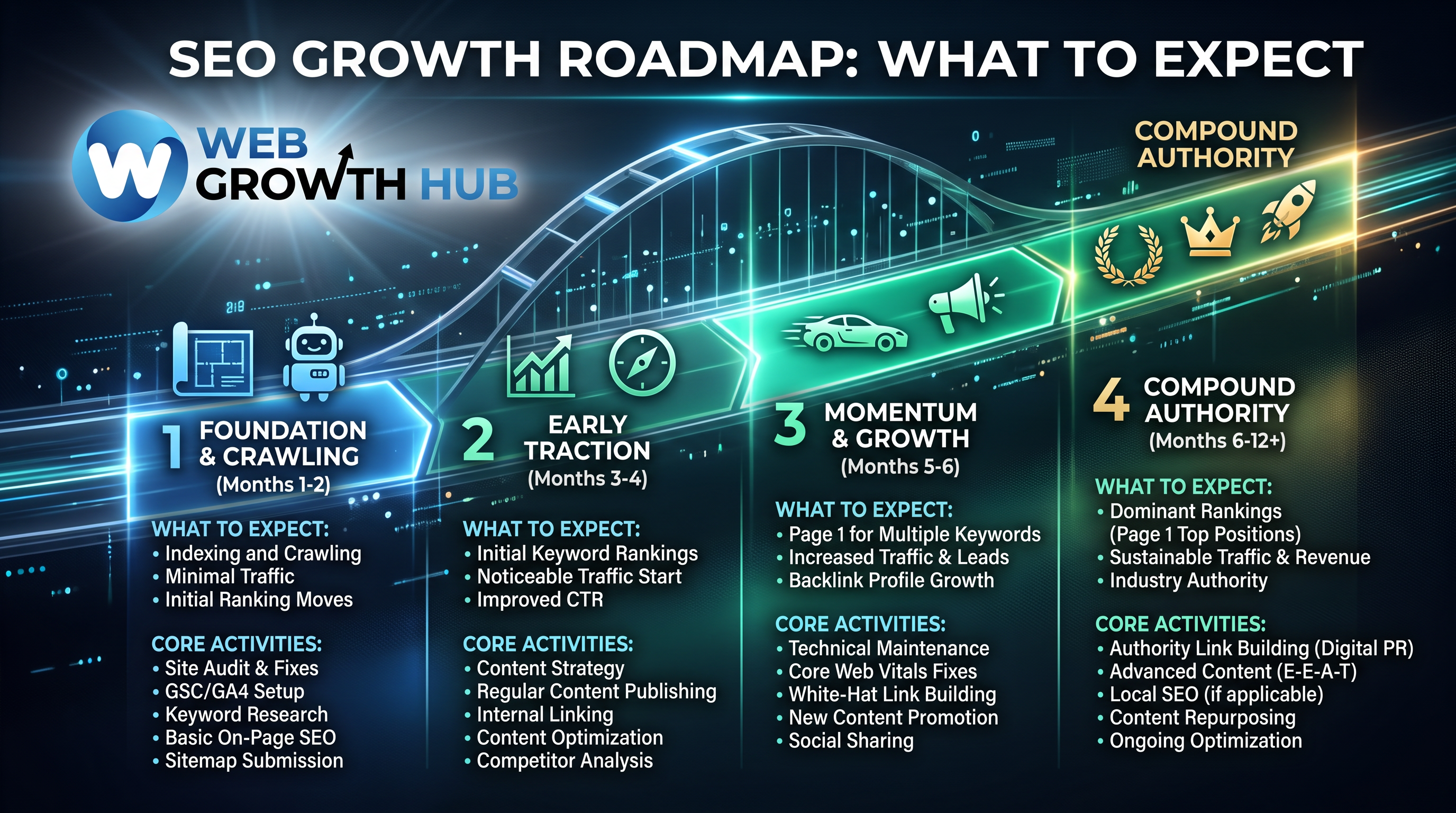
As shown in this progression, most businesses start seeing meaningful SEO results between 3 to 6 months, with substantial, compounding gains materializing in the 6 to 12-month window.
Key Factors That Influence Your Ranking Speed
No two websites experience the exact same timeline. Several critical variables determine whether your site will climb the search rankings in a few months or require a year of intensive work.
1. Domain Age and Historical Authority
An established website with an active history and existing backlinks has an inherent advantage. Google already understands what the site is about and trusts its infrastructure. Conversely, a brand-new domain starts with zero authority. Google goes through a discovery and sandboxing phase, carefully evaluating whether your content is reliable before rewarding you with top positions.
2. Keyword Competition and Search Volume
The competitiveness of your target keywords dictates your timeline. Trying to rank for broad, high-volume terms against entrenched competitors is exceptionally difficult and time-consuming. On the other hand, targeting specific, low-competition long-tail keywords allows newer sites to capture relevant traffic much faster.
3. Content Quality and Relevance
Google’s core algorithms are heavily focused on helpful, original content that directly satisfies user intent. Thin, generic, or AI-generated text without human insight will struggle to gain traction. Websites that consistently publish comprehensive, expert-led content see significantly faster ranking progress.
4. Technical Health and Mobile Usability
If your website suffers from slow page load speeds, broken links, or poor mobile responsiveness, Google will struggle to crawl and index your pages effectively. Technical roadblocks can completely stall your SEO progress regardless of how good your content is.
5. Local Trust Signals
For service providers and brick-and-mortar businesses, the strength of your Google Business Profile, review velocity, and NAP (Name, Address, Phone number) consistency across the web act as powerful accelerators. Businesses that actively manage their online reputation often outrank older websites that neglect their local listings.
What to Do While You Wait for Rankings
Because SEO takes time, business owners need to focus on leading indicators of success rather than fixating solely on whether they are in position one today. While your rankings are developing, you can take several proactive steps to maximize your digital growth:
•Optimize Your Google Business Profile: Ensure your business hours, service categories, and high-resolution photos are fully updated. This is often the fastest way to drive local phone calls and inquiries.
•Encourage Customer Reviews: A steady stream of authentic customer feedback improves local prominence and builds immediate trust with prospective buyers.
•Leverage Multi-Channel Marketing: Combine SEO with paid search advertising (PPC) or targeted social media campaigns to capture immediate demand while your organic presence matures.
•Refresh Existing Content: Regularly update older pages with fresh insights, new data points, and clearer formatting to signal ongoing activity to search engines.
Common Mistakes That Delay SEO Results
Many well-intentioned business owners inadvertently sabotage their own timelines by making avoidable errors:
•Expecting Instant Results: Quitting an SEO campaign after two months because you aren't on the first page yet. SEO requires sustained commitment.
•Keyword Stuffing and Shortcuts: Attempting to game the algorithm by stuffing keywords into text or buying cheap, low-quality backlinks. This frequently results in search penalties.
•Neglecting Technical Maintenance: Ignoring mobile speed, site security (HTTPS), or broken internal links while continuing to publish new content.
•Inconsistent Effort: Publishing ten blog posts in one week and then disappearing for six months. Search engines favor steady, predictable publishing schedules.
How to Measure SEO Progress Before Reaching the Top
Because top-ten rankings take time, tracking the right Key Performance Indicators (KPIs) helps you verify that your strategy is moving in the right direction. Before your keywords hit the first page, monitor these metrics in Google Search Console and analytics tools:
•Search Impressions: Are more people seeing your website in search results, even if they aren't clicking yet? Growing impressions indicate that Google is expanding your keyword footprint.
•Branded Search Volume: Is an increasing number of people searching for your business name directly? This reflects growing offline or multi-channel brand awareness.
•Keyword Footprint: Are you ranking for a growing number of secondary and long-tail terms?
•Click-Through Rate (CTR): Are your meta titles and descriptions compelling enough to turn impressions into website visitors?
Local SEO vs. Broader Organic SEO Timelines
It is important to distinguish between local and national SEO timelines. Local SEO campaigns for service-area businesses often show tangible improvements within 60 to 90 days once Google Business Profile optimization, citation cleanup, and review generation are put into motion.
In contrast, broader organic SEO campaigns targeting competitive national or e-commerce keywords rarely show significant traffic spikes before the 6-month mark. Understanding this difference prevents unrealistic expectations and aligns your strategy with your business model.
How Web Growth Hub Can Help You Build a Realistic SEO Strategy
Navigating search engine optimization without a roadmap can lead to wasted effort and missed opportunities. Every business deserves a clear, predictable approach to digital visibility that aligns with their growth goals.
Businesses that want a clearer, more realistic SEO plan can benefit from a strategy built by Web Growth Hub. We work closely with business owners, local service providers, and growing brands to demystify search algorithms and implement robust digital growth systems. Web Growth Hub helps businesses strengthen the systems behind search visibility, local SEO, and long-term digital growth, ensuring that your online presence builds sustainable momentum over time.
Conclusion: Setting the Foundation for Lasting Success
Ranking on Google is not a lottery, nor is it achieved overnight. It is the natural outcome of consistent technical health, authoritative content, and strong trust signals. While waiting for rankings to mature requires patience, the organic traffic and inbound leads generated by a well-optimized website provide some of the highest return on investment available in modern business.
Don't let unrealistic expectations derail your digital marketing efforts. Focus on building strong foundations, track the right leading indicators, and give your strategy the time it needs to compound. Ready to develop a realistic, high-performing search strategy for your business? Explore how Web Growth Hub can help you build the systems and visibility you need to thrive.


