

How Does Google Decide Which Local Businesses Rank First?
How Does Google Decide Which Local Businesses Rank First?
A customer searches Google for a service nearby. Three local businesses appear at the top of the map results, complete with star ratings, photos, opening hours, and directions. The customer chooses one of those options and rarely scrolls much further.
For a local business, those top positions can influence calls, website visits, bookings, and visits to a physical location. But how does Google decide which local businesses rank first? Is it the number of reviews, the business’s location, the website, or something else?
The answer is that local rankings are based on several signals working together. Google’s own guidance highlights three primary factors: relevance, distance, and prominence. Around those factors sit practical details such as the quality of your Google Business Profile, accurate business information, customer reviews, local content, website quality, citations, and links.
There is no guaranteed shortcut or fixed formula. However, understanding the signals behind local search can help you make better decisions and build a more trustworthy online presence.
What Are Local Rankings and Why Do They Matter?
Local rankings are the results Google shows when a search has a geographic or nearby-business intent. Examples include “plumber near me,” “accountant in Bristol,” or “best coffee shop downtown.” These results can appear in several places.
The local pack is the group of business listings that often appears near the top of a Google results page, usually alongside a map. Google Maps and the Local Finder provide expanded local results. Organic results are traditional website listings that may appear below the map results.
These searches often show strong intent. Someone looking for an emergency locksmith may need help immediately, while someone searching for a wedding photographer may be comparing providers. Appearing prominently gives your business an opportunity to earn the click, call, or visit.
The Three Core Local Ranking Factors
Google says local results are mainly based on relevance, distance, and prominence. Think of these as three questions Google is trying to answer:
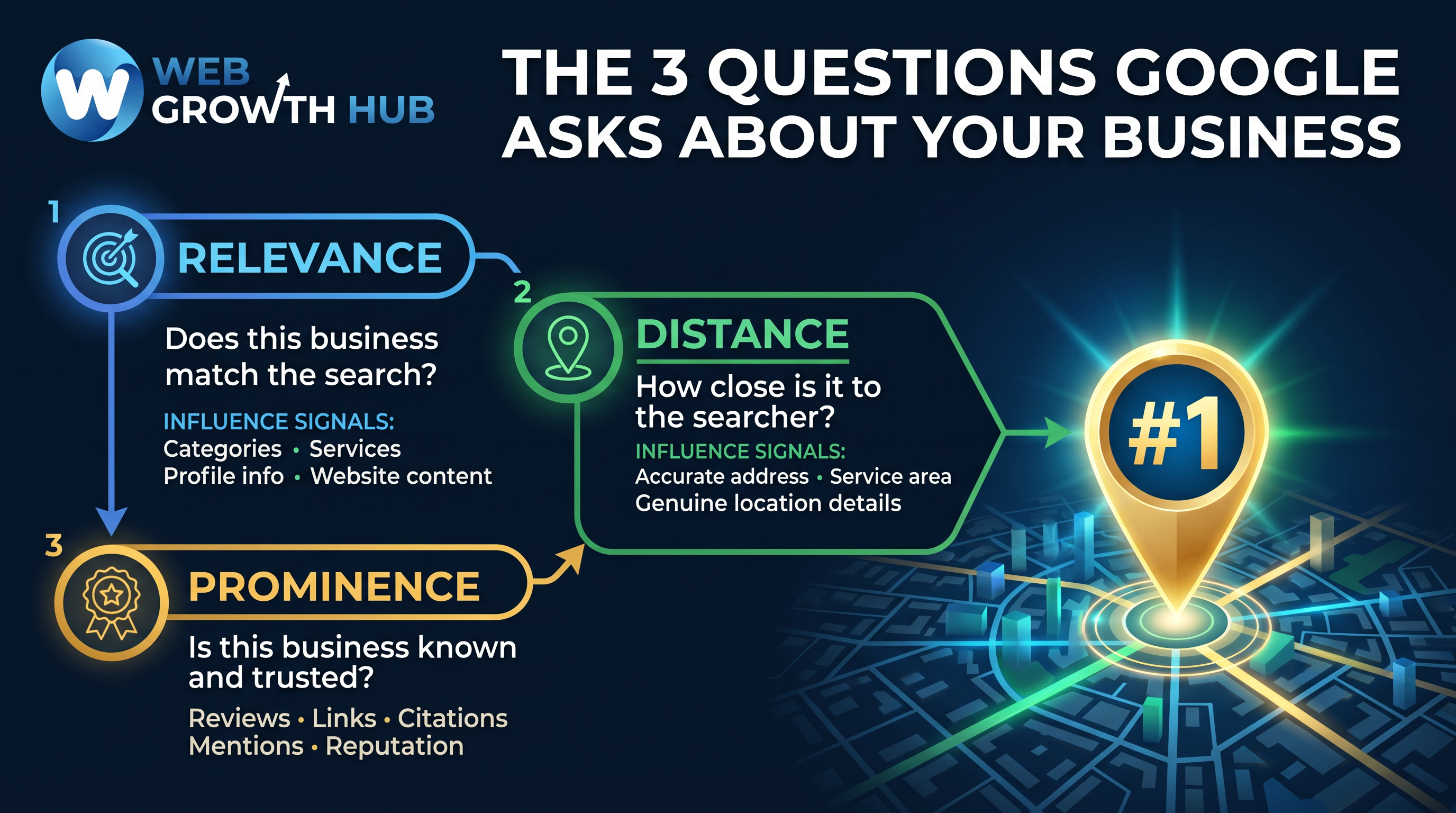
These factors work together. A nearby business may not rank first if it does not offer the searched service, while a prominent company may be less visible outside its service area. A strong local presence combines a clear match, a legitimate location, and credible evidence of quality.
Relevance: Match the Search Clearly
Relevance is about how closely your business matches the customer’s search. Google needs to understand what you do, who you serve, and which services or products are genuinely available.
Start with your Google Business Profile. Choose accurate categories, list the services you provide, and use plain language in your description. A physiotherapy clinic, for example, can specify sports injury treatment or post-operative rehabilitation.
Your website should reinforce the same understanding. Create useful service pages that explain what you offer, who it is for, the locations you serve, what the process involves, and how customers can take the next step. Avoid adding every possible keyword if the page does not genuinely support those services.
Distance: Proximity Still Matters
Distance refers to how far the business is from the person searching or from a location included in the query. Google may use the searcher’s device location, the stated town or neighborhood, and the business address or service area.
You cannot legitimately manipulate distance by creating a virtual office, using a false address, or publishing misleading location pages. If you serve customers at their premises, configure the profile accurately as a service-area business. If customers visit you, provide the correct address and keep it consistent across your website and listings.
Distance is a major reason why local results vary from one street or suburb to another. A listing that appears first for one searcher may appear lower for someone several miles away. Measure visibility from relevant locations rather than assuming that one search from your own office represents the whole market.
Prominence: Build Evidence That Your Business Is Trusted
Prominence is how well-known a business appears to be. Google says this can include information such as how many websites link to the business and how many reviews it has. In practical terms, prominence grows when your business is consistently represented, mentioned, reviewed, and trusted across the web.
This does not mean collecting random links or chasing a particular review count. It means building genuine recognition through good service, relevant community relationships, industry participation, useful content, and reliable business information.
How Your Google Business Profile Affects Local Visibility
Your Google Business Profile is one of the most important assets in local SEO because it gives Google and customers a structured summary of your business. A profile that is incomplete, outdated, or inconsistent creates uncertainty.
Claim and verify the profile, then review every important field. Include your business name as it is used in the real world. Add the correct category, address or service area, phone number, website, hours, holiday hours, services, attributes, and booking or messaging options where relevant.
Keep the profile active and useful. Upload original photos of your premises, team, products, completed work, or vehicles. Share meaningful updates through Google Posts when you have news, events, seasonal information, or helpful advice. These features may not each function as a direct ranking switch, but they can help customers understand and trust the business.
Why Customer Reviews Matter
Reviews influence both local search prominence and customer decisions. Google notes that more reviews and positive ratings can help a business’s local ranking, while responding to reviews shows that the business values feedback.
Consider four dimensions of review quality:
•Quantity: A healthy body of genuine reviews provides more evidence than a profile with only one or two comments.
•Quality: Detailed, authentic feedback gives prospective customers more useful information than vague praise.
•Recency: Recent experiences help show that the business is still active and delivering service.
•Responses: Thoughtful responses demonstrate attentiveness and give you an opportunity to clarify issues professionally.
Generate reviews by providing a good experience and asking for honest feedback at an appropriate time, such as after a completed appointment. A direct review link or follow-up message can make the process easier.
Do not buy reviews, write reviews for customers, offer rewards in exchange for positive ratings, or pressure people to use specific words. Fake or manipulated feedback can damage trust and may violate platform policies.
Keep Business Information Consistent Across the Web
Your business name, address, and phone number—often called NAP information—should be accurate and consistent across your website, Google Business Profile, local directories, social profiles, trade associations, and other relevant platforms.
Conflicting information creates avoidable confusion. An old phone number, former address, or different business name across listings can weaken confidence in which information is correct.
Keep a master record of official details. Check important listings first, correct duplicates, and update information after a move, rebrand, or phone-number change.
Categories, Services, and Attributes Help Google Understand You
Categories describe the type of business you are, while services and attributes add detail. Selecting “general business” because it sounds broad may be less helpful than choosing the most accurate category for your actual offering.
Use secondary categories only when they genuinely apply. Do not select unrelated categories because you hope they will create more visibility. Similarly, do not add services you do not provide or make claims that your website cannot support.
Attributes answer practical questions about accessibility, appointments, delivery, parking, or payment methods. They can improve the customer experience even when their direct ranking effect is uncertain.
How Your Website and Local Content Support Local Rankings
Your profile is not separate from your website. The website linked to your listing can help explain your services, locations, expertise, and customer experience.
Use clear page titles, headings, descriptive URLs, internal links, strong calls to action, and original service information. Build location content only where you have a meaningful connection to the area. A genuine location page might explain local delivery, service coverage, travel times, relevant projects, or area-specific questions. A page that changes only the town name in a copied template offers little value.
Useful local content can include guides, case studies, project galleries, FAQs, community information, and comparisons. The aim is to demonstrate that you understand customers in the market, not to repeat a town name.
Citations, Directories, and Backlinks Build Trust
Local citations are mentions of your business details on directories, industry websites, chambers of commerce, review platforms, and other relevant sources. Quality matters more than volume. Focus on accurate, reputable, and contextually relevant listings.
Backlinks are links from other websites to yours. Links from local newspapers, professional associations, suppliers, community groups, or respected industry publications can provide meaningful authority. Earn them by contributing expertise, supporting local initiatives, publishing research, and creating useful resources.
Avoid automated backlink packages, private link networks, irrelevant directories, and paid placements designed to manipulate rankings. Ethical authority building is slower, but it is more consistent with the trust you want customers and search engines to associate with your brand.
How User Behavior Fits into the Picture
Track website clicks, direction requests, calls, saves, questions, and enquiries to understand whether your profile matches customer needs. Do not assume one action guarantees a ranking boost; use this data to improve the customer journey, such as clarifying services or hours when profile views do not lead to calls.
Common Mistakes That Hurt Local Rankings
Common problems include an incomplete profile, the wrong category, an inaccurate address, ignored review responses, old directory information, duplicate listings, misleading location pages, copied content, fake reviews, and spammy links. Keyword stuffing the business name is also risky. These tactics do not create a credible presence.
A Simple Local Ranking Checklist
Use this checklist to improve your local ranking signals:
•Claim and verify your Google Business Profile.
•Choose the most accurate primary and secondary categories.
•Write a clear, honest, keyword-aware business description.
•Add accurate hours, phone number, address, and service areas.
•List relevant services and genuine attributes.
•Upload high-quality photos of your business, team, products, and work.
•Publish useful updates when you have something meaningful to share.
•Make it easy for satisfied customers to leave honest reviews.
•Respond consistently and professionally to positive and negative feedback.
•Check your business name, address, and phone number across important listings.
•Improve service pages and local content on your website.
•Earn relevant citations, mentions, and backlinks through genuine activity.
•Monitor profile views, calls, website clicks, directions, enquiries, and conversions.
•Review performance regularly and improve the weakest part of the customer journey.
How Web Growth Hub Can Help
Businesses that want a clearer path to better local rankings can benefit from a strategy built around their profile, reviews, content, and customer journey. Web Growth Hub helps businesses organize these systems into a digital growth plan.
Support may include Google Business Profile optimization, local content, review workflows, website improvements, and marketing automation. The value is creating a consistent system that helps customers find and trust your business—not promising a guaranteed position.
Conclusion: Build Stronger Signals Over Time
So, how does Google decide which local businesses rank first? It looks primarily at relevance, distance, and prominence, then interprets those factors through many sources of business information and customer experience.
You cannot control a searcher’s location or guarantee a particular position. You can control whether your business information is accurate, whether your profile clearly explains what you do, whether your website answers local questions, whether you earn genuine customer reviews, and whether trusted sources recognize your business.
Start with the checklist, fix the basics, and measure meaningful actions rather than obsessing over one ranking screenshot. If you would like help building stronger local SEO, review, and digital growth systems, explore the practical support available from Web Growth Hub.


