

Google Maps vs. Google Search: Where Should Local Businesses Focus?
Google Maps vs. Google Search: Where Should Local Businesses Focus?
You search for your own service and see two very different sets of results. At the top is a map with three local businesses, ratings, opening hours, and directions. Below that are the familiar blue links to service pages, guides, directories, and company websites.
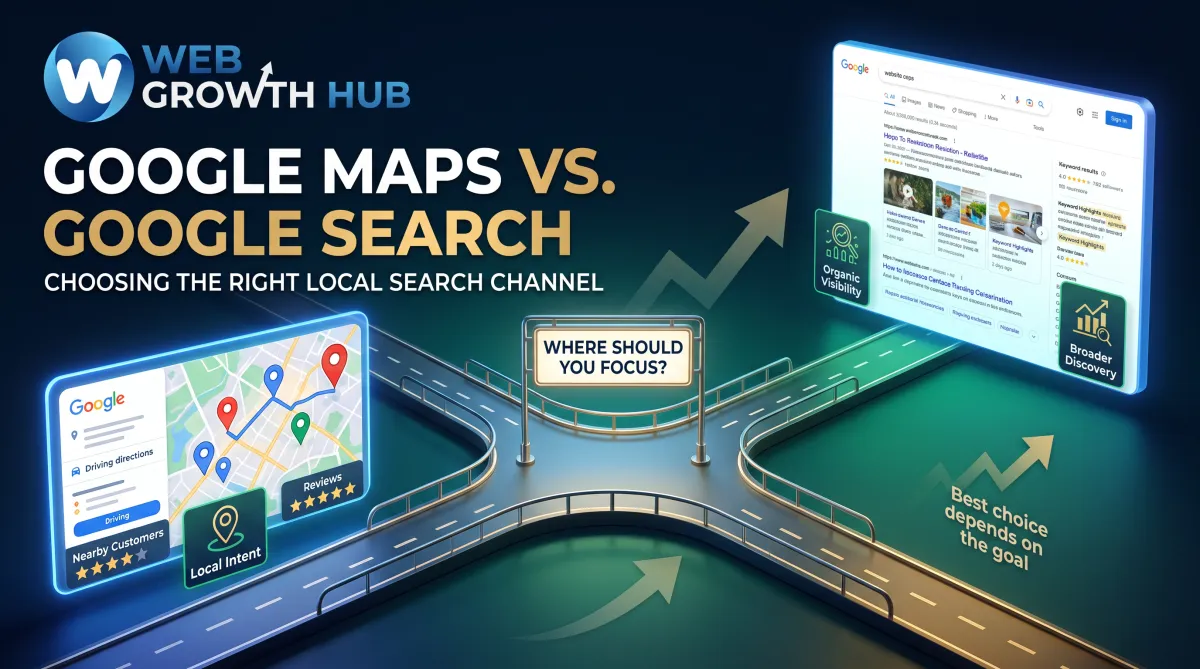
Many business owners ask: Google Maps vs. Google Search: where should local businesses focus? Should they invest in their Google Business Profile and reviews, or spend more time improving website content and organic search rankings?
The answer depends on your customers, services, service area, and goals. Most local businesses should understand both channels and allocate effort according to customer behaviour. This guide explains the difference and how to choose priorities.
Google Maps and Google Search Are Connected, but Not the Same
Google Maps is a dedicated discovery environment built around places, locations, directions, reviews, services, and immediate actions. A customer may open Maps to find a dentist, restaurant, repair company, or directions.
Google Search is broader. It includes traditional organic results, local features, images, videos, products, and other formats. A local search can display a map-based local pack alongside standard organic pages. Google says local results can appear on both Maps and Search, and that local visibility is influenced mainly by relevance, distance, and prominence.
Channel | What customers usually want | Main asset to improve | Typical actions |
Google Maps | A nearby business they can visit, call, book, or contact | Google Business Profile | Calls, directions, bookings, website visits, walk-ins |
Local pack in Search | A quick comparison of local options | Business Profile, reviews, local relevance | Calls, profile visits, map clicks, website visits |
Organic Search | Information, comparison, confidence, or a specific service | Website content and authority | Reading, comparing, enquiring, booking, purchasing |
The channels overlap because the Google Business Profile can influence representation in both Maps and Search. Improving a profile does not replace a useful website, and website content does not remove the need for an accurate profile.
How Google Maps Results Work
Google Maps results are designed around location and local intent. For searches such as “plumber near me” or “coffee shop,” Google tries to show relevant nearby businesses.
A verified and complete Google Business Profile is the starting point. Google says complete and accurate information helps businesses appear in local results. Include the name, address or service area, hours, category, phone, website, photos, and reviews.
Maps visibility is shaped by three broad factors:
•Relevance: How well the business matches what the customer searched for.
•Distance: How far the business is from the searcher or the location in the query.
•Prominence: How well-known and trusted the business appears, with information such as reviews and links contributing to this picture.
Maps is valuable when the customer wants a nearby, actionable solution. Someone looking for an emergency locksmith, takeaway meal, hairdresser, dental appointment, or shop may care less about an article than whether the business is close, open, credible, and easy to contact.
How Google Search Results Work for Local Queries
Traditional organic Search results are usually website pages that Google has crawled, understood, and selected as useful responses to a query. A page might explain a service, compare options, answer a question, show a project, or guide a customer toward a decision.
Google’s SEO Starter Guide describes SEO as helping search engines understand content and helping users discover and evaluate a website. It emphasises useful, people-first content, logical organisation, crawlability, links, and clear pages rather than secret tactics or guaranteed first place.
Organic search is valuable when customers need information before contacting a business. Someone researching costs, treatment options, cleaning requirements, or venue questions may be several steps from an enquiry. A useful service page, guide, case study, or comparison page can build confidence.
Organic results also help businesses serving wider areas, multiple locations, specialist services, or non-location-specific searches. A website can explain the offer in more depth than a Business Profile.
How the Local Pack Connects Maps and Search
The local pack is the map-based group of local business listings that may appear within a Google Search results page. It is not exactly the same as opening Google Maps, but it uses related local business information and often gives customers a quick route to Maps, calls, directions, or a website.
The decision is not completely binary. A strong Google Business Profile can support Maps and the local pack, while a strong website can support organic results and add context when someone clicks from a profile.
For example, someone searching “family solicitor near me” may see a local pack, compare providers, then open an organic service page. Someone searching “what does a family solicitor do?” may begin with organic content. Both journeys can lead to the same business.
Which Businesses Benefit Most from Google Maps Visibility?
Focus more on Maps when customers need a nearby provider or immediate action. This includes:
•Restaurants, cafés, shops, salons, gyms, and other walk-in businesses.
•Healthcare, dental, beauty, and appointment-based local services.
•Plumbers, locksmiths, electricians, mechanics, and other urgent providers.
•Trades and home-service companies competing within defined service areas.
•Businesses that rely on calls, direction requests, bookings, or foot traffic.
•Local businesses operating in crowded markets where customers compare several nearby options.
These businesses should prioritise an accurate profile, correct categories, genuine reviews, current hours, photos, services, and contact actions. Monitor calls, bookings, directions, and website visits.
Maps is not only for shopfronts. An eligible service-area business can benefit from a profile that represents its service area accurately. It should not use a fake address or misleading location.
Which Businesses Benefit Most from Organic Search Visibility?
Give organic Search more attention when customers research or compare before contacting a provider. This includes:
•Professional services such as legal, financial, consulting, and business-to-business firms.
•Specialist healthcare and technical services that require explanation.
•Businesses serving several towns, regions, or customer segments.
•High-value purchases where customers compare options over time.
•Companies targeting broader topics, educational searches, or non-location-specific keywords.
•Businesses with multiple services that need dedicated pages and case studies.
These businesses should invest in useful service pages, genuinely relevant location pages, guides, case studies, FAQs, internal links, mobile usability, and clear conversion paths. The aim is to answer real questions and make the next step clear.
Key Ranking Factors for Google Maps
Google Business Profile completeness and accuracy
Verify the profile and keep its name, address or service area, hours, category, services, phone number, website, and attributes current. Google says complete and accurate information helps it match businesses to relevant searches.
Relevance and categories
Choose the most accurate primary category and relevant secondary categories. Describe real services in natural language. Do not add unrelated categories or stuff keywords into the business name.
Reviews and responses
Genuine customer reviews help potential customers assess the business and can contribute to prominence. Google prohibits incentives in exchange for posting, changing, or removing reviews. Ask for honest feedback through an appropriate review link or QR code, and reply professionally to positive and negative reviews.
Distance
Distance depends on the searcher’s location or the location included in the query. You cannot make a business physically closer to every customer, so focus on accurate location information and a strong customer experience rather than misleading addresses.
Profile usefulness and activity
Photos, videos, services, products, booking links, and accurate updates can help customers understand the business. Activity alone does not guarantee higher map rankings, but useful information can improve confidence and actions.
Key Ranking Factors for Organic Local Search
Website quality and relevance
A page should explain what the business offers, who it helps, where it operates, and what the customer should do next. Write for customers first.
Local content and service pages
Create pages for important services and locations when they contain genuinely useful information. Include local project examples, service boundaries, customer questions, and practical details instead of duplicating the same page for every town.
Authority and local citations
Relevant links from professional associations, local publications, community organisations, partners, and reputable directories can reinforce authority. Quality matters more than volume.
On-page SEO and technical performance
Use descriptive titles, headings, URLs, internal links, mobile-friendly layouts, and clear calls to action. Fix indexing problems, broken links, slow pages, and barriers that prevent Google or users from accessing important content. LocalBusiness structured data can help Google understand business details, but it does not guarantee rankings or rich results.
Google Maps vs. Google Search: Where Should Local Businesses Focus?
Use the following decision framework rather than choosing based on whichever channel a competitor appears to dominate.
Focus more on Google Maps if:
•Customers search with “near me” or location-based phrases.
•Customers need urgent or convenient local service.
•The business relies on calls, directions, bookings, or walk-ins.
•Customers compare nearby providers using ratings, hours, photos, and distance.
Focus more on organic Search if:
•Customers research extensively before contacting you.
•You serve a wide area or multiple locations.
•Your services require explanation, comparison, or education.
•You want to rank for broader searches beyond a single neighbourhood.
Focus on both, as most local businesses should:
•Optimise and verify the Google Business Profile.
•Build genuine reviews and respond consistently.
•Create useful service and local pages on the website.
•Keep name, address, and phone details consistent.
•Improve mobile usability, page speed, and clarity.
•Build ethical local citations and relevant backlinks.
•Connect both channels to clear calls, bookings, forms, or enquiries.
Where Should You Focus? A Simple Checklist
Start with the channel closest to the customer’s decision, then build the supporting asset.
Question | Primary focus | First action |
Do customers need a nearby provider now? | Maps | Improve profile accuracy, categories, reviews, hours, and contact actions |
Do customers need education before contacting you? | Organic Search | Build useful service pages, guides, FAQs, and case studies |
Do you serve several areas? | Both | Create accurate location information and useful area-specific content |
Is your local market crowded? | Both | Strengthen reviews, relevance, website quality, and local authority |
Do you receive profile views but few enquiries? | Conversion system | Improve offers, contact paths, booking links, and follow-up |
Measure calls, bookings, direction requests, website visits, form submissions, and qualified enquiries rather than obsessing over one position. Local results vary by searcher and location, so one manual search is not a complete report.
Common Mistakes Businesses Make
A common mistake is treating Maps and Search as competing channels. They often support different stages of the same journey. Another is optimising the profile while neglecting the website, or publishing content while leaving the profile incomplete.
Other errors include buying reviews, using a fake address, creating thin location pages, copying competitor content, keyword-stuffing the business name, building low-quality citations, and posting without measuring customer actions. These shortcuts can damage trust or create policy problems.
How Web Growth Hub Can Help
Businesses that want clarity on where to focus can benefit from a local SEO strategy that balances Google Maps visibility, organic search, and customer behaviour. Web Growth Hub helps businesses organise these systems into a practical digital growth plan.
That may include Google Business Profile optimisation, review-generation workflows, local content, website SEO, accurate listings, conversion tracking, and marketing follow-up. The goal is to clarify the journey from search to enquiry, booking, or visit.
Conclusion: Google Maps vs. Google Search
The answer to Google Maps vs. Google Search: where should local businesses focus is usually not “only one.” Use Maps and the local pack when customers need a nearby provider. Use organic Search to explain services, serve wider areas, answer questions, and build confidence.
For most businesses, the strongest approach is balanced: maintain an accurate profile, earn genuine reviews, and support it with a quality website and relevant local content. If you need help deciding where to invest first, Web Growth Hub can help you turn Maps, organic Search, and local marketing into a practical digital growth system.


