Why Is My Business Showing Up on Google Maps but Not Google Search?
You search your own business name, and there you are — right on Google Maps, pin dropped, hours listed, reviews showing. So you try a more general search, something like "plumber in [your city]" or the actual service you offer. And your website is nowhere to be found. Not on page one. Maybe not anywhere.
It's a confusing spot to be in. Your business clearly has some visibility — customers are finding you on Maps, calling, getting directions. So why does that same visibility disappear the moment someone searches Google the regular way?
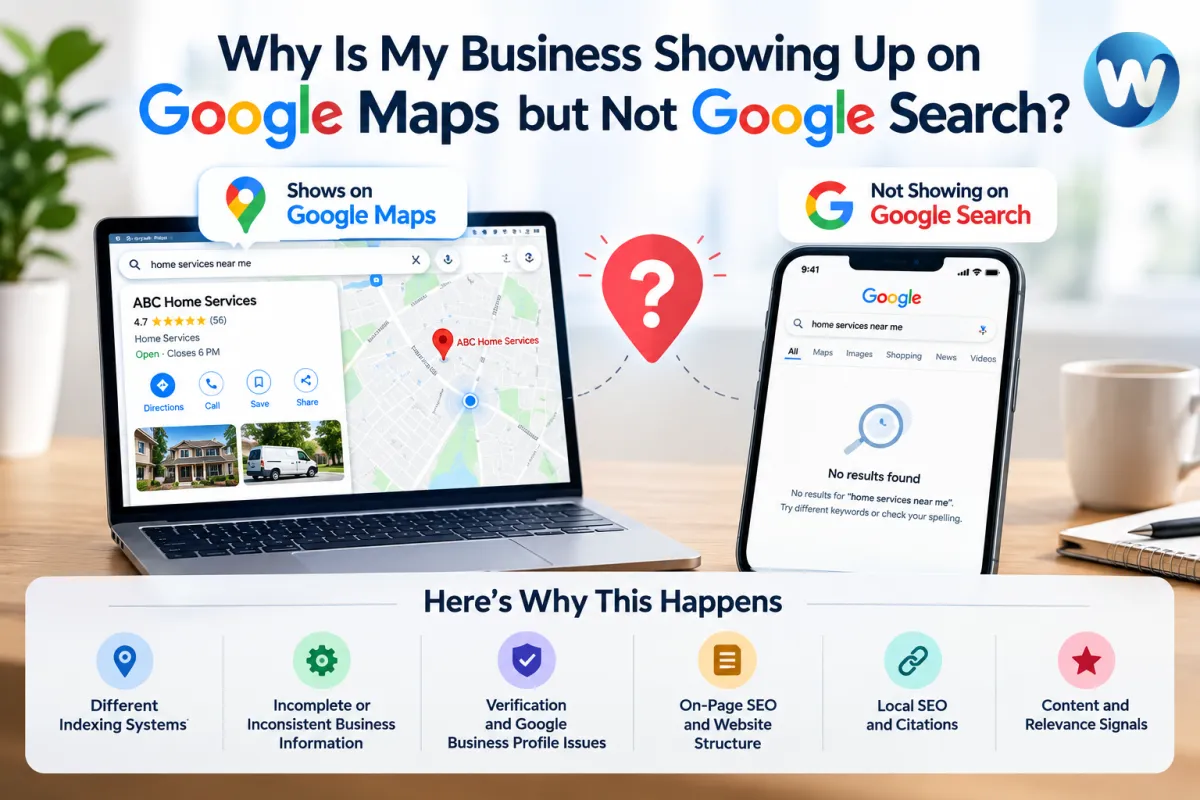
The short answer: Google Maps and regular Google Search aren't the same ranking system. They look connected because they both live inside Google, but under the hood, they're judging two different things.
Google Maps and Google Search Use Different Ranking Systems
When someone searches with local intent — something like "electrician near me" — Google typically shows the Local Pack (the map with three business listings) above the regular search results. That Local Pack is powered mainly by your Google Business Profile: your business category, proximity to the searcher, reviews, photos, and how complete and active your profile is.
Regular organic search results — the list of blue links below or instead of the map — are powered by your website: its content, technical health, backlink profile, and overall authority in Google's eyes.
These two systems overlap and influence each other, but they don't move together automatically. It's entirely possible to have a well-optimized, review-rich Google Business Profile that earns you a spot on Maps, while your actual website is too thin, too slow, or too poorly optimized to earn a spot in organic search at all.
Here are 7 of the most common reasons that gap shows up.
7 Reasons You're Ranking on Maps but Not in Search Results
1. Your Google Business Profile Is Strong, But Your Website Isn't
Local rankings lean heavily on proximity, relevance, and prominence — signals like your business category, reviews, photos, and posts, most of which live inside your Google Business Profile itself, not your website. A well-maintained profile can earn a Maps spot even while your website sits in the background with outdated content or minimal SEO work behind it.
What to check: Compare how complete and active your Google Business Profile is against how developed and up to date your actual website content is.
2. Your Website Isn't Targeting the Right Search Terms

The searches that trigger the Map Pack aren't always the same ones that pull up organic website results. If your website's pages don't clearly cover the specific services, locations, or topics people are actually typing into Google, there's little for the algorithm to match you to — even if your business itself is a strong local fit.
What to check: Look at the actual service and location pages on your website and compare them to the terms a customer would realistically search.
3. Your Website Has Technical SEO Issues
Page speed, mobile-friendliness, proper indexing, and overall site health matter far more for organic rankings than they do for the Map Pack. A site with crawl errors, slow load times, a missing sitemap, or an accidental no-index tag can be effectively invisible to organic search — while your Business Profile, which lives independently on Google's side, is completely unaffected.
What to check: Run your site through Google Search Console and look for indexing errors or pages marked as excluded.
4. Your Website Doesn't Have Enough Authority Yet
Organic rankings depend heavily on backlinks — other websites linking to yours — which is a signal that takes time to build. A Google Business Profile, by contrast, can start showing up in local results fairly quickly once it's verified and has consistent activity and reviews. A newer or smaller website can lag well behind its own Business Profile in authority.
What to check: Compare your website's backlink profile to competitors who show up in both Maps and organic search, using a free backlink checker.
5. Your Website Content Is Thin or Duplicate

Some small business websites amount to a homepage and a contact page, with little real depth on what the business does, who it serves, or where. Organic search rewards depth and originality; the Map Pack doesn't require nearly as much website content to appear, since it can lean on your profile, category, and reviews instead.
What to check: Read your website the way a stranger would — does it actually explain your services in detail, or is it mostly placeholder text?
6. The Search Has Local Intent, But Your Organic Presence Doesn't Match It
Not every search that surfaces your business on Maps carries the same kind of intent that also favors organic rankings. If most of your visibility comes from tightly local, "near me"-style searches, but you rarely appear for broader or more general searches related to your industry, that's often because your website hasn't built the topical authority organic search rewards.
What to check: Look at which keywords your website actually ranks for organically, and whether they skew narrow or genuinely reflect your services.
7. Your Website Was Recently Changed or Isn't Indexed the Same Way as Your Profile

A redesign, a platform migration, or a new content management system can quietly disrupt how Google indexes your website — without touching your Google Business Profile at all, since the two are managed completely separately. If Google can crawl your business listing just fine but can't properly crawl your website, you end up visible on Maps and absent everywhere else.
What to check: Confirm your website is submitted in Google Search Console and that no recent update accidentally blocked indexing.
What This Gap Really Costs Your Business
Showing up on Maps is genuinely valuable — it drives calls, direction requests, and walk-ins from people already searching with intent to buy. But it's only part of the picture. A large share of searchers scroll past the Map Pack, click into organic results, or search in ways that don't trigger the Map Pack at all. If your website isn't showing up there, you're missing that entire second stream of potential customers — along with the credibility and staying power that comes from having a website Google actually trusts.
Frequently Asked Questions
Are Google Maps rankings and Google Search rankings the same thing?
No. Map Pack rankings are based mainly on your Google Business Profile — proximity, relevance, and prominence — while organic search rankings depend on your website's content, technical health, and backlinks. They influence each other, but they aren't the same ranking system.
Can I improve my organic search ranking without touching my Google Business Profile?
Yes. Because your website and your profile are ranked largely independently, improving your website's content, technical SEO, and backlinks can lift your organic visibility even if your profile stays exactly the same.
Does a strong Google Business Profile help my website rank in search results?
Indirectly, yes — a complete, consistent, review-rich profile supports your overall online presence. But it isn't a substitute for a website that's actually built and optimized for organic search.
How do I know if my website simply isn't indexed?
Search site:yourdomain.com in Google, or check the Pages report in Google Search Console. If pages are missing from the results, that points to an indexing problem rather than a ranking problem.
Getting Found Is Only the First Step
Right now, your Google Business Profile is doing its job — it's putting your business in front of people ready to act. The next step is making sure your website can do the same thing for everyone who searches a different way.
This is where WebGrowthHub fits into the picture. WebGrowthHub is an all-in-one business growth platform that combines websites, CRM, lead capture, sales pipelines, marketing automation, AI-powered communication, reputation management, and client management — built to support the full journey from getting found to getting paid, not just one piece of it.
A few ways this connects directly to closing this gap:
Website & Funnel Builder — build lead-generating pages with SEO built in, so your website has a real foundation to compete in organic search instead of relying on your Google Business Profile alone.
Reputation Management — a built-in review generation system to help keep the review activity that supports your Google Business Profile consistent and current.
CRM & Lead Management — so that as your organic traffic grows alongside your Maps visibility, every new visitor, call, or form fill is captured and tracked rather than lost.
Workflows & Automations — to make sure the increase in leads from two visibility channels instead of one doesn't turn into a follow-up bottleneck.
WebGrowthHub doesn't promise guaranteed search rankings — no honest platform can. What it does is give your website the SEO-minded foundation it needs to start closing the gap with your Google Business Profile, and the systems to make sure every lead that finds you, however they find you, actually gets followed up with.
If your business is visible on Maps but missing from search results, that's not a sign something is broken — it's a sign your website has room to catch up to where your profile already is.


